
Best Dreadnought Acoustic Guitars for Intermediate 2026
So, you're past the beginner phase, your chords are cleaner, and you're starting to crave a dreadnought that can really sing. A good dreadnought is a workhorse - it's got the low-end thump for strumming, the headroom for more aggressive playing, and the projection to cut through a band. But not all dreadnoughts are created equal, especially when you're looking for something that'll inspire you without breaking the bank. Let's find you something that'll actually help you level up.
Last updated: October 9, 2026
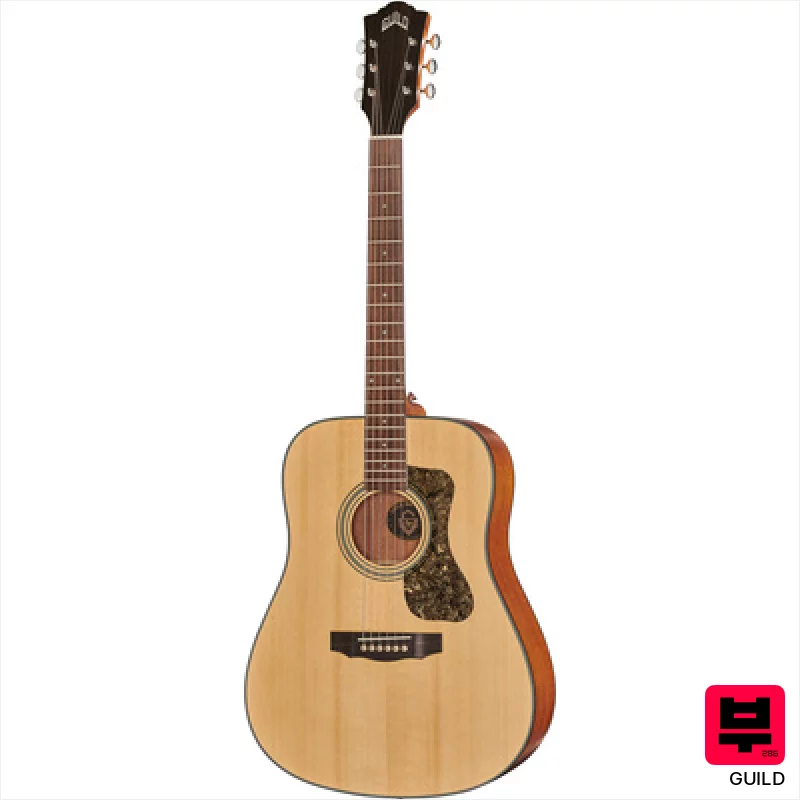
Guild D-340 Nat
- • Solid Sitka spruce top delivers excellent projection and headroom for strumming.
- • Mahogany back and sides provide a warm, focused tone with rich overtones.
- • Comfortable 'C' neck profile and 16” radius fingerboard facilitates easy playability.
- • Open-gear tuning machines offer reliable tuning stability and vintage aesthetics.
- • Mahogany construction can limit versatility for players seeking brighter, more articulate tones.
- • Matt finish might not appeal to those preferring a glossier, more reflective appearance.
- • Dreadnought body size may be unwieldy for smaller players or those seeking portability.
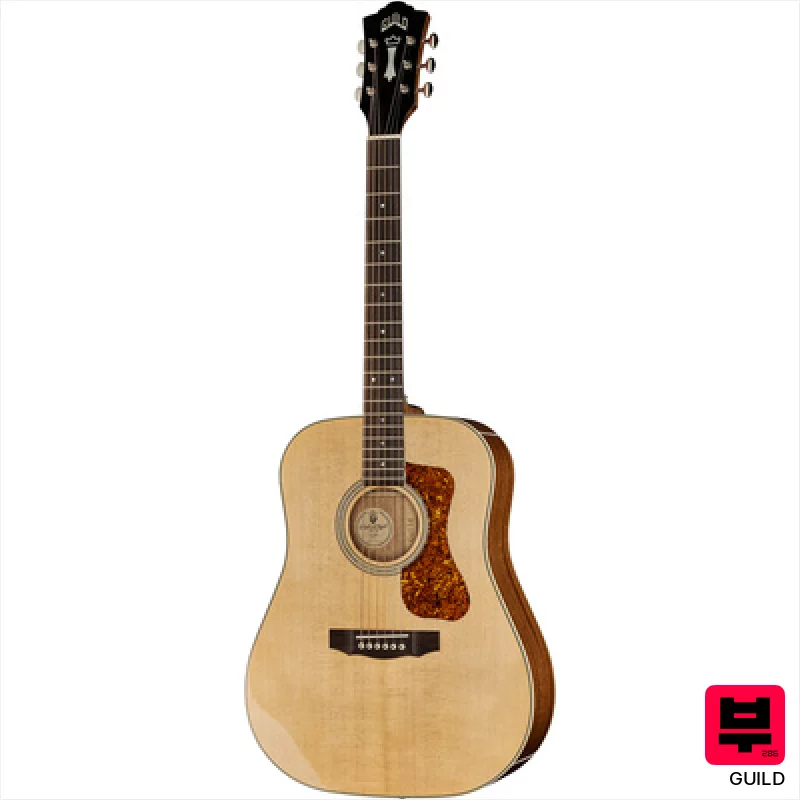
Guild D-140 Nat Westerly
- • Solid Sitka spruce top delivers a responsive, articulate sound with good headroom.
- • Solid mahogany back and sides provide warmth and a focused midrange presence.
- • Bone nut and saddle contribute to improved sustain and clarity throughout the tonal spectrum.
- • Westerly bracing pattern enhances projection and balances the guitar’s tonal response.
- • High-gloss finish might feel a bit thick for players preferring a more vintage, matte aesthetic.
- • Mahogany construction can be slightly less versatile for very bright or overly clean styles.
- • The 16in radius fingerboard might feel a touch steeper for players accustomed to flatter profiles.
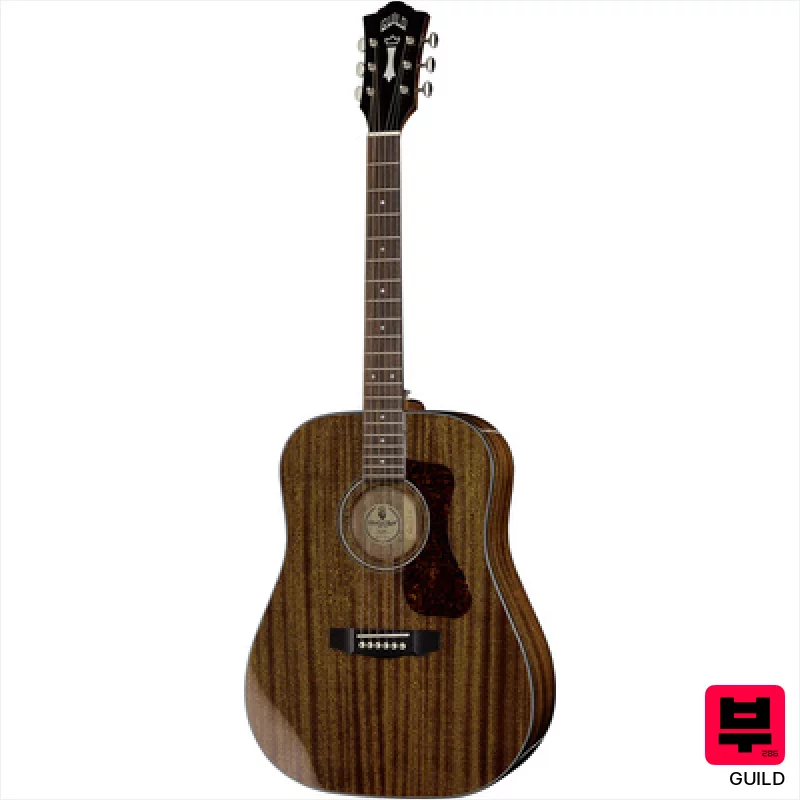
Guild D-120 Nat Westerly
- • Solid mahogany back and sides deliver a warm, focused, and mature tone.
- • Westerly Concert bracing provides excellent projection and balanced response across the spectrum.
- • Bone nut and saddle enhance sustain and improve string-to-body resonance.
- • Vintage 18 Guild machine heads offer smooth tuning stability and a classic aesthetic.
- • Mahogany's inherent brightness can be less versatile for certain modern playing styles.
- • The 16in fingerboard radius might feel less familiar to players accustomed to flatter profiles.
- • High-gloss finish, while beautiful, can be prone to fingerprints and may slightly dampen resonance.
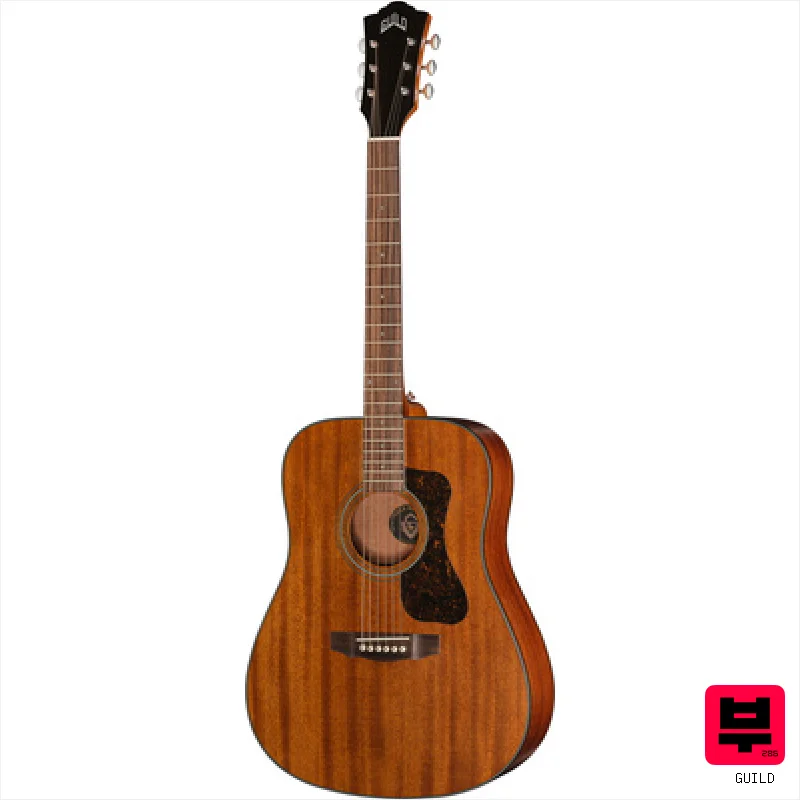
Guild D-320 Nat
- • Solid mahogany top delivers warm, mid-focused tone.
- • Rosewood fingerboard provides comfortable playability.
- • Compensated bone saddle ensures intonation accuracy.
- • Dovetail neck join offers strong structural stability.
- • All mahogany construction limits high-end brightness.
- • No electronics included for stage amplification.
- • Mahogany body may lack sustain compared to spruce tops.
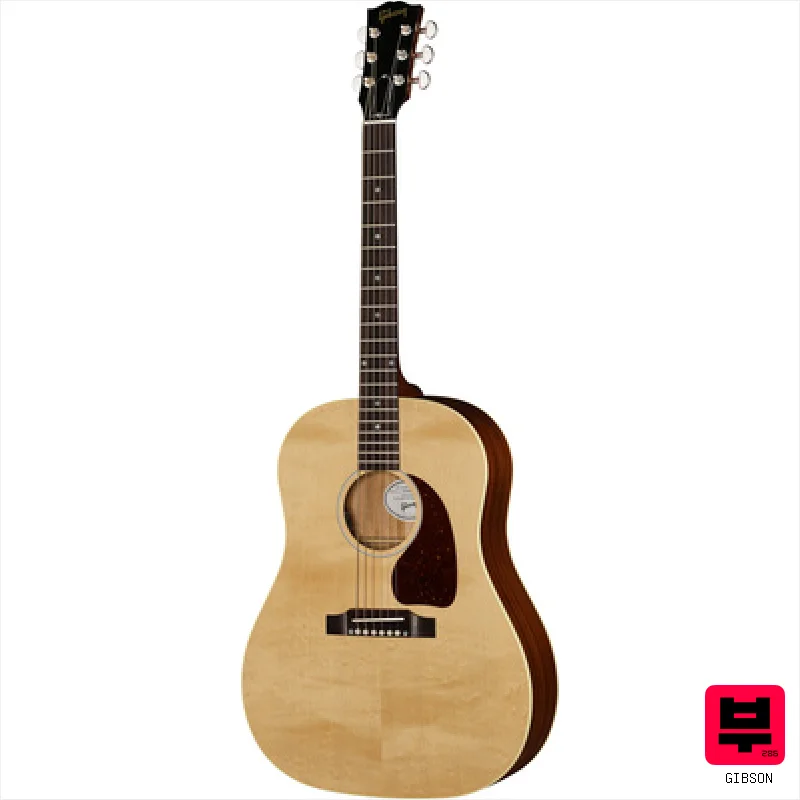
Gibson J-45 Special Satin Natural
- • Solid Sitka spruce top drives volume and clarity
- • Solid mahogany back and sides add warm tone
- • L.R. Baggs Element Bronze pickup ensures clear signal
- • Gig bag included for easy transport
- • Satin finish offers less scratch protection than gloss
- • Single-ply binding looks less premium than multi-ply
- • No weight specification listed for player comfort
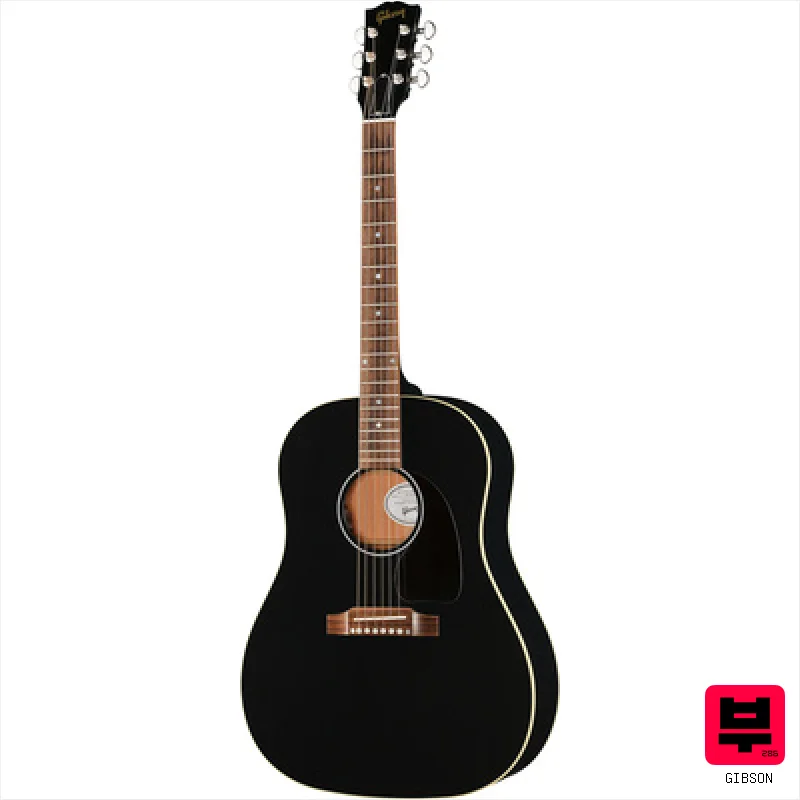
Gibson J-45 Special Satin Ebony
- • Solid sitka spruce top delivers bright, punchy attack.
- • Mahogany body creates warm, mid-focused resonance.
- • L.R. Baggs pickup ensures clean, balanced output.
- • Satin ebony finish offers modern, low-maintenance look.
- • No weight listed makes carrying unknown.
- • Mahogany back lacks traditional mahogany tone depth.
- • Satin finish may lack depth of gloss finish.
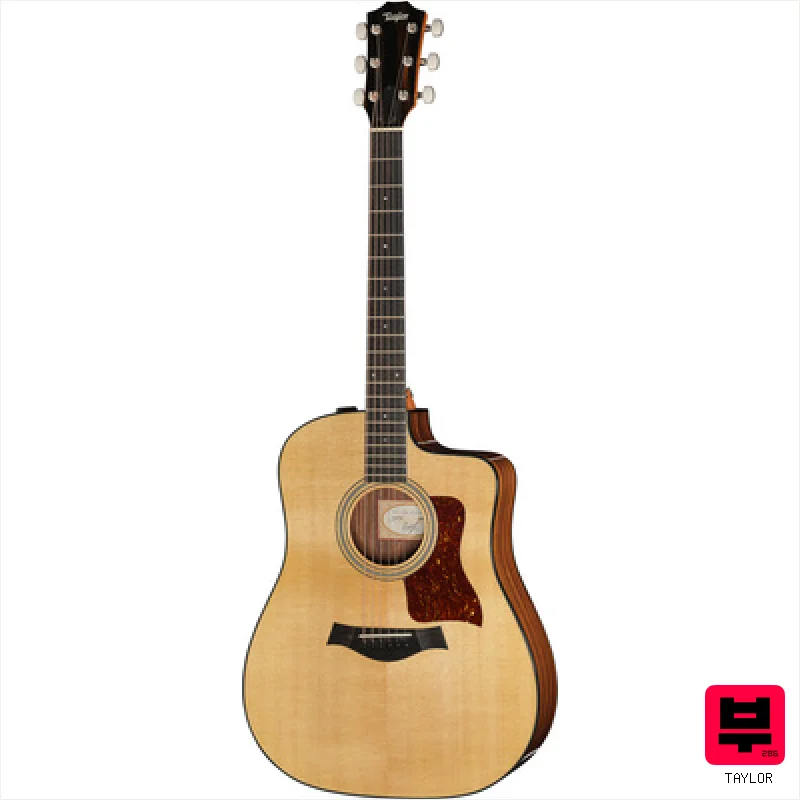
Taylor 210ce Plus
- • Solid spruce top for strong, responsive attack
- • Rosewood back and sides add warmth
- • ES2 pickup system handles stage volume
- • Dreadnought cutaway reaches high frets easily
- • Mahogany neck can limit bass response
- • No listed weight makes portability unclear
- • Micarta saddle adds weight to the bridge
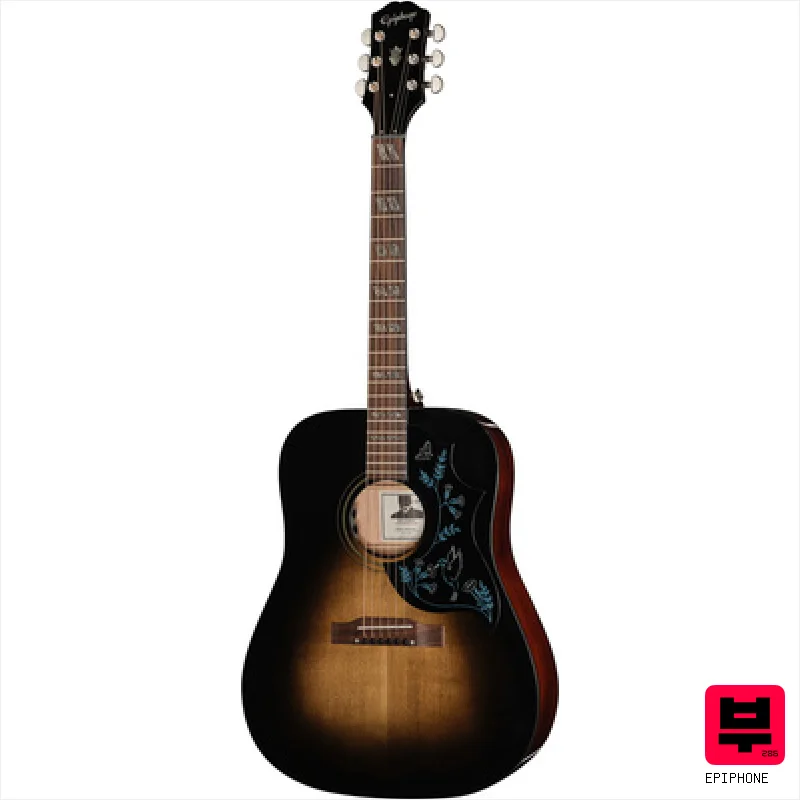
Epiphone Eric Church Hummingbird DCB
- • Solid spruce top drives a responsive attack for strumming and fingerpicking
- • Solid mahogany back and sides deliver a warm, mid-focused tone
- • Fishman Sonicore pickup offers clear output without midrange mud
- • Fishman Presys VT preamp provides balanced controls for any playing style
- • Pearloid inlays lack the visual depth of genuine mother-of-pearl
- • Single-ply binding keeps costs down but adds minimal structural rigidity
- • No explicit weight rating means heavy players may feel strain over long sessions
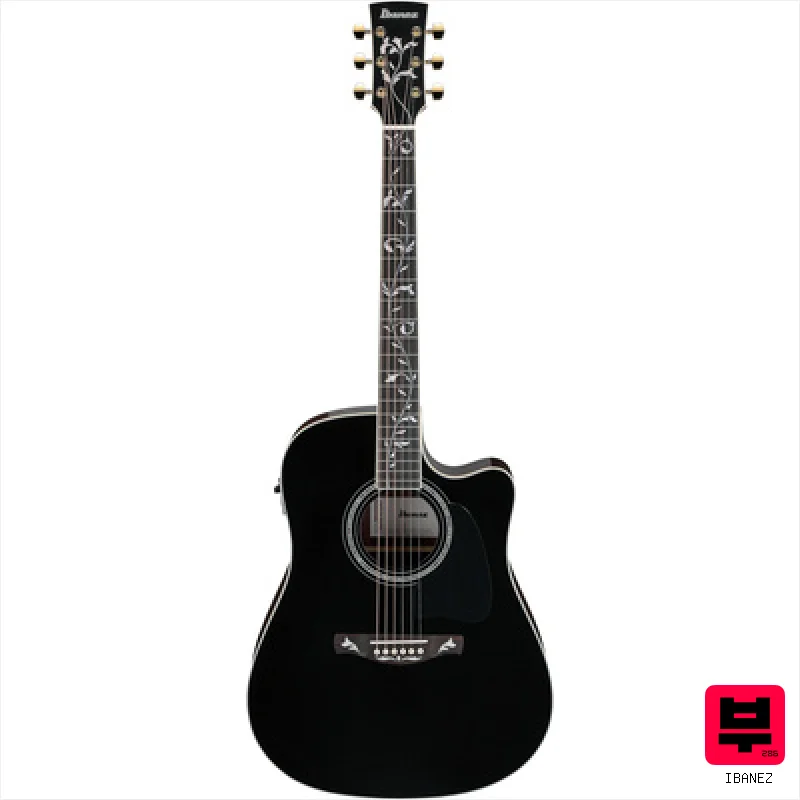
Ibanez AW391RCE-BKH
- • Solid sitka spruce top for strong attack and projection
- • African mahogany neck offers smooth playability and stability
- • Ibanez T-bar pickup provides reliable on-stage clarity
- • Dreadnought cutaway design gives easy access to upper frets
- • No listed weight makes heavy carry possible for some
- • High-gloss finish shows wear and scratches easily over time
- • Rosewood back and sides may crack in very dry climates
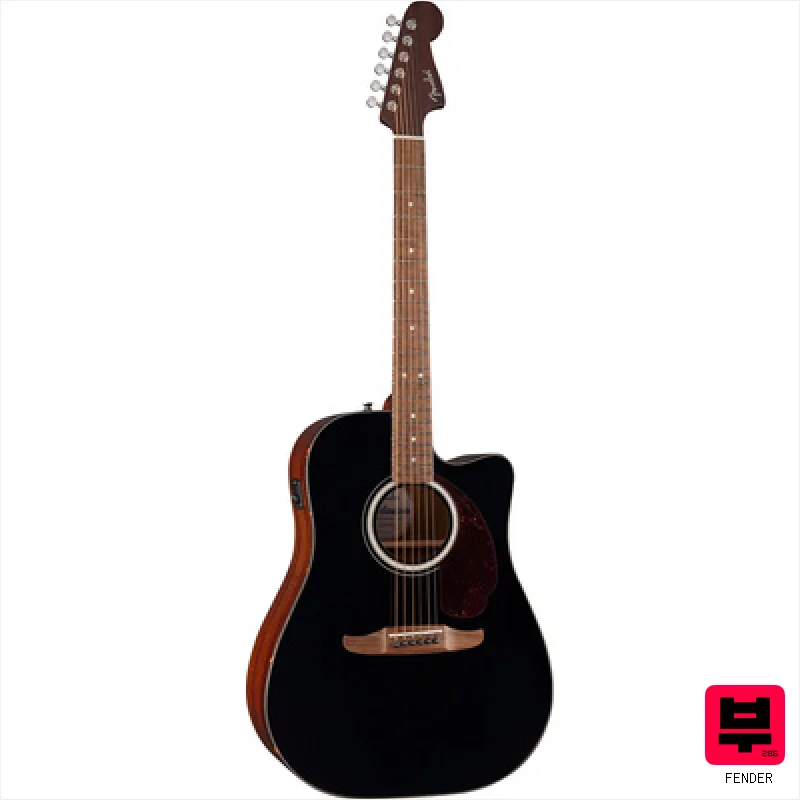
Fender CA DLX Redondo CE BLK
- • Solid spruce top offers strong, responsive attack for strumming
- • Mahogany back and sides deliver warm, mid-focused tone
- • Fishman CD-1 preamp adds clear pickup output and controls
- • Slim C neck profile makes playing chords and solos easy
- • Micarta nut may feel different to some players compared to bone
- • Mahogany body construction lacks traditional acoustic resonance depth
- • No weight specification provided in the official description text
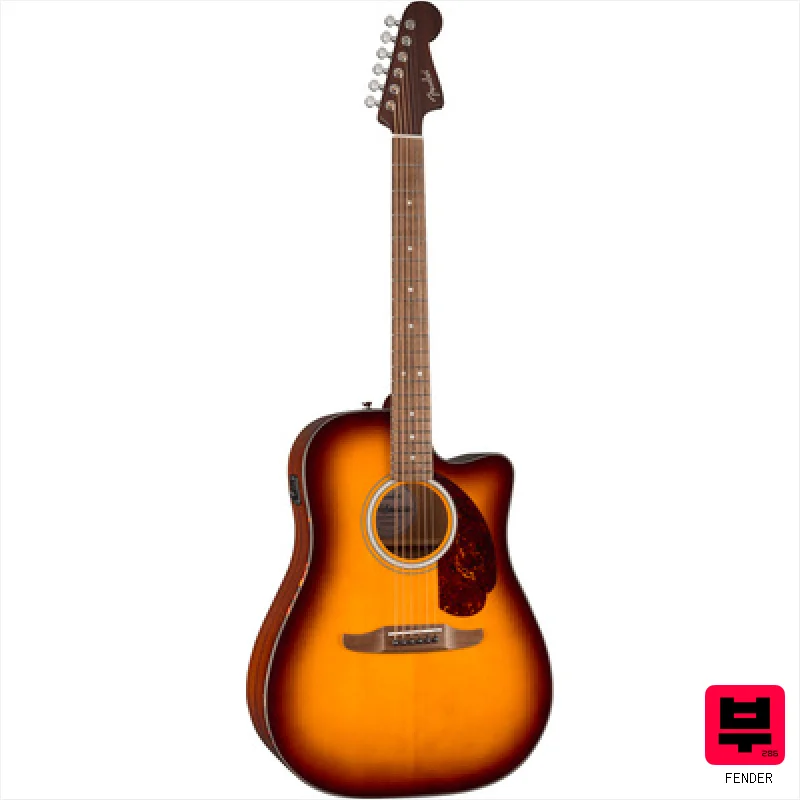
Fender CA DLX Redondo CE HSB
- • Solid spruce top drives a strong, clear tone
- • Mahogany back and sides add warmth and depth
- • Fishman CD-1 preamp handles all mix settings
- • Slim C neck profile plays easily for beginners
- • No weight listed means unknown comfort for large players
- • Mahogany back and sides can sound thin in some styles
- • Single volume/bass/treble control lacks dedicated mid knob
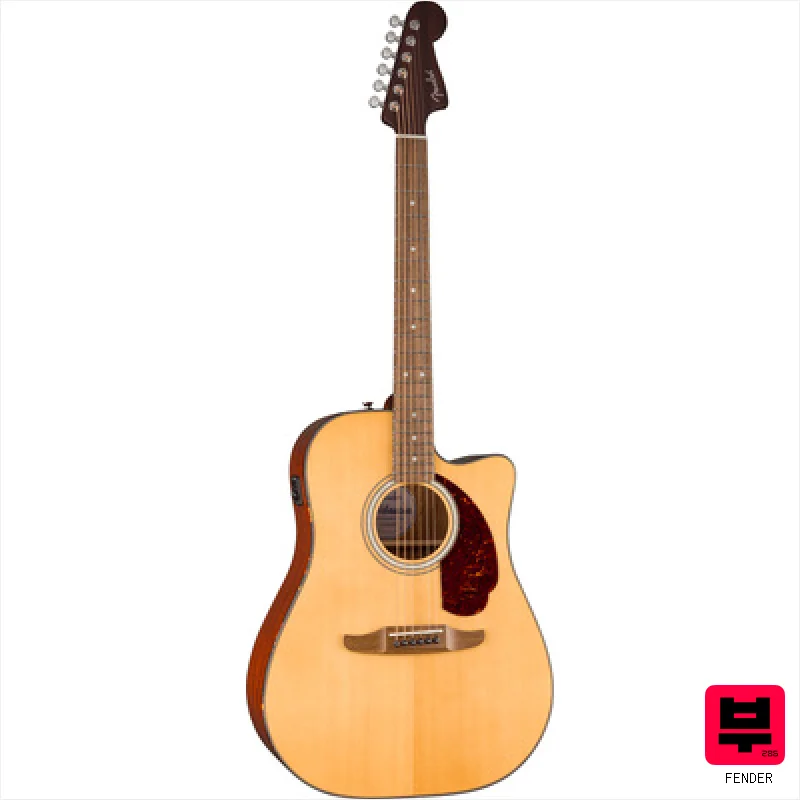
Fender CA DLX Redondo CE NAT
- • Solid spruce top offers strong attack and projection.
- • Mahogany back and sides add warm, mid-focused tone.
- • Fishman CD-1 preamp gives clear, balanced pickup output.
- • Slim C neck profile plays comfortably for smaller hands.
- • Natural finish may show dust and wear easily.
- • No hard case or gig bag included with purchase.
- • Weight is not specified, likely heavier than all-mahogany models.
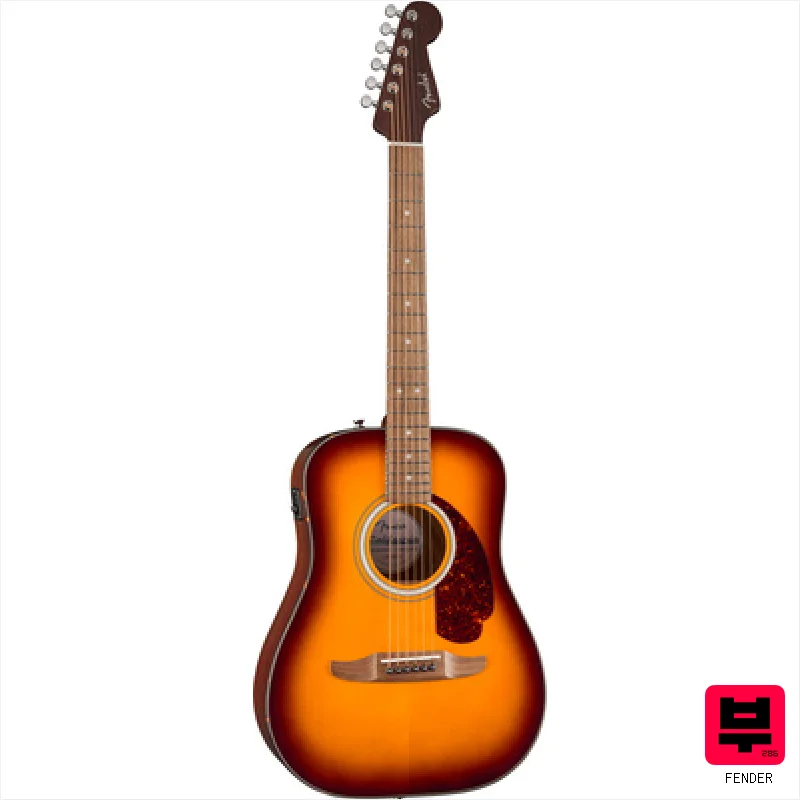
Fender CA DLX Redondo Jr. E HSB
- • Solid spruce top drives the guitar with bright, responsive attack
- • Mahogany back and sides add warm midrange and deep bass response
- • Fishman CD-1 preamp offers clear volume, bass, and treble controls
- • Slim C neck profile provides comfortable playability for both hands
- • Single-ply strings offer less sustain and volume than coated options
- • Tortoise shell pickguard is a dated design choice for modern players
- • No specific weight rating listed for long-play comfort testing
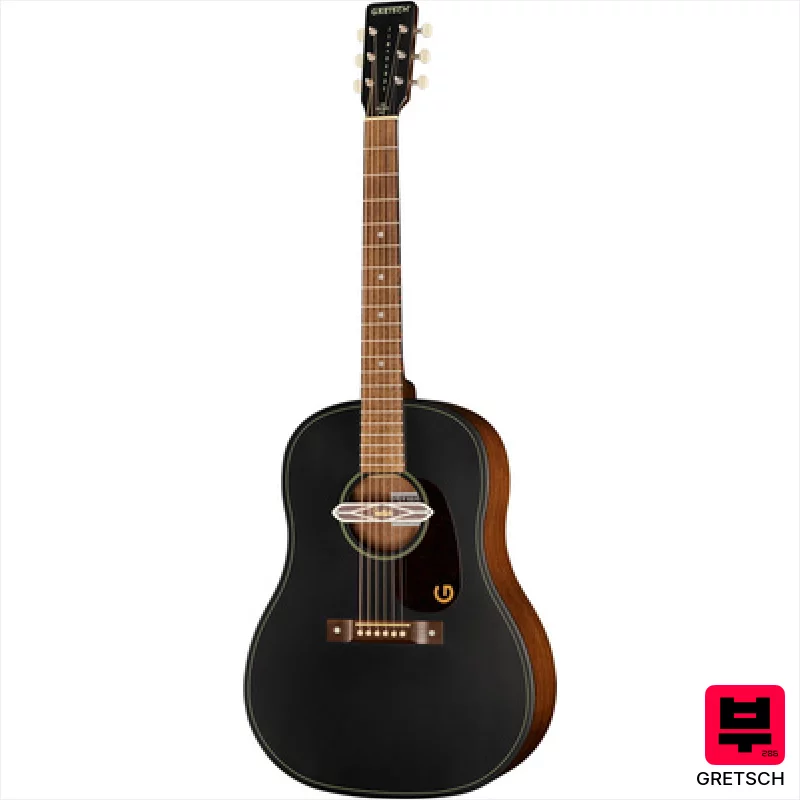
Gretsch JD Dread DELTO TSPG BLKT
- • Sapele laminate top delivers surprisingly warm, resonant tones.
- • Deltoluxe pickup offers usable, amplified sound for stage or recording.
- • Walnut fingerboard provides a smooth, comfortable playing experience.
- • 24.75” scale length eases bends and feels familiar to vintage players.
- • Laminated construction limits high-end sparkle and complex overtones.
- • Nato neck, while stable, lacks the premium feel of mahogany or maple.
- • Open-gear tuners might not offer the absolute finest tuning stability.
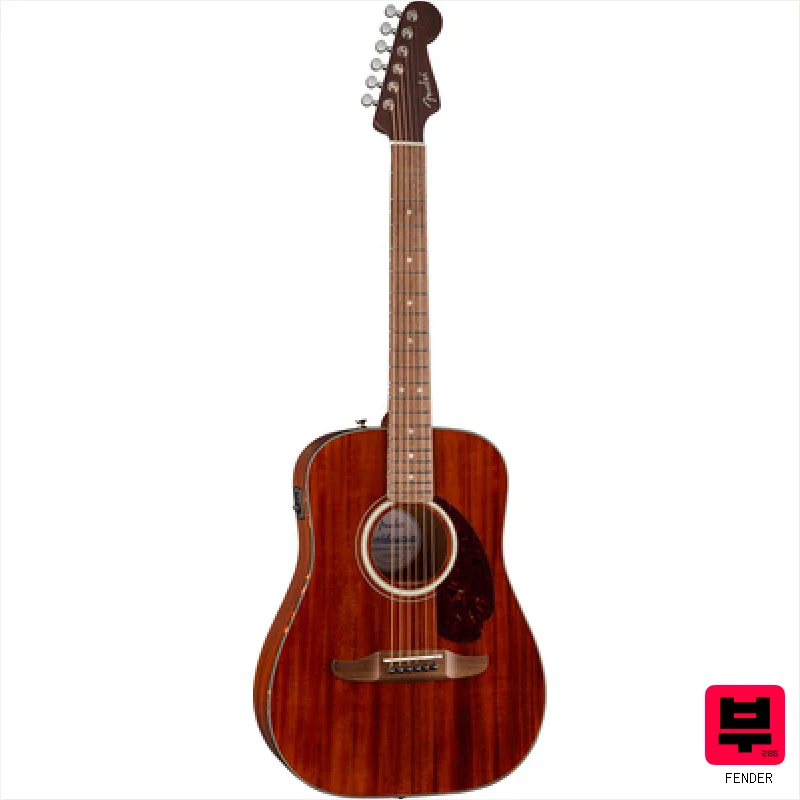
Fender CA DLX Redondo Jr. E NAT
- • Solid spruce top delivers bright, cutting top-end response
- • Mahogany back and sides provide warm, mid-focused depth
- • Fishman CD-1 preamp offers easy on-the-fly EQ control
- • Slim C neck profile ensures fast playability for all hands
- • Tortoise shell pickguard is a fragile, non-standard plastic
- • Micarta nut may feel slippery or uneven under fingertips
- • No listed weight allows no verified carry comfort claim
Every dreadnought acoustic guitars that matches
521 models exist in this category. The 15 above are covered in detail, and the next 385 are listed here — the longest tail is capped to keep the page loadable.
| # | Model | Specifications | Price |
|---|---|---|---|
| 16 | Guild D-140CE SB Westerly | Nut width 44.5 mm (1.75") · Scale 648 mm (25.51") · Frets 20 frets · Neck profile C-shape neck · Body Mahogany body | $1,006 |
| 17 | Guild D-140 Cherry Burst | Nut width 44.5 mm (1.75") · Scale 648 mm (25.51") · Frets 20 frets · Neck profile C-shape neck · Fingerboard Rosewood fingerboard | $893 |
| 18 | Ibanez PF34MHE-NT | Nut width 42 mm (1.65") · Scale 634 mm (24.96") · Frets 20 frets · Neck profile U-shape neck · Fingerboard Purpleheart fingerboard | $379 |
| 19 | Harley Benton Custom Line CLD-1048SCE w/Case | Nut width 48 mm (1.89") · Scale 648 mm (25.51") · Frets 20 frets · Fingerboard radius 400 mm (15.75") · Fingerboard Pau ferro fingerboard | $323 |
| 20 | Ibanez AAD361CE-TKR | Nut width 43 mm (1.69") · Scale 650 mm (25.59") · Frets 20 frets · Fingerboard radius 400 mm (15.75") | $894 |
| 21 | Ibanez AAD371E-ATW | Nut width 43 mm (1.69") · Scale 650 mm (25.59") · Frets 20 frets · Fingerboard radius 400 mm (15.75") | $838 |
| 22 | Ibanez AAD381CE-NT | Nut width 43 mm (1.69") · Scale 650 mm (25.59") · Frets 20 frets · Fingerboard radius 400 mm (15.75") | $782 |
| 23 | Harley Benton Custom Line CLD-41SE WN w/Case | Nut width 43 mm (1.69") · Scale 643 mm (25.31") · Frets 20 frets · Weight 5 kg | $480 |
| 24 | Harley Benton HBD120 CE BK Bundle | Nut width 42.5 mm (1.67") · Scale 650 mm (25.59") · Frets 20 frets · Neck profile C-shape neck · Body Mahogany body · Fingerboard Jatoba fingerboard · Weight 10 kg | $223 |
| 25 | Martin Guitar D-13E Retro Walnut | Nut width 44.5 mm (1.75") · Scale 645 mm (25.39") · Frets 20 frets · Fingerboard Ebony fingerboard | $2,180 |
| 26 | Furch Blue Performance Dc-SW a | Nut width 45 mm (1.77") · Scale 650 mm (25.59") · Frets 20 frets · Fingerboard Ebony fingerboard | $2,158 |
| 27 | Gibson J-45 Special Satin Vint. Burst | Nut width 43.8 mm (1.72") · Scale 629 mm (24.76") · Frets 20 frets · Fingerboard Rosewood fingerboard | $2,124 |
| 28 | Guild D-20 VSB USA | Nut width 43 mm (1.69") · Scale 648 mm (25.51") · Frets 20 frets · Body Mahogany body | $2,124 |
| 29 | Gibson Hummingbird Special SN | Nut width 43.8 mm (1.72") · Scale 629 mm (24.76") · Frets 20 frets · Fingerboard Rosewood fingerboard | $2,067 |
| 30 | Martin Guitar D-12E Retro Nat | Nut width 44.5 mm (1.75") · Scale 645 mm (25.39") · Frets 20 frets · Fingerboard Ebony fingerboard | $2,046 |
| 31 | Furch Blue Performance Dc-CM a | Nut width 45 mm (1.77") · Scale 650 mm (25.59") · Frets 20 frets · Fingerboard Ebony fingerboard | $2,012 |
| 32 | Guild D-20 Nat USA | Nut width 44 mm (1.73") · Scale 648 mm (25.51") · Frets 20 frets · Body Mahogany body | $2,012 |
| 33 | Yamaha FGX5G NT High Gloss | Nut width 44 mm (1.73") · Scale 634 mm (24.96") · Frets 20 frets · Fingerboard Ebony fingerboard | $1,990 |
| 34 | Furch Vintage 1 D-SM a w/GB | Nut width 45 mm (1.77") · Scale 650 mm (25.59") · Frets 20 frets · Fingerboard Ebony fingerboard | $1,956 |
| 35 | Furch Blue Deluxe Dc-CM a w/GB | Nut width 45 mm (1.77") · Scale 650 mm (25.59") · Frets 20 frets · Fingerboard Ebony fingerboard | $1,901 |
| 36 | Martin Guitar DC-10E Modern BLK | Nut width 44.5 mm (1.75") · Scale 645 mm (25.39") · Frets 20 frets · Fingerboard Ebony fingerboard | $1,822 |
| 37 | Furch Violet Performance Dc-EM a SPE | Nut width 45 mm (1.77") · Scale 650 mm (25.59") · Frets 20 frets · Fingerboard Ebony fingerboard | $1,789 |
| 38 | Furch Vintage Pure D-EM VTC a w / GB | Nut width 45 mm (1.77") · Scale 650 mm (25.59") · Frets 20 frets · Fingerboard Ebony fingerboard | $1,789 |
| 39 | Yamaha TAG3 C Sandburst | Nut width 44 mm (1.73") · Scale 650 mm (25.59") · Frets 20 frets · Fingerboard Ebony fingerboard | $1,789 |
| 40 | Yamaha TAG3 C Natural | Nut width 44 mm (1.73") · Scale 650 mm (25.59") · Frets 20 frets · Fingerboard Ebony fingerboard | $1,789 |
| 41 | Yamaha FG5G NT High Gloss | Nut width 44 mm (1.73") · Scale 634 mm (24.96") · Frets 20 frets · Fingerboard Ebony fingerboard | $1,676 |
| 42 | Furch Vintage Pure D-EM a w/GB | Nut width 45 mm (1.77") · Scale 650 mm (25.59") · Frets 20 frets · Fingerboard Ebony fingerboard | $1,654 |
| 43 | Furch Vintage Pure D-MM a w/GB | Nut width 45 mm (1.77") · Scale 650 mm (25.59") · Frets 20 frets · Fingerboard Ebony fingerboard | $1,621 |
| 44 | Furch Violet Deluxe Dc-EM a | Nut width 45 mm (1.77") · Scale 650 mm (25.59") · Frets 20 frets · Fingerboard Ebony fingerboard | $1,531 |
| 45 | Martin Guitar D-10E Retro Nat | Nut width 44.5 mm (1.75") · Scale 645 mm (25.39") · Frets 20 frets · Fingerboard Ebony fingerboard | $1,520 |
| 46 | Godin Century Maho Cognac Burst EQ | Nut width 43.7 mm (1.72") · Scale 648 mm (25.51") · Fingerboard radius 406 mm (15.98") · Fingerboard Ebony fingerboard | $1,453 |
| 47 | Yamaha TAG1 C Sand Burst | Nut width 44 mm (1.73") · Scale 650 mm (25.59") · Frets 20 frets · Fingerboard Walnut fingerboard | $1,453 |
| 48 | Yamaha TAG1 C Natural | Nut width 44 mm (1.73") · Scale 650 mm (25.59") · Frets 20 frets · Fingerboard Walnut fingerboard | $1,408 |
| 49 | Epiphone 1942 Banner J-45 Reis. VS IBC | Nut width 43.9 mm (1.73") · Scale 629 mm (24.76") · Frets 19 frets · Fingerboard Rosewood fingerboard | $1,341 |
| 50 | Epiphone 1960 Hummingbird Rei. HTS IBC | Nut width 44.2 mm (1.74") · Scale 629 mm (24.76") · Frets 20 frets · Fingerboard Rosewood fingerboard | $1,341 |
| 51 | Epiphone 1963 Dove Reissue Natural IBC | Nut width 42.9 mm (1.69") · Scale 648 mm (25.51") · Frets 20 frets · Fingerboard Rosewood fingerboard | $1,341 |
| 52 | Martin Guitar D Jr E Street Legend Burst | Nut width 44.5 mm (1.75") · Scale 632 mm (24.88") · Frets 20 frets · Fingerboard Ebony fingerboard | $1,341 |
| 53 | Martin Guitar D-X2E Billy Strings | Nut width 43.7 mm (1.72") · Scale 635 mm (25") · Frets 20 frets · Fingerboard Ebony fingerboard | $1,341 |
| 54 | Epiphone Hummingbird Deluxe EC AB IBC | Nut width 43.9 mm (1.73") · Scale 629 mm (24.76") · Frets 20 frets · Fingerboard Ebony fingerboard | $1,308 |
| 55 | Epiphone Hummingbird Deluxe EC NA IBC | Nut width 43.9 mm (1.73") · Scale 629 mm (24.76") · Frets 20 frets · Fingerboard Ebony fingerboard | $1,305 |
| 56 | Martin Guitar D Jr E StreetMaster New | Nut width 44.5 mm (1.75") · Scale 632 mm (24.88") · Frets 20 frets · Fingerboard Ebony fingerboard | $1,229 |
| 57 | Taylor 210ce | Nut width 42.8 mm (1.69") · Scale 648 mm (25.51") · Frets 20 frets · Fingerboard Ebony fingerboard | $1,229 |
| 58 | Guild D-150CE Nat Westerly | Nut width 44.5 mm (1.75") · Scale 648 mm (25.51") · Frets 20 frets · Neck profile C-shape neck | $1,173 |
| 59 | Epiphone Marcus King El Dorado AN | Nut width 43 mm (1.69") · Scale 629 mm (24.76") · Frets 20 frets · Fingerboard Rosewood fingerboard | $1,117 |
| 60 | Epiphone Masterbilt Excellente | Nut width 43.8 mm (1.72") · Scale 643 mm (25.31") · Frets 20 frets · Neck profile C-shape neck | $1,117 |
| 61 | Framus Vintage Hootenanny 6 SB HP | Nut width 44 mm (1.73") · Scale 643 mm (25.31") · Frets 19 frets · Fingerboard Rosewood fingerboard | $1,117 |
| 62 | Framus Vintage Hootenanny 6 TN | Nut width 44 mm (1.73") · Scale 643 mm (25.31") · Frets 19 frets · Fingerboard Rosewood fingerboard | $1,117 |
| 63 | Framus Vintage Hootenanny 6 SB Nitro | Nut width 44 mm (1.73") · Scale 643 mm (25.31") · Frets 19 frets · Fingerboard Rosewood fingerboard | $1,117 |
| 64 | Epiphone Hummingbird Standard CS | Nut width 42.9 mm (1.69") · Scale 629 mm (24.76") · Frets 20 frets · Fingerboard Rosewood fingerboard | $1,062 |
| 65 | Framus Vintage Hootenanny 6 SB Satin | Nut width 44 mm (1.73") · Scale 643 mm (25.31") · Frets 19 frets · Fingerboard Rosewood fingerboard | $1,006 |
| 66 | Guild D-140ce Black | Nut width 44.5 mm (1.75") · Scale 648 mm (25.51") · Frets 20 frets · Neck profile C-shape neck | $1,006 |
| 67 | Journey Instruments Comfort Dreadnought JCD422 | Nut width 43 mm (1.69") · Scale 648 mm (25.51") · Frets 20 frets · Fingerboard Ebony fingerboard | $1,006 |
| 68 | Martin Guitar D Jr E LH | Nut width 44.5 mm (1.75") · Scale 632 mm (24.88") · Frets 20 frets · Fingerboard Ebony fingerboard | $1,006 |
| 69 | Martin Guitar D Jr E | Nut width 44.5 mm (1.75") · Scale 632 mm (24.88") · Frets 20 frets · Fingerboard Ebony fingerboard | $1,006 |
| 70 | Taylor 110ce Sapele | Nut width 42.8 mm (1.69") · Scale 648 mm (25.51") · Frets 20 frets · Fingerboard Ebony fingerboard | $950 |
| 71 | Yamaha TAG1 E Translucent Black | Nut width 44 mm (1.73") · Scale 650 mm (25.59") · Frets 20 frets · Fingerboard Walnut fingerboard | $894 |
| 72 | Guild D-140 SB Westerly | Nut width 44.5 mm (1.75") · Scale 648 mm (25.51") · Frets 20 frets · Body Mahogany body | $893 |
| 73 | Epiphone Hummingbird Standard EC CS | Nut width 42.9 mm (1.69") · Scale 629 mm (24.76") · Frets 20 frets · Fingerboard Rosewood fingerboard | $838 |
| 74 | Yamaha TAG1 E Sand Burst | Nut width 44 mm (1.73") · Scale 650 mm (25.59") · Frets 20 frets · Fingerboard Walnut fingerboard | $815 |
| 75 | Epiphone J-45 Standard Vintage Sunburst | Nut width 42.9 mm (1.69") · Scale 629 mm (24.76") · Frets 20 frets · Fingerboard Rosewood fingerboard | $791 |
| 76 | Epiphone Hummingbird Standard EC N | Nut width 42.9 mm (1.69") · Scale 629 mm (24.76") · Frets 20 frets · Fingerboard Rosewood fingerboard | $768 |
| 77 | Epiphone J-45 Standard EC Honey Burst | Nut width 42.9 mm (1.69") · Scale 629 mm (24.76") · Frets 20 frets · Fingerboard Rosewood fingerboard | $746 |
| 78 | Guild DS-240E Black | Nut width 43 mm (1.69") · Scale 629 mm (24.76") · Frets 20 frets · Fingerboard Rosewood fingerboard | $719 |
| 79 | Guild DS-240 Wine Red | Nut width 43 mm (1.69") · Scale 629 mm (24.76") · Frets 20 frets · Fingerboard Rosewood fingerboard | $621 |
| 80 | Takamine GD51CE-BSB W/Bag | Nut width 42.5 mm (1.67") · Scale 644 mm (25.35") · Frets 21 frets · Fingerboard Laurel fingerboard | $546 |
| 81 | Epiphone Dove Studio Nat LH | Nut width 42.9 mm (1.69") · Scale 648 mm (25.51") · Frets 20 frets · Fingerboard Rosewood fingerboard | $525 |
| 82 | Epiphone Dove Studio Nat | Nut width 42.9 mm (1.69") · Scale 648 mm (25.51") · Frets 20 frets · Fingerboard Rosewood fingerboard | $525 |
| 83 | Epiphone Hummingbird Studio EC HCS | Nut width 42.9 mm (1.69") · Scale 629 mm (24.76") · Frets 20 frets · Fingerboard Rosewood fingerboard | $525 |
| 84 | Takamine GD51CE-NAT | Nut width 43 mm (1.69") · Scale 643 mm (25.31") · Frets 21 frets · Fingerboard Laurel fingerboard | $525 |
| 85 | Takamine GD51CE-BSB | Nut width 42.5 mm (1.67") · Scale 644 mm (25.35") · Frets 21 frets · Fingerboard Laurel fingerboard | $525 |
| 86 | Epiphone J-45 Studio Vintage Sunburst | Nut width 42.9 mm (1.69") · Scale 629 mm (24.76") · Frets 20 frets · Fingerboard Rosewood fingerboard | $502 |
| 87 | Richwood D-65-VA Master Series | Nut width 43 mm (1.69") · Scale 650 mm (25.59") · Frets 20 frets · Fingerboard Rosewood fingerboard | $502 |
| 88 | Epiphone Hummingbird Studio HCS | Nut width 42.9 mm (1.69") · Scale 629 mm (24.76") · Frets 20 frets · Fingerboard Rosewood fingerboard | $497 |
| 89 | Epiphone Hummingbird Studio Antique Nat | Nut width 42.9 mm (1.69") · Scale 629 mm (24.76") · Frets 20 frets · Fingerboard Rosewood fingerboard | $492 |
| 90 | Epiphone Hummingbird Studio EC AN | Nut width 42.9 mm (1.69") · Scale 629 mm (24.76") · Frets 20 frets · Fingerboard Rosewood fingerboard | $469 |
| 91 | Epiphone J-45 Studio EC VS | Nut width 42.9 mm (1.69") · Scale 629 mm (24.76") · Frets 20 frets · Fingerboard Rosewood fingerboard | $446 |
| 92 | Fender CD-140SCE Nat | Nut width 43 mm (1.69") · Scale 648 mm (25.51") · Frets 20 frets · Fingerboard Walnut fingerboard | $402 |
| 93 | Epiphone J-45 Studio EC Natural | Nut width 42.9 mm (1.69") · Scale 629 mm (24.76") · Frets 20 frets · Fingerboard Rosewood fingerboard | $399 |
| 94 | Epiphone J-45 Studio Natural | Nut width 42.9 mm (1.69") · Scale 629 mm (24.76") · Frets 20 frets · Fingerboard Rosewood fingerboard | $392 |
| 95 | Recording King RDS-11-FE3-TBR | Nut width 43 mm (1.69") · Scale 645 mm (25.39") · Frets 20 frets · Neck profile C-shape neck | $390 |
| 96 | Fender CA DLX Redondo CE SHW | Nut width 42.9 mm (1.69") · Scale 648 mm (25.51") · Fingerboard radius 305 mm (12.01") · Fingerboard Walnut fingerboard | $379 |
| 97 | Harley Benton CLD-60SCE BK Cust. Line Bundle | Nut width 43 mm (1.69") · Scale 648 mm (25.51") · Fingerboard Walnut fingerboard · Weight 11 kg | $379 |
| 98 | Yamaha FG800 Sand Burst | Nut width 43 mm (1.69") · Scale 650 mm (25.59") · Frets 20 frets · Fingerboard Walnut fingerboard | $379 |
| 99 | Yamaha FG800 NT | Nut width 43 mm (1.69") · Scale 650 mm (25.59") · Frets 20 frets · Fingerboard Walnut fingerboard | $379 |
| 100 | Recording King RD-G6-CFE5 | Nut width 42.9 mm (1.69") · Scale 645 mm (25.39") · Frets 20 frets · Neck profile C-shape neck | $372 |
| 101 | Fender CA DLX Redondo SSB | Nut width 42.9 mm (1.69") · Scale 648 mm (25.51") · Frets 20 frets · Fingerboard radius 305 mm (12.01") · Fingerboard Walnut fingerboard | $301 |
| 102 | Harley Benton Custom Line CLD-1048SCE Bundle | Nut width 48 mm (1.89") · Scale 648 mm (25.51") · Frets 20 frets · Fingerboard radius 400 mm (15.75") · Fingerboard Pau ferro fingerboard | $301 |
| 103 | Takamine GD11MCENS | Nut width 43 mm (1.69") · Scale 644 mm (25.35") · Frets 21 frets · Fingerboard Laurel fingerboard | $368 |
| 104 | Harley Benton Custom Line CLD-15M w/Case | Nut width 43 mm (1.69") · Scale 643 mm (25.31") · Frets 20 frets · Body Sapele body · Weight 5 kg | $290 |
| 105 | Martin Guitar D-15M | Nut width 42.9 mm (1.69") · Scale 645 mm (25.39") · Body Mahogany body · Fingerboard Rosewood fingerboard | $2,124 |
| 106 | Recording King Dirty 30s Series 9 12-String | Nut width 49 mm (1.93") · Scale 645 mm (25.39") · Frets 20 frets · Strings 12-string | $334 |
| 107 | Fender CA STD Redondo CE IPG BLK | Nut width 42.9 mm (1.69") · Scale 648 mm (25.51") · Frets 20 frets · Fingerboard radius 305 mm (12.01") · Neck profile C-shape neck · Fingerboard Walnut fingerboard | $228 |
| 108 | Harley Benton Custom Line Superior-E w/Bag | Nut width 43 mm (1.69") · Scale 648 mm (25.51") · Frets 20 frets · Fingerboard radius 400 mm (15.75") · Body Okoume body | $279 |
| 109 | Harley Benton Custom Line CLD-1048SCE NS | Nut width 48 mm (1.89") · Scale 648 mm (25.51") · Frets 20 frets · Fingerboard radius 400 mm (15.75") · Fingerboard Pau ferro fingerboard | $279 |
| 110 | Harley Benton CLD-15MCE SolidWood w/Bag | Nut width 43 mm (1.69") · Scale 643 mm (25.31") · Frets 20 frets · Fingerboard Pau ferro fingerboard | $346 |
| 111 | Gretsch JD Dread WPG RXB | Nut width 42.7 mm (1.68") · Scale 629 mm (24.76") · Frets 20 frets · Fingerboard radius 305 mm (12.01") · Neck profile C-shape neck · Fingerboard Walnut fingerboard | $223 |
| 112 | Fender CA STD Redondo CE BPG NAT | Nut width 42.9 mm (1.69") · Scale 648 mm (25.51") · Frets 20 frets · Fingerboard radius 305 mm (12.01") · Neck profile C-shape neck · Fingerboard Walnut fingerboard | $220 |
| 113 | Fender CA STD Redondo CE IPG FRD | Nut width 42.9 mm (1.69") · Scale 648 mm (25.51") · Frets 20 frets · Fingerboard radius 305 mm (12.01") · Neck profile C-shape neck · Fingerboard Walnut fingerboard | $218 |
| 114 | Harley Benton Custom Line Superior-E VS | Nut width 43 mm (1.69") · Scale 648 mm (25.51") · Frets 20 frets · Fingerboard radius 400 mm (15.75") · Body Okoume body | $267 |
| 115 | Epiphone J-45 Studio NA | Nut width 43 mm (1.69") · Scale 648 mm (25.51") · Frets 20 frets · Body Mahogany body | $334 |
| 116 | Harley Benton CLD-15MCE SolidWood | Nut width 43 mm (1.69") · Scale 643 mm (25.31") · Frets 20 frets · Fingerboard Pau ferro fingerboard | $334 |
| 117 | Furch Vintage 1 D-SR a w/GB | Nut width 45 mm (1.77") · Scale 650 mm (25.59") · Frets 20 frets | $2,124 |
| 118 | Taylor 217e Plus Special Edition HB | Nut width 42.8 mm (1.69") · Scale 648 mm (25.51") · Frets 20 frets | $1,901 |
| 119 | Yamaha FGX3 NT | Nut width 44 mm (1.73") · Scale 634 mm (24.96") · Frets 20 frets | $1,420 |
| 120 | Yamaha Transacoustic LL-TA VT | Nut width 44 mm (1.73") · Scale 650 mm (25.59") · Frets 20 frets | $1,397 |
| 121 | Martin Guitar D-10E Retro Sapele | Nut width 44.5 mm (1.75") · Scale 645 mm (25.39") · Frets 20 frets | $1,364 |
| 122 | Furch Violet D-ER a w/GB | Nut width 45 mm (1.77") · Scale 650 mm (25.59") · Frets 20 frets | $1,319 |
| 123 | Yamaha A3R ARE TBS | Nut width 43 mm (1.69") · Scale 650 mm (25.59") · Frets 20 frets | $1,285 |
| 124 | Martin Guitar D-X2E Brazilian Burst Special | Nut width 44.5 mm (1.75") · Scale 645 mm (25.39") · Frets 20 frets | $1,229 |
| 125 | Furch Violet D-EM a w/GB | Nut width 45 mm (1.77") · Scale 650 mm (25.59") · Frets 20 frets | $1,151 |
| 126 | Yamaha A3M ARE TBS | Nut width 43 mm (1.69") · Scale 650 mm (25.59") · Frets 20 frets | $1,062 |
| 127 | Martin Guitar D-X2E Rosewood | Nut width 44.5 mm (1.75") · Scale 645 mm (25.39") · Frets 20 frets | $1,006 |
| 128 | Recording King RD-342 Tonewood Reserve Elite | Nut width 44.5 mm (1.75") · Scale 645 mm (25.39") · Frets 20 frets | $1,006 |
| 129 | Martin Guitar D-X2E Mahogany LH | Nut width 44.5 mm (1.75") · Scale 645 mm (25.39") · Frets 20 frets | $983 |
| 130 | Martin Guitar D-X2E Mahogany | Nut width 44.5 mm (1.75") · Scale 645 mm (25.39") · Frets 20 frets | $983 |
| 131 | Martin Guitar DX2E Ziricote Burst | Nut width 44.5 mm (1.75") · Scale 645 mm (25.39") · Frets 20 frets | $983 |
| 132 | Art & Lutherie Americana Bourbon Burst Presys | Nut width 43.7 mm (1.72") · Scale 631 mm (24.84") · Frets 21 frets | $950 |
| 133 | Taylor 117e Grand Pacific Eucalyptus | Nut width 42.8 mm (1.69") · Scale 648 mm (25.51") · Frets 20 frets | $927 |
| 134 | Seagull S6 Original Burnt Umber Presys | Nut width 45.7 mm (1.8") · Scale 648 mm (25.51") · Frets 21 frets | $894 |
| 135 | Yamaha A1R II TBS | Nut width 43 mm (1.69") · Scale 650 mm (25.59") · Frets 20 frets | $883 |
| 136 | Martin Guitar DX1E Mahogany | Nut width 44.5 mm (1.75") · Scale 645 mm (25.39") · Frets 20 frets | $871 |
| 137 | Martin Guitar DX1E Koa | Nut width 44.5 mm (1.75") · Scale 645 mm (25.39") · Frets 20 frets | $838 |
| 138 | Martin Guitar DX Johnny Cash | Nut width 44.5 mm (1.75") · Scale 645 mm (25.39") · Frets 20 frets | $838 |
| 139 | Martin Guitar DX1EL Mahogany LH | Nut width 44.5 mm (1.75") · Scale 645 mm (25.39") · Frets 20 frets | $838 |
| 140 | Taylor Academy 10e Walnut/Eucalyptus | Nut width 42.8 mm (1.69") · Scale 632 mm (24.88") · Frets 20 frets | $815 |
| 141 | Yamaha FGX830C NT | Nut width 43 mm (1.69") · Scale 650 mm (25.59") · Frets 20 frets | $804 |
| 142 | Seagull Entourage Autumn Burst CW Pres | Nut width 43.7 mm (1.72") · Scale 631 mm (24.84") · Frets 21 frets | $782 |
| 143 | Takamine GD90CEZC-NAT | Nut width 43 mm (1.69") · Scale 643 mm (25.31") · Frets 20 frets | $782 |
| 144 | Takamine GD93CE-NAT-2 Set 1 | Nut width 43 mm (1.69") · Scale 644 mm (25.35") · Frets 20 frets | $744 |
| 145 | Takamine GD93CE-NAT | Nut width 43 mm (1.69") · Scale 644 mm (25.35") · Frets 20 frets | $726 |
| 146 | Yamaha FGX820C NTII | Nut width 43 mm (1.69") · Scale 650 mm (25.59") · Frets 20 frets | $648 |
| 147 | Guild DS-240 Memoir Series | Nut width 43 mm (1.69") · Scale 629 mm (24.76") · Frets 20 frets | $617 |
| 148 | Ibanez AW247CE-WKH | Nut width 48 mm (1.89") · Scale 650 mm (25.59") · Frets 20 frets | $545 |
| 149 | Takamine GD30CE-N Bundle w/GB | Nut width 43 mm (1.69") · Scale 643 mm (25.31") · Frets 20 frets | $536 |
| 150 | Yamaha FG830 TBS | Nut width 43 mm (1.69") · Scale 650 mm (25.59") · Frets 20 frets | $536 |
| 151 | Ibanez AW417CE-OPS | Nut width 48 mm (1.89") · Scale 651 mm (25.63") · Frets 20 frets | $531 |
| 152 | Yamaha FG830 NT Bundle | Nut width 43 mm (1.69") · Scale 650 mm (25.59") · Frets 20 frets | $531 |
| 153 | Takamine GD30CE-N | Nut width 43 mm (1.69") · Scale 643 mm (25.31") · Frets 20 frets | $513 |
| 154 | Baton Rouge TLA/D Alder | Nut width 46 mm (1.81") · Scale 630 mm (24.8") · Frets 20 frets | $497 |
| 155 | Yamaha FG830 NT | Nut width 43 mm (1.69") · Scale 650 mm (25.59") · Frets 20 frets | $489 |
| 156 | Takamine GD30CE-B | Nut width 43 mm (1.69") · Scale 643 mm (25.31") · Frets 20 frets | $487 |
| 157 | Harley Benton CLD-30SCM-CE SolidWood w/Bag | Nut width 44.5 mm (1.75") · Scale 650 mm (25.59") · Frets 20 frets | $458 |
| 158 | Breedlove Discovery S Dreadnought Spruce | Nut width 43 mm (1.69") · Scale 643 mm (25.31") · Frets 20 frets | $446 |
| 159 | Harley Benton CLD-30SCM-CE SolidWood | Nut width 44.5 mm (1.75") · Scale 650 mm (25.59") · Frets 20 frets | $446 |
| 160 | Takamine GD20CE-N | Nut width 43 mm (1.69") · Scale 643 mm (25.31") · Frets 20 frets | $446 |
| 161 | Harley Benton Custom Line CLD-41SE WN w/Case | Nut width 43 mm (1.69") · Scale 643 mm (25.31") · Frets 20 frets | $435 |
| 162 | Fender CD-140SCE Sunburst | Nut width 43 mm (1.69") · Scale 643 mm (25.31") · Frets 20 frets | $413 |
| 163 | Fender CD-140SCE All Mah | Nut width 43 mm (1.69") · Scale 643 mm (25.31") · Frets 20 frets | $402 |
| 164 | Harley Benton Custom Line CLD-41SE WN w/Bag | Nut width 43 mm (1.69") · Scale 643 mm (25.31") · Frets 20 frets | $402 |
| 165 | Takamine GD51 Nat | Nut width 42.5 mm (1.67") · Scale 644 mm (25.35") · Frets 21 frets | $396 |
| 166 | Harley Benton Custom Line CLD-41SE WN | Nut width 43 mm (1.69") · Scale 643 mm (25.31") · Frets 20 frets | $390 |
| 167 | Harley Benton Custom Line CLD-41S WN W/Case | Nut width 43 mm (1.69") · Scale 643 mm (25.31") · Frets 20 frets | $379 |
| 168 | Ibanez AAD51CE-NT | Nut width 43 mm (1.69") · Scale 650 mm (25.59") · Frets 20 frets | $372 |
| 169 | Ibanez AAD77M1E-OAW | Nut width 43 mm (1.69") · Scale 650 mm (25.59") · Frets 20 frets | $372 |
| 170 | Yamaha FG800 BL | Nut width 43 mm (1.69") · Scale 650 mm (25.59") · Frets 20 frets | $372 |
| 171 | Yamaha FG800 BS | Nut width 43 mm (1.69") · Scale 650 mm (25.59") · Frets 20 frets | $368 |
| 172 | Yamaha FG800M | Nut width 43 mm (1.69") · Scale 650 mm (25.59") · Frets 20 frets · Fingerboard Walnut fingerboard | $312 |
| 173 | Gibson Hummingbird Special SVS | Nut width 43.8 mm (1.72") · Scale 629 mm (24.76") · Fingerboard Rosewood fingerboard | $2,209 |
| 174 | Furch Blue Deluxe Dc-CM 48mm a w/GB | Nut width 48 mm (1.89") · Scale 650 mm (25.59") · Fingerboard Ebony fingerboard | $1,956 |
| 175 | Takamine P5DC w/Softcase | Nut width 42.5 mm (1.67") · Scale 644 mm (25.35") · Fingerboard Rosewood fingerboard | $1,901 |
| 176 | Furch Blue DC-SW a SPE w/GB | Nut width 45 mm (1.77") · Scale 650 mm (25.59") · Fingerboard Ebony fingerboard | $1,845 |
| 177 | Furch Blue D-SX C14 | Nut width 45 mm (1.77") · Scale 650 mm (25.59") · Fingerboard Ebony fingerboard | $1,789 |
| 178 | Furch Blue Dc-CM a SPE w/GB | Nut width 45 mm (1.77") · Scale 650 mm (25.59") · Fingerboard Ebony fingerboard | $1,710 |
| 179 | Furch Blue Dc-CM a 48mm w/GB | Nut width 48 mm (1.89") · Scale 650 mm (25.59") · Fingerboard Ebony fingerboard | $1,543 |
| 180 | Furch Blue plus D-CM a w/GB | Nut width 45 mm (1.77") · Scale 650 mm (25.59") · Fingerboard Ebony fingerboard | $1,509 |
| 181 | Takamine P3DC w/Softcase | Nut width 42.5 mm (1.67") · Scale 644 mm (25.35") · Fingerboard Rosewood fingerboard | $1,498 |
| 182 | Takamine EF341SC w/Softcase | Nut width 42.5 mm (1.67") · Scale 644 mm (25.35") · Fingerboard Rosewood fingerboard | $1,442 |
| 183 | Gretsch G5034TFT Rancher Bigsby | Nut width 43 mm (1.69") · Scale 635 mm (25") · Body Mahogany body | $1,006 |
| 184 | Yamaha TAG1 E Natural | Scale 650 mm (25.59") · Frets 20 frets · Fingerboard Walnut fingerboard | $894 |
| 185 | Takamine GD37CE PW | Nut width 42.5 mm (1.67") · Scale 644 mm (25.35") · Fingerboard Rosewood fingerboard | $871 |
| 186 | Epiphone Miranda Lambert Bluebird | Scale 629 mm (24.76") · Frets 20 frets · Fingerboard Laurel fingerboard | $782 |
| 187 | Ibanez ALT50FA-TVT | Nut width 43 mm (1.69") · Scale 648 mm (25.51") · Frets 22 frets | $352 |
| 188 | Fender CA DLX Redondo NAT | Nut width 42.9 mm (1.69") · Scale 648 mm (25.51") · Fingerboard radius 305 mm (12.01") · Fingerboard Walnut fingerboard | $301 |
| 189 | Yamaha FX400 Smoky Black | Nut width 43 mm (1.69") · Scale 634 mm (24.96") · Frets 20 frets · Fingerboard Rosewood fingerboard | $301 |
| 190 | Yamaha FG820 SBII | Nut width 43 mm (1.69") · Scale 650 mm (25.59") · Frets 20 frets | $351 |
| 191 | Harley Benton Custom Line CLD-15MCE Bundle | Nut width 43 mm (1.69") · Scale 643 mm (25.31") · Frets 20 frets · Body Sapele body | $301 |
| 192 | Ibanez PF16MWCE WBK | Nut width 48 mm (1.89") · Scale 648 mm (25.51") · Frets 20 frets · Fingerboard Laurel fingerboard | $299 |
| 193 | Ibanez ALT50FA-BDB | Nut width 43 mm (1.69") · Scale 648 mm (25.51") · Frets 22 frets | $347 |
| 194 | Harley Benton Custom Line CLD-41S WN w/Bag | Nut width 43 mm (1.69") · Scale 643 mm (25.31") · Frets 20 frets | $346 |
| 195 | Fender CA STD Redondo IPG BLK | Nut width 42.9 mm (1.69") · Scale 648 mm (25.51") · Frets 20 frets · Fingerboard radius 305 mm (12.01") · Neck profile C-shape neck · Fingerboard Walnut fingerboard | $173 |
| 196 | Fender CA STD Redondo CE BPG 3TS | Nut width 42.9 mm (1.69") · Frets 20 frets · Fingerboard radius 305 mm (12.01") · Neck profile C-shape neck · Fingerboard Walnut fingerboard | $243 |
| 197 | Harley Benton Custom Line CLD-15MCE w/Bag | Nut width 43 mm (1.69") · Scale 643 mm (25.31") · Frets 20 frets · Body Sapele body | $290 |
| 198 | Cort Earth 100 NS w/Bag | Nut width 43 mm (1.69") · Scale 643 mm (25.31") · Frets 20 frets | $334 |
| 199 | Harley Benton Custom Line CLD-41S WN | Nut width 43 mm (1.69") · Scale 643 mm (25.31") · Frets 20 frets | $334 |
| 200 | Ibanez AAD54E-OMH | Nut width 43 mm (1.69") · Scale 650 mm (25.59") · Frets 20 frets | $334 |
| 201 | Ibanez AAD70CE-TBN | Nut width 43 mm (1.69") · Scale 650 mm (25.59") · Frets 20 frets | $334 |
| 202 | Gretsch JD DREAD MAH WPG CHRY BRST | Nut width 42.7 mm (1.68") · Scale 629 mm (24.76") · Frets 20 frets · Fingerboard radius 305 mm (12.01") · Fingerboard Walnut fingerboard | $211 |
| 203 | Harley Benton Custom Line CLD-15MCE | Nut width 43 mm (1.69") · Scale 643 mm (25.31") · Frets 20 frets · Body Sapele body | $279 |
| 204 | Yamaha FX400 Natural Satin | Nut width 43 mm (1.69") · Scale 634 mm (24.96") · Frets 20 frets · Fingerboard Rosewood fingerboard | $272 |
| 205 | Harley Benton CLD-65ME NT w/Bag | Nut width 43 mm (1.69") · Scale 649 mm (25.55") · Fingerboard radius 380 mm (14.96") · Neck profile C-shape neck · Fingerboard Pau ferro fingerboard | $211 |
| 206 | Harley Benton CLD-65AE NT | Nut width 43 mm (1.69") · Scale 649 mm (25.55") · Fingerboard radius 380 mm (14.96") · Neck profile C-shape neck · Fingerboard Pau ferro fingerboard | $211 |
| 207 | Baton Rouge X15S/D-B | Nut width 46 mm (1.81") · Scale 630 mm (24.8") · Frets 21 frets | $312 |
| 208 | Cort Earth 100 NS | Nut width 43 mm (1.69") · Scale 643 mm (25.31") · Frets 20 frets | $312 |
| 209 | Ibanez ALT50FA-RDB | Nut width 43 mm (1.69") · Scale 648 mm (25.51") · Frets 22 frets | $308 |
| 210 | Epiphone Hummingbird Tribute Ebo w/ GB | Scale 629 mm (24.76") · Frets 20 frets · Fingerboard radius 305 mm (12.01") · Fingerboard Laurel fingerboard | $256 |
| 211 | Epiphone Hummingbird Tribute AN | Scale 629 mm (24.76") · Frets 20 frets · Fingerboard radius 305 mm (12.01") · Fingerboard Laurel fingerboard | $256 |
| 212 | Cort MR500E Open Pore | Nut width 43 mm (1.69") · Scale 643 mm (25.31") · Frets 20 frets | $304 |
| 213 | Taylor 317e V-Class | Nut width 44.5 mm (1.75") · Frets 20 frets | $2,180 |
| 214 | Takamine P4DC w/Softcase | Nut width 42.5 mm (1.67") · Scale 644 mm (25.35") | $1,733 |
| 215 | Furch Blue Plus D-SW a w/GB | Nut width 45 mm (1.77") · Scale 650 mm (25.59") | $1,621 |
| 216 | Furch Blue D-SW a w/GB | Nut width 45 mm (1.77") · Scale 650 mm (25.59") | $1,565 |
| 217 | Furch Blue Plus D-SW a | Nut width 45 mm (1.77") · Scale 650 mm (25.59") | $1,453 |
| 218 | Taylor 117e Special Edition DTB | Nut width 42.8 mm (1.69") · Scale 648 mm (25.51") | $1,453 |
| 219 | Framus Vintage Hootenanny 6 HP | Nut width 44 mm (1.73") · Scale 643 mm (25.31") | $1,117 |
| 220 | Guild D-240E Westerly Archback | Nut width 42.9 mm (1.69") · Scale 648 mm (25.51") | $536 |
| 221 | DAngelico Premier Bowery Black Cherry B | Nut width 43 mm (1.69") · Scale 635 mm (25") | $480 |
| 222 | Takamine GD30 B | Nut width 43 mm (1.69") · Scale 643 mm (25.31") | $390 |
| 223 | Ibanez AW65ECE-LG | Nut width 43 mm (1.69") · Frets 20 frets | $375 |
| 224 | Applause AED96-5HG Black Gloss Electro | Nut width 43 mm (1.69") · Scale 648 mm (25.51") · Frets 20 frets | $302 |
| 225 | Harley Benton CLD-65ME NT | Nut width 43 mm (1.69") · Scale 649 mm (25.55") · Fingerboard radius 380 mm (14.96") · Neck profile C-shape neck · Fingerboard Pau ferro fingerboard | $200 |
| 226 | Harley Benton HBD120CEBK Bundle France | Nut width 42.5 mm (1.67") · Scale 650 mm (25.59") · Frets 20 frets · Neck profile C-shape neck · Body Mahogany body · Fingerboard Jatoba fingerboard | $144 |
| 227 | Ibanez AW84CE-WK Artwood | Nut width 43 mm (1.69") · Scale 651 mm (25.63") | $362 |
| 228 | Ibanez PF15ECE-TBS Bundle | Nut width 42 mm (1.65") · Scale 650 mm (25.59") · Frets 20 frets | $291 |
| 229 | Ibanez AW54CE-OPN | Nut width 43 mm (1.69") · Scale 651 mm (25.63") | $357 |
| 230 | Harley Benton HBD120CEBK Bundle UK | Nut width 42.5 mm (1.67") · Scale 650 mm (25.59") · Frets 20 frets · Neck profile C-shape neck · Body Mahogany body · Fingerboard Jatoba fingerboard | $133 |
| 231 | Harley Benton HBD120CEBK Bundle | Nut width 42.5 mm (1.67") · Scale 650 mm (25.59") · Frets 20 frets · Neck profile C-shape neck · Body Mahogany body · Fingerboard Jatoba fingerboard | $133 |
| 232 | Furch Green D-TR a w/GB | Nut width 45 mm (1.77") · Fingerboard Maple fingerboard | $2,012 |
| 233 | Godin Century Maho Rustic Burst EQ | Nut width 43.7 mm (1.72") · Fingerboard Ebony fingerboard | $1,453 |
| 234 | Godin Century Maho Natural EQ | Nut width 43.7 mm (1.72") · Fingerboard Maple fingerboard | $1,453 |
| 235 | Takamine GD21CE SM | Nut width 42.5 mm (1.67") · Fingerboard Rosewood fingerboard | $614 |
| 236 | Epiphone Hummingbird Tribute Ebony | Scale 629 mm (24.76") · Frets 20 frets · Fingerboard radius 305 mm (12.01") · Fingerboard Laurel fingerboard | $232 |
| 237 | Epiphone Hummingbird Tribute HCS LH | Scale 629 mm (24.76") · Frets 20 frets · Fingerboard radius 305 mm (12.01") · Fingerboard Laurel fingerboard | $232 |
| 238 | Harley Benton HBJ-45E SBK w/Bag | Nut width 43 mm (1.69") · Scale 648 mm (25.51") · Frets 20 frets · Fingerboard radius 356 mm (14.02") | $211 |
| 239 | Epiphone Hummingbird Tribute HCS | Scale 629 mm (24.76") · Frets 21 frets · Fingerboard radius 305 mm (12.01") · Fingerboard Laurel fingerboard | $229 |
| 240 | Ibanez AW65-LG | Nut width 43 mm (1.69") · Scale 651 mm (25.63") · Frets 20 frets | $280 |
| 241 | Harley Benton HB Custom Line CLD-10SC w/Case | Nut width 43 mm (1.69") · Scale 648 mm (25.51") · Frets 20 frets | $279 |
| 242 | Ibanez PF15ECE-BK | Nut width 42 mm (1.65") · Scale 650 mm (25.59") · Frets 20 frets | $279 |
| 243 | Harley Benton HBJ-45E SBK | Nut width 43 mm (1.69") · Scale 648 mm (25.51") · Frets 20 frets · Fingerboard radius 356 mm (14.02") | $200 |
| 244 | DAngelico Premier Bowery LS Aged Mah | Nut width 43 mm (1.69") · Scale 647 mm (25.47") · Frets 20 frets | $267 |
| 245 | Ibanez PF15ECE-TBS | Nut width 42 mm (1.65") · Scale 650 mm (25.59") · Frets 20 frets | $267 |
| 246 | Epiphone J-15 EC Deluxe NA | Nut width 42.6 mm (1.68") · Scale 647 mm (25.47") | $334 |
| 247 | Yamaha FX370C BL | Scale 634 mm (24.96") · Frets 21 frets | $334 |
| 248 | Ibanez V50NJP-OPN Jam Pack | Nut width 42 mm (1.65") · Scale 650 mm (25.59") · Frets 20 frets · Neck profile V-shape neck · Fingerboard Laurel fingerboard | $163 |
| 249 | Yamaha FX370C NT | Scale 634 mm (24.96") · Frets 21 frets | $333 |
| 250 | Harley Benton D-120CE BK w/Bag | Nut width 42.5 mm (1.67") · Scale 650 mm (25.59") · Frets 20 frets · Neck profile C-shape neck · Body Mahogany body · Fingerboard Jatoba fingerboard | $111 |
| 251 | Applause AAS-69-HB Jump | Nut width 43 mm (1.69") · Scale 648 mm (25.51") · Frets 20 frets | $256 |
| 252 | Ibanez V40WSCE-OPB | Nut width 42 mm (1.65") · Scale 650 mm (25.59") · Frets 21 frets · Fingerboard radius 250 mm (9.84") | $185 |
| 253 | Harley Benton D-120CE BK | Nut width 42.5 mm (1.67") · Scale 650 mm (25.59") · Frets 20 frets · Neck profile C-shape neck · Body Mahogany body · Fingerboard Jatoba fingerboard | $100 |
| 254 | Harley Benton Custom Line CLD-15M w/Bag | Nut width 43 mm (1.69") · Scale 643 mm (25.31") · Frets 20 frets · Body Sapele body | $200 |
| 255 | Ibanez V54NJP-WK Set | Nut width 42 mm (1.65") · Scale 650 mm (25.59") · Frets 20 frets · Fingerboard radius 250 mm (9.84") | $181 |
| 256 | Ibanez V44CE-WK | Nut width 42 mm (1.65") · Scale 650 mm (25.59") · Frets 20 frets · Fingerboard radius 250 mm (9.84") | $178 |
| 257 | Harley Benton CLD-65M NT | Nut width 43 mm (1.69") · Scale 649 mm (25.55") · Fingerboard radius 380 mm (14.96") · Neck profile C-shape neck · Fingerboard Pau ferro fingerboard | $144 |
| 258 | Fender FA-125CE II Blk | Nut width 43 mm (1.69") · Scale 643 mm (25.31") · Frets 20 frets | $245 |
| 259 | DAngelico Premier Bowery LS Sat.Vint.SB | Nut width 42.9 mm (1.69") · Scale 648 mm (25.51") · Frets 20 frets | $242 |
| 260 | Harley Benton Custom Line CLD-15M | Nut width 43 mm (1.69") · Scale 643 mm (25.31") · Frets 20 frets · Body Sapele body | $189 |
| 261 | Harley Benton HB Custom Line CLD-10SC Bundle | Nut width 43 mm (1.69") · Scale 648 mm (25.51") · Frets 20 frets | $234 |
| 262 | Harley Benton HB Custom Line CLD-10SC w/Bag | Nut width 43 mm (1.69") · Scale 648 mm (25.51") · Frets 20 frets | $234 |
| 263 | Furch Violet D-EM VTC a w/GB | Scale 650 mm (25.59") | $1,341 |
| 264 | Yamaha FGX800C NT | Frets 20 frets | $480 |
| 265 | Epiphone PR-150 GC Exclusive VS | Nut width 43 mm (1.69") · Scale 648 mm (25.51") · Frets 20 frets · Fingerboard Rosewood fingerboard | $178 |
| 266 | Harley Benton D-120CE NT Bundle | Nut width 42.5 mm (1.67") · Scale 650 mm (25.59") · Frets 20 frets · Neck profile C-shape neck · Fingerboard Jatoba fingerboard | $122 |
| 267 | Harley Benton D-120CE TB Bundle | Nut width 42.5 mm (1.67") · Scale 650 mm (25.59") · Frets 20 frets · Neck profile C-shape neck · Body Mahogany body | $122 |
| 268 | Harley Benton D-120CE TB Bundle | Nut width 42.5 mm (1.67") · Scale 650 mm (25.59") · Frets 20 frets · Neck profile C-shape neck · Body Mahogany body | $122 |
| 269 | Harley Benton D-120CE VS Bundle | Nut width 42.5 mm (1.67") · Scale 650 mm (25.59") · Frets 20 frets · Neck profile C-shape neck · Fingerboard Jatoba fingerboard | $122 |
| 270 | Harley Benton D-120CE VS w/Bag | Nut width 42.5 mm (1.67") · Scale 650 mm (25.59") · Frets 20 frets · Neck profile C-shape neck · Fingerboard Jatoba fingerboard | $122 |
| 271 | DAngelico Premier Lexington LS Aged Mah | Nut width 43 mm (1.69") · Scale 647 mm (25.47") · Frets 20 frets | $223 |
| 272 | Harley Benton HB Custom Line CLD-10SCE BKS | Nut width 43 mm (1.69") · Scale 648 mm (25.51") · Frets 20 frets | $223 |
| 273 | Ibanez PF12MHCE-OPN | Nut width 42 mm (1.65") · Scale 650 mm (25.59") · Frets 20 frets | $223 |
| 274 | Harley Benton D-120CE NT Bundle | Nut width 42.5 mm (1.67") · Scale 650 mm (25.59") · Frets 20 frets · Neck profile C-shape neck · Fingerboard Jatoba fingerboard | $117 |
| 275 | Harley Benton CLD-65SE NT | Nut width 43 mm (1.69") · Scale 649 mm (25.55") · Fingerboard radius 380 mm (14.96") · Fingerboard Pau ferro fingerboard | $167 |
| 276 | Ibanez V50NJP-OVS Jam Pack | Nut width 42 mm (1.65") · Scale 650 mm (25.59") · Frets 20 frets · Neck profile V-shape neck | $167 |
| 277 | Ibanez V40CE-OPN | Nut width 42 mm (1.65") · Scale 650 mm (25.59") · Frets 20 frets · Fingerboard Laurel fingerboard | $167 |
| 278 | Takamine EF360GF Glenn Frey w/Softcase | Fingerboard Rosewood fingerboard | $1,990 |
| 279 | Takamine GB7C w/Softcase | Fingerboard Rosewood fingerboard | $1,710 |
| 280 | Harley Benton D-120CE NT w/Bag | Nut width 42.5 mm (1.67") · Scale 650 mm (25.59") · Frets 20 frets · Neck profile C-shape neck · Fingerboard Jatoba fingerboard | $111 |
| 281 | Harley Benton HB Custom Line CLD-10S w/Case | Nut width 43 mm (1.69") · Scale 648 mm (25.51") · Frets 20 frets | $211 |
| 282 | Applause AAS-69-VC Jump | Nut width 43 mm (1.69") · Scale 648 mm (25.51") | $279 |
| 283 | Martin Guitar Custom Shop D HPW | Nut width 44.5 mm (1.75") · Scale 645 mm (25.39") · Frets 20 frets · Fingerboard radius 406 mm (15.98") · Fingerboard Ebony fingerboard | $10,849 |
| 284 | Martin Guitar Custom Shop D 1935 Sunburst | Nut width 44.5 mm (1.75") · Scale 645 mm (25.39") · Frets 20 frets · Fingerboard radius 406 mm (15.98") · Fingerboard Ebony fingerboard | $8,938 |
| 285 | Gibson 1955 J-45 Vintage Sunburst LA3 | Nut width 43.8 mm (1.72") · Scale 629 mm (24.76") · Frets 20 frets · Fingerboard Rosewood fingerboard · Weight 1.76 kg | $6,710 |
| 286 | Gibson Dove Anniversary Ltd CB | Nut width 44 mm (1.73") · Scale 648 mm (25.51") · Frets 20 frets · Fingerboard radius 305 mm (12.01") · Fingerboard Rosewood fingerboard | $6,599 |
| 287 | Gibson Hummingbird Anniversary Ltd CB | Nut width 44 mm (1.73") · Scale 629 mm (24.76") · Frets 20 frets · Fingerboard radius 305 mm (12.01") · Fingerboard Rosewood fingerboard | $6,039 |
| 288 | Martin Guitar Custom Shop D Black Walnut | Nut width 44.5 mm (1.75") · Scale 645 mm (25.39") · Frets 20 frets · Fingerboard radius 406 mm (15.98") · Fingerboard Ebony fingerboard | $4,463 |
| 289 | Guild D-50E Std NAT USA | Nut width 43 mm (1.69") · Scale 651 mm (25.63") · Frets 20 frets · Fingerboard radius 305 mm (12.01") · Fingerboard Rosewood fingerboard | $3,813 |
| 290 | Guild D-50E Std ATB USA | Nut width 43 mm (1.69") · Scale 651 mm (25.63") · Frets 20 frets · Fingerboard radius 305 mm (12.01") · Fingerboard Rosewood fingerboard | $3,802 |
| 291 | Guild D-40E Std PSB USA | Nut width 43 mm (1.69") · Scale 651 mm (25.63") · Frets 20 frets · Fingerboard radius 305 mm (12.01") · Fingerboard Rosewood fingerboard | $3,567 |
| 292 | Guild D-40E Std NAT USA | Nut width 43 mm (1.69") · Scale 651 mm (25.63") · Frets 20 frets · Fingerboard radius 305 mm (12.01") · Fingerboard Rosewood fingerboard | $3,444 |
| 293 | Guild D-20E VSB USA | Nut width 43 mm (1.69") · Scale 651 mm (25.63") · Frets 20 frets · Fingerboard radius 305 mm (12.01") · Fingerboard Rosewood fingerboard | $2,460 |
| 294 | Martin Guitar DSS-14E Burst | Nut width 44.5 mm (1.75") · Scale 632 mm (24.88") · Frets 20 frets · Fingerboard radius 406 mm (15.98") · Fingerboard Rosewood fingerboard | $2,460 |
| 295 | Guild D-20E NAT USA | Nut width 43 mm (1.69") · Scale 651 mm (25.63") · Frets 20 frets · Fingerboard radius 305 mm (12.01") · Fingerboard Rosewood fingerboard | $2,337 |
| 296 | Baton Rouge X11LS/D-W-SCC | Nut width 48 mm (1.89") · Scale 630 mm (24.8") · Frets 21 frets | $207 |
| 297 | Harley Benton D-120CE TB | Nut width 42.5 mm (1.67") · Scale 650 mm (25.59") · Frets 20 frets · Neck profile C-shape neck · Body Mahogany body | $100 |
| 298 | Harley Benton D-120CE NT | Nut width 42.5 mm (1.67") · Scale 650 mm (25.59") · Frets 20 frets · Neck profile C-shape neck · Fingerboard Jatoba fingerboard | $100 |
| 299 | Harley Benton D-120CE VS | Nut width 42.5 mm (1.67") · Scale 650 mm (25.59") · Frets 20 frets · Neck profile C-shape neck · Fingerboard Jatoba fingerboard | $100 |
| 300 | Harley Benton Custom Line CLD-16S Bundle | Nut width 43 mm (1.69") · Scale 643 mm (25.31") · Frets 20 frets | $200 |
| 301 | Harley Benton Custom Line CLD-16S w/Bag | Nut width 43 mm (1.69") · Scale 643 mm (25.31") · Frets 20 frets | $200 |
| 302 | DAngelico Premier Bowery LS | Nut width 43 mm (1.69") · Scale 647 mm (25.47") | $267 |
| 303 | Yamaha FX370C TBS | Scale 634 mm (24.96") | $333 |
| 304 | Yamaha F400 Natural Satin | Nut width 43 mm (1.69") · Scale 634 mm (24.96") · Frets 20 frets · Fingerboard Rosewood fingerboard | $140 |
| 305 | DAngelico Premier Lexington LS SVSB | Nut width 43 mm (1.69") · Scale 647 mm (25.47") · Frets 20 frets | $190 |
| 306 | Guild Limited Edition D-50T NAT | Nut width 43 mm (1.69") · Scale 651 mm (25.63") · Fingerboard radius 305 mm (12.01") · Neck profile C-shape neck · Fingerboard Ebony fingerboard | $4,921 |
| 307 | Guild D-40 Standard PSB VG USA | Nut width 43 mm (1.69") · Scale 651 mm (25.63") · Frets 20 frets · Neck profile C-shape neck · Fingerboard Rosewood fingerboard | $3,131 |
| 308 | Brümmer Acoustic Steel CLD-10S Set | Nut width 43 mm (1.69") · Scale 648 mm (25.51") · Frets 20 frets | $189 |
| 309 | Harley Benton Custom Line CLD-16S | Nut width 43 mm (1.69") · Scale 643 mm (25.31") · Frets 20 frets | $189 |
| 310 | Recording King RDS-9-TS | Nut width 43 mm (1.69") · Scale 645 mm (25.39") · Frets 20 frets | $185 |
| 311 | Harley Benton D-120NT Bundle | Nut width 42.5 mm (1.67") · Scale 650 mm (25.59") · Frets 20 frets · Fingerboard Jatoba fingerboard | $133 |
| 312 | Ibanez V40-OPN | Nut width 42 mm (1.65") · Scale 650 mm (25.59") · Frets 20 frets · Fingerboard Laurel fingerboard | $133 |
| 313 | Ibanez AW54-OPN | Nut width 43 mm (1.69") · Scale 651 mm (25.63") | $252 |
| 314 | Fender CD-60SCE Blk WN w/Bag | Frets 20 frets | $321 |
| 315 | Applause AAD96-M Mahogany | Nut width 43 mm (1.69") · Scale 648 mm (25.51") · Frets 20 frets | $178 |
| 316 | Harley Benton HB Custom Line CLD-10S Bundle | Nut width 43 mm (1.69") · Scale 648 mm (25.51") · Frets 20 frets | $178 |
| 317 | Yamaha F310P NA Set | Nut width 43 mm (1.69") · Scale 634 mm (24.96") | $245 |
| 318 | Harley Benton D120BK Bundle English | Nut width 42.5 mm (1.67") · Scale 650 mm (25.59") · Frets 20 frets · Fingerboard Jatoba fingerboard | $122 |
| 319 | Harley Benton D120BK Bundle | Nut width 42.5 mm (1.67") · Scale 650 mm (25.59") · Frets 20 frets · Fingerboard Jatoba fingerboard | $122 |
| 320 | Fender FA-125 Blk | Nut width 43 mm (1.69") · Scale 643 mm (25.31") · Frets 20 frets | $167 |
| 321 | Harley Benton HB Custom Line CLD-10S NS | Nut width 43 mm (1.69") · Scale 648 mm (25.51") · Frets 20 frets | $167 |
| 322 | Harley Benton D-120NT Bundle | Nut width 42.5 mm (1.67") · Scale 650 mm (25.59") · Frets 20 frets · Fingerboard Jatoba fingerboard | $111 |
| 323 | Gibson Hummingbird Standard VCS 2026 | Nut width 43.8 mm (1.72") · Scale 629 mm (24.76") · Frets 20 frets · Fingerboard radius 305 mm (12.01") | $4,026 |
| 324 | Fender CD-60SCE Blk WN | Frets 20 frets | $296 |
| 325 | Harley Benton D-120BK Bundle | Nut width 42.5 mm (1.67") · Scale 650 mm (25.59") · Frets 20 frets · Fingerboard Jatoba fingerboard | $106 |
| 326 | Baton Rouge X11LS/D Dreadnought | Nut width 46 mm (1.81") · Scale 630 mm (24.8") · Frets 21 frets | $155 |
| 327 | Recording King RDS-7-MBK | Nut width 43 mm (1.69") · Scale 645 mm (25.39") · Frets 20 frets | $155 |
| 328 | Yamaha F310P TBS Set | Nut width 43 mm (1.69") · Scale 634 mm (24.96") | $223 |
| 329 | Harley Benton D-120VS w/Bag | Nut width 42.5 mm (1.67") · Scale 650 mm (25.59") · Frets 20 frets · Body Mahogany body | $100 |
| 330 | Harley Benton D-120NT w/Bag | Nut width 42.5 mm (1.67") · Scale 650 mm (25.59") · Frets 20 frets · Fingerboard Jatoba fingerboard | $100 |
| 331 | Harley Benton D-120BK w/Bag | Nut width 42.5 mm (1.67") · Scale 650 mm (25.59") · Frets 20 frets · Fingerboard Jatoba fingerboard | $100 |
| 332 | Yamaha F400 Smoky Black | Nut width 43 mm (1.69") · Frets 20 frets · Fingerboard Rosewood fingerboard | $169 |
| 333 | Fender CD-60 BK V3 DS | Nut width 43 mm (1.69") · Scale 643 mm (25.31") · Fingerboard Walnut fingerboard | $164 |
| 334 | Martin Guitar D-200 Deluxe | Nut width 44.5 mm (1.75") · Scale 645 mm (25.39") · Frets 20 frets · Fingerboard Ebony fingerboard | $167,779 |
| 335 | Martin Guitar CFM 50th Anniversary | Nut width 44.5 mm (1.75") · Scale 645 mm (25.39") · Frets 20 frets · Fingerboard Ebony fingerboard | $70,471 |
| 336 | Martin Guitar D45 | Nut width 44.5 mm (1.75") · Scale 645 mm (25.39") · Frets 20 frets · Fingerboard Ebony fingerboard | $13,981 |
| 337 | Martin Guitar D45 LH | Nut width 44.5 mm (1.75") · Scale 645 mm (25.39") · Frets 20 frets · Fingerboard Ebony fingerboard | $13,758 |
| 338 | Martin Guitar D-28 Authentic 1937 VTS Aged | Nut width 44.5 mm (1.75") · Scale 645 mm (25.39") · Frets 20 frets · Fingerboard Ebony fingerboard | $12,583 |
| 339 | Martin Guitar D28 Authentic 1937 | Nut width 44.5 mm (1.75") · Scale 645 mm (25.39") · Frets 20 frets · Fingerboard Ebony fingerboard | $12,303 |
| 340 | Martin Guitar D-18 Authentic 1937 Aged | Nut width 44.5 mm (1.75") · Scale 645 mm (25.39") · Frets 20 frets · Fingerboard Ebony fingerboard | $11,063 |
| 341 | Martin Guitar D-42 LH | Nut width 44.5 mm (1.75") · Scale 645 mm (25.39") · Frets 20 frets · Fingerboard Ebony fingerboard | $8,948 |
| 342 | Martin Guitar D42 | Nut width 44.5 mm (1.75") · Scale 645 mm (25.39") · Frets 20 frets · Fingerboard Ebony fingerboard | $8,948 |
| 343 | Martin Guitar D18 Authentic 1937 | Nut width 44.5 mm (1.75") · Scale 645 mm (25.39") · Frets 20 frets · Fingerboard Ebony fingerboard | $8,612 |
| 344 | Gibson 1963 Dove LA Dark Natural #1 | Nut width 42.8 mm (1.69") · Scale 648 mm (25.51") · Frets 20 frets · Fingerboard Rosewood fingerboard | $8,388 |
| 345 | Martin Guitar D42 Modern Deluxe | Nut width 44.5 mm (1.75") · Scale 645 mm (25.39") · Frets 20 frets · Fingerboard Ebony fingerboard | $8,388 |
| 346 | Martin Guitar D-28 Rich Robinson | Nut width 44.5 mm (1.75") · Scale 633 mm (24.92") · Frets 20 frets · Fingerboard Ebony fingerboard | $8,053 |
| 347 | Martin Guitar D-35 Johnny Cash | Nut width 42.9 mm (1.69") · Scale 645 mm (25.39") · Frets 20 frets · Fingerboard Ebony fingerboard | $7,605 |
| 348 | Gibson 1960 Hummingbird Heavy Aged | Nut width 43.8 mm (1.72") · Scale 629 mm (24.76") · Frets 20 frets · Fingerboard Rosewood fingerboard | $7,270 |
| 349 | Martin Guitar D-18 1955 CFM IV 70th LH | Nut width 42.9 mm (1.69") · Scale 645 mm (25.39") · Frets 20 frets · Fingerboard Rosewood fingerboard | $6,990 |
| 350 | Martin Guitar D-18 1955 CFM IV 70th | Nut width 42.9 mm (1.69") · Scale 645 mm (25.39") · Frets 20 frets · Fingerboard Rosewood fingerboard | $6,990 |
| 351 | Gibson 1960 Hummingbird Light Aged | Nut width 43.8 mm (1.72") · Scale 629 mm (24.76") · Frets 20 frets · Fingerboard Rosewood fingerboard | $6,709 |
| 352 | Gibson 1942 Banner J-45 VS Light Aged | Nut width 43.8 mm (1.72") · Scale 629 mm (24.76") · Frets 19 frets · Fingerboard Rosewood fingerboard | $6,487 |
| 353 | Gibson 1942 Banner Southern Jumbo LA | Nut width 45 mm (1.77") · Scale 629 mm (24.76") · Frets 19 frets · Fingerboard Rosewood fingerboard | $6,487 |
| 354 | Martin Guitar O'ahu HG-28K2 | Nut width 44.5 mm (1.75") · Scale 632 mm (24.88") · Frets 20 frets · Fingerboard Ebony fingerboard | $6,151 |
| 355 | Martin Guitar GPE Inception Maple | Nut width 44.5 mm (1.75") · Scale 645 mm (25.39") · Frets 20 frets · Fingerboard Ebony fingerboard | $6,151 |
| 356 | Martin Guitar GPE Inception Maple LH | Nut width 44.5 mm (1.75") · Scale 645 mm (25.39") · Frets 20 frets · Fingerboard Ebony fingerboard | $6,151 |
| 357 | Taylor Gold Label 817e Sunburst | Nut width 44.5 mm (1.75") · Scale 648 mm (25.51") · Frets 20 frets · Fingerboard Ebony fingerboard | $5,927 |
| 358 | Martin Guitar GPCE Inception Maple New | Nut width 44.5 mm (1.75") · Scale 645 mm (25.39") · Frets 20 frets · Fingerboard Ebony fingerboard | $5,816 |
| 359 | Martin Guitar Super HD-28 | Nut width 44.5 mm (1.75") · Scale 645 mm (25.39") · Frets 20 frets · Fingerboard Ebony fingerboard | $5,771 |
| 360 | Gibson Hummingbird Elegant Koa HoneyB | Scale 629 mm (24.76") · Frets 20 frets · Fingerboard radius 305 mm (12.01") · Fingerboard Rosewood fingerboard | $5,759 |
| 361 | Martin Guitar HD28E LRB | Nut width 44.5 mm (1.75") · Scale 645 mm (25.39") · Frets 20 frets · Fingerboard Ebony fingerboard | $5,592 |
| 362 | Martin Guitar D-28 Billy Strings LH | Nut width 43.7 mm (1.72") · Scale 635 mm (25") · Frets 20 frets · Fingerboard Ebony fingerboard | $5,592 |
| 363 | Martin Guitar D-28 Billy Strings | Nut width 43.7 mm (1.72") · Scale 635 mm (25") · Frets 20 frets · Fingerboard Ebony fingerboard | $5,480 |
| 364 | Martin Guitar Custom Shop D-18 | Nut width 44.5 mm (1.75") · Scale 645 mm (25.39") · Frets 20 frets · Fingerboard Ebony fingerboard | $5,424 |
| 365 | Martin Guitar HD28 Sunburst | Nut width 44.5 mm (1.75") · Scale 645 mm (25.39") · Frets 20 frets · Fingerboard Ebony fingerboard | $5,368 |
| 366 | Martin Guitar HD35 | Nut width 44.5 mm (1.75") · Scale 645 mm (25.39") · Frets 20 frets · Fingerboard Ebony fingerboard | $5,368 |
| 367 | Martin Guitar HD28 Ambertone | Nut width 44.5 mm (1.75") · Scale 645 mm (25.39") · Frets 20 frets · Fingerboard Ebony fingerboard | $5,368 |
| 368 | Martin Guitar HD28 Sunburst LH | Nut width 44.5 mm (1.75") · Scale 645 mm (25.39") · Frets 20 frets · Fingerboard Ebony fingerboard | $5,368 |
| 369 | Martin Guitar HD35 LH | Nut width 44.5 mm (1.75") · Scale 645 mm (25.39") · Frets 20 frets · Fingerboard Ebony fingerboard | $5,368 |
| 370 | Martin Guitar O'ahu HG-28 | Nut width 44.5 mm (1.75") · Scale 632.5 mm (24.9") · Frets 20 frets · Fingerboard Ebony fingerboard | $5,256 |
| 371 | Martin Guitar D35 Sunburst | Nut width 44.5 mm (1.75") · Scale 645 mm (25.39") · Frets 20 frets · Fingerboard Ebony fingerboard | $5,255 |
| 372 | Taylor Gold Label 817e | Nut width 44.5 mm (1.75") · Scale 648 mm (25.51") · Frets 20 frets · Fingerboard Ebony fingerboard | $5,255 |
| 373 | Martin Guitar Custom D-18 | Nut width 42.9 mm (1.69") · Scale 645 mm (25.39") · Frets 20 frets · Fingerboard Rosewood fingerboard | $5,246 |
| 374 | Martin Guitar D28 1933 Ambertone | Nut width 44.5 mm (1.75") · Scale 645 mm (25.39") · Frets 20 frets · Fingerboard Ebony fingerboard | $5,033 |
| 375 | Martin Guitar HD-35 LH | Nut width 44.5 mm (1.75") · Scale 645 mm (25.39") · Frets 20 frets · Fingerboard Ebony fingerboard | $5,033 |
| 376 | Martin Guitar D35 | Nut width 44.5 mm (1.75") · Scale 645 mm (25.39") · Frets 20 frets · Fingerboard Ebony fingerboard | $5,033 |
| 377 | Gibson Songwriter EC Custom | Nut width 44 mm (1.73") · Scale 648 mm (25.51") · Frets 20 frets · Fingerboard Ebony fingerboard | $4,971 |
| 378 | Gibson J-45 Anniversary Ltd CB | Scale 629 mm (24.76") · Frets 20 frets · Fingerboard radius 305 mm (12.01") · Fingerboard Rosewood fingerboard | $4,921 |
| 379 | Martin Guitar HD-28 | Nut width 44.5 mm (1.75") · Scale 645 mm (25.39") · Frets 20 frets · Fingerboard Ebony fingerboard | $4,809 |
| 380 | Martin Guitar D28 | Nut width 44.5 mm (1.75") · Scale 645 mm (25.39") · Frets 20 frets · Fingerboard Ebony fingerboard | $4,809 |
| 381 | Martin Guitar D-28 Sunburst | Nut width 44.5 mm (1.75") · Scale 645 mm (25.39") · Frets 20 frets · Fingerboard Ebony fingerboard | $4,809 |
| 382 | Taylor Legacy 810e Special Edition HB | Nut width 44.5 mm (1.75") · Scale 632 mm (24.88") · Frets 20 frets · Fingerboard Ebony fingerboard | $4,809 |
| 383 | Epiphone Frontier USA Frontier Burst | Nut width 43.8 mm (1.72") · Scale 648 mm (25.51") · Frets 20 frets · Fingerboard Rosewood fingerboard | $4,697 |
| 384 | Gibson Songwriter Rec Artist AN | Nut width 43.8 mm (1.72") · Scale 648 mm (25.51") · Frets 20 frets · Fingerboard Ebony fingerboard | $4,697 |
| 385 | Yamaha FG9 MX | Nut width 44 mm (1.73") · Scale 650 mm (25.59") · Frets 20 frets · Fingerboard Ebony fingerboard | $4,641 |
| 386 | Gibson Songwriter Rec Artist EC RB | Nut width 43.8 mm (1.72") · Scale 648 mm (25.51") · Frets 20 frets · Fingerboard Ebony fingerboard | $4,563 |
| 387 | Gibson Songwriter Rec Artist EC AN | Nut width 43.8 mm (1.72") · Scale 648 mm (25.51") · Frets 20 frets · Fingerboard Ebony fingerboard | $4,563 |
| 388 | Gibson J-45 Koa/Carpathian Spruce HB | Nut width 43.8 mm (1.72") · Scale 629 mm (24.76") · Frets 19 frets · Fingerboard Ebony fingerboard | $4,473 |
| 389 | Martin Guitar D18 Sunburst | Nut width 44.5 mm (1.75") · Scale 645 mm (25.39") · Frets 20 frets · Fingerboard Ebony fingerboard | $4,473 |
| 390 | Martin Guitar D18 Ambertone | Nut width 44.5 mm (1.75") · Scale 645 mm (25.39") · Frets 20 frets · Fingerboard Ebony fingerboard | $4,473 |
| 391 | Gibson Hummingbird Standard PB | Nut width 43.8 mm (1.72") · Scale 629 mm (24.76") · Frets 20 frets · Fingerboard Rosewood fingerboard | $4,361 |
| 392 | Martin Guitar Super D-18 | Nut width 44.5 mm (1.75") · Scale 645 mm (25.39") · Frets 20 frets · Fingerboard Ebony fingerboard | $4,361 |
| 393 | Yamaha FG9 RX | Nut width 44 mm (1.73") · Scale 634 mm (24.96") · Frets 20 frets · Fingerboard Ebony fingerboard | $4,351 |
| 394 | Martin Guitar D-19 190th anniversary | Nut width 44.5 mm (1.75") · Scale 645 mm (25.39") · Frets 20 frets · Fingerboard Rosewood fingerboard | $4,250 |
| 395 | Martin Guitar D28 Satin 1935 Burst | Nut width 44.5 mm (1.75") · Scale 645 mm (25.39") · Frets 20 frets · Fingerboard Ebony fingerboard | $4,216 |
| 396 | Martin Guitar D28 Satin | Nut width 44.5 mm (1.75") · Scale 645 mm (25.39") · Frets 20 frets · Fingerboard Ebony fingerboard | $4,216 |
| 397 | Martin Guitar D18 | Nut width 44.5 mm (1.75") · Scale 645 mm (25.39") · Frets 20 frets · Fingerboard Ebony fingerboard | $4,194 |
| 398 | Epiphone Frontier USA Antique Natural | Nut width 43.8 mm (1.72") · Scale 648 mm (25.51") · Frets 20 frets · Fingerboard Rosewood fingerboard | $4,138 |
| 399 | Martin Guitar D-28 Satin | Nut width 44.5 mm (1.75") · Scale 645 mm (25.39") · Frets 20 frets · Fingerboard Ebony fingerboard | $3,914 |
| 400 | Martin Guitar D-28 Sunburst Lefthand | Nut width 44.5 mm (1.75") · Scale 645 mm (25.39") · Frets 20 frets · Fingerboard Ebony fingerboard | $3,914 |
Dreadnought Acoustic Guitars by the numbers
Measured across all 521 models in this category, so «wide», «short» or «expensive» mean something you can check.
How to Choose the Best Dreadnought Acoustic Guitars
Playability (Action & Neck Profile)
As an intermediate player, you need a comfortable neck. A high action will fight you, while a too-low action can lead to fret buzz. We're looking for something in the 2.0-2.5mm range at the 12th fret, and a neck profile that fits your hand - whether you prefer a slim C, a comfortable D, or something else.
Tone (Low-End Response & Articulation)
That low-end thump is a dreadnought's signature, but it shouldn't muddy the midrange. We want clarity and articulation, so individual notes are distinct, even when strumming aggressively. A little bit of that 'fat midrange honk' is a big plus.
Build Quality (Bracing & Finish)
Solid wood tops are a must for real sustain and responsiveness. Look for well-executed bracing - it's the skeleton of the guitar's tone. A decent finish isn't just about looks; it protects the wood and affects resonance, too.
Versatility (Strumming & Fingerpicking)
Can it handle both? A dreadnought should be equally comfortable strumming full chords and laying down intricate fingerstyle patterns. A balanced EQ and good dynamic range are key here.
Electronics (Pickup Voicing & Headroom)
If you plan on gigging or recording, a decent pickup system is essential. Cheap pickups often sound brittle and lifeless; we're looking for something that captures the guitar's natural tone without adding unwanted harshness or ice-picky highs.
Buying Guide
Don't fall for the hype. A lot of guitars in this price range cut corners on bracing or use cheaper wood for the back and sides, which will limit the tone. Pay attention to the neck - a comfortable neck profile is more important than fancy binding. If you can, try before you buy; what feels good and sounds good is subjective.
How This List Is Built
We don't play these instruments — we're a catalog, not a review desk, and we'd rather say so than pretend otherwise. This page covers 400 of 521 dreadnought acoustic guitars from the Thomann catalogue, which is the largest single source of specification data in this category: 15 in detail, the rest listed with their specifications.
Position is computed, not curated. We parse the manufacturer's own description into actual values — nut width, scale, fret count, fingerboard radius, size, alloy — and rank on them: how many specifications a model has published, how many of them are measurable numbers, and how precisely it meets this page's criterion. A product image adds a little. Price is not a ranking signal: it tells you nothing about whether a neck fits your hand. The same inputs always produce the same order, so nothing here is shuffled to look fresh.
What this list is good for: narrowing a category down to a shortlist by spec and budget. What it isn't: a substitute for hearing an instrument. Before you buy, read hands-on reviews and, where you can, play it. Full methodology.

