AudioFu Chart · October 2026
Best DJ Mixers Under $1,000 2026
The top pick is Ecler WARM2 Two-Channel Analogue Rotary Mixer ($715). Reloop RMX-10BT 2-Channel DJ Mixer with Bluetooth gives you the most for the money at $145. Ranked by the AudioFu Index from 38 models across 9 brands, prices checked every night.
Last updated: October 19, 2026
Top 10
Full detail for the 10 highest AudioFu Index scores. Every other model is listed below.
-
- Weight3.6 kg
The Warm2 is a beautifully built, no-frills rotary mixer perfect for DJs focused on classic house, disco, or soulful sounds. The Alps pots are a real treat, and the EQ gives you excellent control—it's a solid choice if you appreciate a vintage feel and a direct connection to your music.
Pros
- Alps Blue Velvet pots offer exceptional feel and longevity.
- Wooden side panels add a touch of class and dampen vibrations.
- 3-band EQ per channel provides precise tonal shaping capabilities.
Cons
- Limited effects options compared to modern, feature-rich mixers.
- Rotary mixers have a learning curve for those used to fader-based mixing.
75AudioFu
IndexStableno change since Aug 17Aug 17$715 now$715€635 at Thomann · in stockCheck price ↗ -
Allen & Heath XONE:43 4+1 Channel DJ Scratch Mixer
Xone 43 · Allen & Heath
16 for sale on Reverb2 finishes at Thomann
The Xone 43 is a fantastic, reliable mixer for DJs who appreciate a classic, clean sound and robust build. It's a great all-rounder – perfect for house, techno, and everything in between – without getting bogged down in excessive features. It's a solid choice for experienced DJs or those stepping up from entry-level gear.
Pros
- Solid build quality with robust metal chassis and reliable faders
- Excellent sound clarity thanks to the Xone EQ and filter design
- Flexible microphone input caters to both vocalists and podcasting
Cons
- Crossfader, while serviceable, isn't the premium quality of high-end models
- Limited USB functionality compared to newer, more feature-rich mixers
72AudioFu
IndexStableno change since Aug 17Aug 17$697 now$697€619 at Thomann · in stockCheck price ↗ -
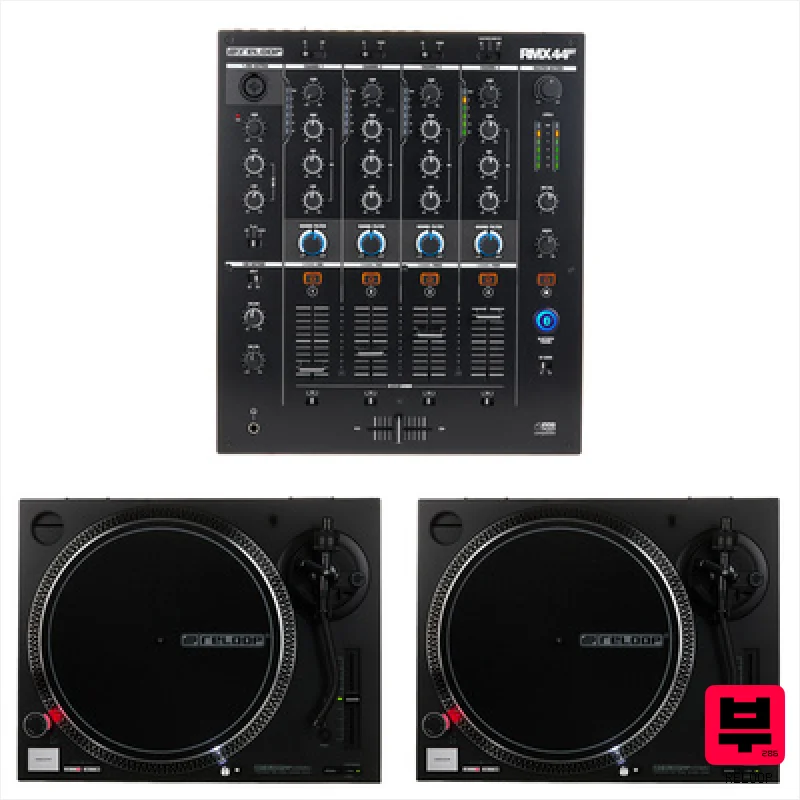
Reloop RMX-44BT 4-Channel DJ Mixer with Bluetooth
RMX-44BT · Reloop
7 for sale on Reverb2 finishes at Thomann
- Weight5.4 kg
The RMX-44BT is a surprisingly capable mixer for the price. It’s a great entry point for DJs looking for a reliable, feature-rich platform with Bluetooth connectivity, or a budget-friendly option for mobile setups where portability and simplicity are key. It's not going to replace a top-tier mixer, but it delivers solid performance for the money.
Pros
- Solid build quality with metal faceplate and robust knobs.
- Innofader compatibility offers a significant upgrade path.
- Flexible EQ and filter options provide creative mixing possibilities.
Cons
- Master output level can be a bit lower than some higher-end mixers.
- Limited USB functionality; primarily for playback, not advanced routing.
68AudioFu
IndexStableno change since Aug 17Aug 17$386 now$386€343 at Thomann · in stockCheck price ↗ -
Reloop RMX-10BT 2-Channel DJ Mixer with Bluetooth
RMX-10BT · Reloop
9 for sale on Reverb1 finish at Thomann
- Weight1.72 kg
The RMX-10BT is a surprisingly capable little mixer, especially for beginners or those needing a basic, Bluetooth-enabled solution. It's perfect for bedroom DJs, mobile events where minimal gear is required, or as a secondary mixer for practice. Don't expect high-end performance, but it delivers a lot for the asking price.
Pros
- Solid 21.5mm pots offer precise control and feel.
- Bluetooth routing provides surprising versatility for mobile setups.
- The included crossfader is surprisingly decent for the price point.
Cons
- EQ is basic – lacks the finesse of higher-end mixers.
- Microphone input is adequate, but lacks headroom for dynamic vocals.
65AudioFu
IndexStableno change since Aug 17Aug 17$145 now$145€129 at Thomann · in stockCheck price ↗ -
Behringer DDM4000 Professional 4-Channel Digital DJ Mixer with Sampler
DDM4000 · Behringer
8 for sale on Reverb3 finishes at Thomann
The DDM4000 is a surprisingly capable mixer for the price, offering a ton of features you'd normally find in much more expensive gear. It's a great option for budget-conscious DJs and producers who want a lot of creative control and built-in effects, especially those experimenting with sampling and looping.
Pros
- Extensive control mapping offers deep customization for complex mixes
- Dual effect processors with tempo sync are genuinely useful and creative
- Four phono/line channels support eight signal sources for flexible setups
Cons
- Plastic construction feels budget-oriented and lacks premium durability
- Digital crossfader may lack the feel of a high-end, motorized unit
65AudioFu
IndexStableno change since Aug 17Aug 17$372 now$372€331 at Thomann · in stockCheck price ↗ -
- Size19"
- Weight5.8 kg
The TRM-422 is a solid rotary mixer offering a unique sonic palette with that isolator. It’s a great choice for DJs focused on blending and creative sound shaping, particularly those who like a more hands-on, analog feel. This is a well-equipped option for club and mobile DJs.
Pros
- ALPS potentiometers offer smooth, reliable feel and reduced wear over time.
- The master isolator provides precise frequency manipulation for dynamic mixing.
- Dedicated mic inputs with EQ expand versatility for live vocal performances.
Cons
- The 3.5mm front aux input feels like an afterthought; RCA would be preferable.
- Limited USB functionality compared to some competitors in the same price bracket.
-
- Weight2.2 kg
The PM-202F is a solid, affordable option for mobile DJs and solo entertainers needing basic mixing functionality with Bluetooth. Don't expect high-end performance, but it's surprisingly capable for its price point and size – a good starter mixer for smaller parties and events where portability is key.
Pros
- Metal housing provides decent durability for mobile DJing scenarios.
- Bluetooth connectivity offers convenient audio streaming for solo entertainers.
- Adjustable crossfader curve allows for customization of mixing style.
Cons
- Limited EQ controls (2-band) restrict tonal shaping flexibility.
- Frequency response suggests a slightly rolled-off high end, lacking sparkle.
57AudioFu
Index↓ 0.7%since Aug 17 · lowest so far$161 · Aug 17$160 now$160€142 at Thomann · in stockCheck price ↗ -
Behringer DJX900USB 5-Channel DJ Mixer USB
DJX900USB · Behringer
5 for sale on Reverb1 finish at Thomann
- Weight3.7 kg
The DJX900USB is a surprisingly capable entry-level mixer. It’s a great option for aspiring DJs or those needing a budget-friendly solution for mobile setups. While it lacks the refinement of more expensive models, the core features are well-implemented and offer a good starting point.
Pros
- Optical Infinium crossfader offers surprisingly smooth and reliable performance
- 3-band kill EQ provides precise tonal shaping for creative mixing
- Integrated USB interface simplifies recording and playback of digital tracks
Cons
- Build quality feels plasticky; lacks the premium feel of higher-end mixers
- Effects are basic and lack depth compared to dedicated processors
57AudioFu
IndexStableno change since Aug 17Aug 17$224 now$224€199 at Thomann · in stockCheck price ↗ -
The RMX-22i is a surprisingly capable mixer for the price. It’s a great option for bedroom DJs or mobile setups needing a compact, feature-rich solution with a decent sound. The digital effects add a lot of potential for creative mixing, and the build, while not luxurious, is perfectly serviceable for regular use.
Pros
- Solid 45mm club-style crossfader offers reliable, adjustable cuts.
- Digital effects are surprisingly usable and creatively flexible.
- Comprehensive input options cater to diverse DJ setups and sources.
Cons
- Plastic build feels budget-oriented; lacks premium robustness.
- Limited effects compared to higher-end digital mixers.
-
Behringer Pro Mixer DX2000USB 7-channel DJ Mixer with USB Interface
DX2000USB · Behringer
4 for sale on Reverb1 finish at Thomann
- Size19"
The DX2000USB is a surprisingly capable mixer for the price, offering a lot of channels and useful features like phantom power. It’s ideal for mobile DJs, bedroom producers, or anyone needing a flexible, budget-friendly mixing solution – just don't expect a high-end studio experience.
Pros
- Seven channels offer flexible routing for complex setups.
- Infinium crossfader provides smoother transitions and better durability.
- Phantom power supports condenser microphones for vocal recording or live performance.
Cons
- Build quality feels plasticky; lacks the premium heft of higher-end mixers.
- EQ controls are basic; lacks the precision of more advanced options.
55AudioFu
IndexStableno change since Aug 17Aug 17$250 now$250€222 at Thomann · in stockCheck price ↗
All 38 DJ mixers
Same index, same nightly prices — compact. Colour options of one model share a row. Tap a photo to zoom.
- 11
Omnitronic TRM-202 MK3Omnitronic · 2 finishes55↓ 4.3%$303€269$303€269Check ↗
- 12
Omnitronic GNOME 202P BlackOmnitronic · 2 finishes53Stable$86€76$86€76Check ↗
- 13
Omnitronic PM-222Omnitronic · 2 finishes53Stable$107€95$107€95Check ↗
- 14
Ecler NUO 2.0Ecler · 2 finishes53↓ 3.9%$449€399$449€399Check ↗
- 15
Reloop RMX-60 DigitalReloop · 2 finishes51Stable$595€529$595€529Check ↗
- 16
Ecler eCompact 4 BTEcler51↑ 3.3%$843€749$843€749Check ↗
- 17
Behringer Pro Mixer DX626 3-Channel DJ MixerDX626 · Behringer50Stable$117€104$117€104Check ↗
- 18
Allen & Heath Xone 24Allen & Heath · 3 finishes50↓ 2.5%$394€350$394€350Check ↗
- 19
Omnitronic TRM-402Omnitronic49↓ 5.0%$426€379$426€379Check ↗
- 20
Omnitronic PM-444PiOmnitronic48↓ 1.5%$224€199$224€199Check ↗
- 21
Omnitronic PM-422POmnitronic47Stable$200€178$200€178Check ↗
- 22
Omnitronic PM-322POmnitronic47Stable$201€179$201€179Check ↗
- 23
Omnitronic PM-404FOmnitronic47Stable$291€259$291€259Check ↗
- 24
Omnitronic CM-5300Omnitronic47Stable$463€411$463€411Check ↗
- 25
Reloop RMX-30 BTReloop45Stable$224€199$224€199Check ↗
- 26
Omnitronic TRM-222Omnitronic45↑ 4.6%$618€549$618€549Check ↗
- 27
Behringer VMX1000 USBBehringer44Stable$198€176$198€176Check ↗
- 28
Numark M4 USB 3-Channel DJ MixerM 4 Black · Numark43Stable$163€145$163€145Check ↗
- 29
Behringer NOX101 2-Channel DJ Mixer VCANOX101 DJ-Mixer · Behringer42Stable$99€88$99€88Check ↗
- 30
the t.mix 201-USB Playthe t.mix42Stable$110€98$110€98Check ↗
- 31
the t.mix 401-USB Playthe t.mix42Stable$111€99$111€99Check ↗
- 32
Fun Generation USB Mix 3Fun Generation41Stable$44€39$44€39Check ↗
- 33
Fun Generation USB Mix 2Fun Generation41Stable$66€59$66€59Check ↗
- 34
DAP-Audio CORE ClubDAP-Audio41Stable$242€215$242€215Check ↗
- 35
DAP-Audio CORE MIX-4 USBDAP-Audio41↓ 0.9%$512€455$512€455Check ↗
- 36
Allen & Heath Xone 24CAllen & Heath39↓ 0.6%$528€469$528€469Check ↗
- 37
Reloop PTB-2Reloop38Stable$280€249$280€249Check ↗
- 38
the t.mix 201-USB Play Bundlethe t.mix30Stable$607€539$607€539Check ↗
DJ Mixers by the numbers
Measured across all 54 models we track, not a sample.
Median $359 — half of all DJ mixers here cost less.
median of 42 models · 1 kg–6 kg
median of 9 models · 10"–19"
How to choose the best DJ mixers
EQ Capabilities
You want more than just basic bass, mid, treble. Look for isolators or semi-parametric EQ for surgical cuts and boosts to really shape your sound and prevent muddiness. The ability to carve out space for the kick drum is crucial.
Faders & Knobs
The feel is EVERYTHING. Cheap plastic faders will feel scratchy and inconsistent, making smooth transitions impossible. Check for motorized faders if you're serious about beatmatching, and make sure the knobs have a solid, responsive feel - no mushiness.
Effects
Built-in effects are a bonus, but don't expect miracles. Reverb and delay are common, but the quality can vary wildly. Consider these as a convenience rather than a replacement for dedicated effects units.
Connectivity
Think about your setup. Do you need multiple phono inputs? Booth outs for monitors? USB for recording or DVS? Don't get caught short because of a missing connection.
Build Quality
This isn't just about aesthetics. A solid build means the mixer will survive the inevitable bumps and scrapes of gigging. Check the chassis material and the overall construction - flimsy plastic is a red flag.
Buying guide
Alright, so you're looking at DJ mixers under a grand. That's a sweet spot - enough to get serious without needing a second mortgage. You're probably tired of those flimsy, plastic feeling mixers that sound like they're filtering your signal through a sock. Let's find you something that'll cut through a live band or handle a late-night club set without falling apart.
At this price point, you're making trade-offs. You won't get the pristine sound of a flagship mixer, but you can find something that performs admirably. Don't be fooled by flashy features; focus on solid EQ, reliable faders, and a build that can handle the road.
A used, slightly older model from a reputable brand can often be a better value than a brand new budget option.
How the AudioFu Index works
Five measured signals and nothing else — no stars from strangers, no “tested by experts” we didn’t do. The weights are fixed and public. We don’t play these instruments; we measure the market around them.
This chart covers 54 DJ mixers from the Thomann catalogue. Before you buy, read hands-on reviews and, where you can, play it. Full methodology.
AudioFu earns a commission when you buy through our Thomann links. It never changes the order — the index does.
- Demand40%
How many of this exact model are for sale on Reverb right now — what musicians actually buy and resell.
- Lineup20%
How many finishes Thomann stocks — makers expand the models that sell.
- Price15%
Where the price has moved since we started tracking in August.
- Specs15%
How completely the maker documents it.
- Maker10%
How deep the brand’s range is in this category.
Questions
What's the deal with motorized faders? Do I really need them?
Motorized faders automatically adjust the fader position to match the beat, simplifying beatmatching. They're great for beginners or those who prefer a more automated workflow, but experienced DJs often prefer manual control for more nuanced mixing.
Can I record mixes with these mixers?
Most mixers in this range have USB connectivity for recording, but the quality of the audio interface built-in varies. Don't expect studio-grade recordings - it's fine for demoing or podcasting, but consider an external audio interface for critical recordings.
What does 'DVS' mean and do I need it?
DVS (Digital Vinyl System) lets you control digital music files like vinyl records using turntables and a mixer. You'll need DVS-compatible software and hardware (usually timecode vinyl or a control disc). It's a more advanced setup, but offers a lot of flexibility.
Are used mixers a good option?
Absolutely! You can often find excellent deals on used mixers from reputable brands. Just be sure to inspect the faders and knobs for wear and tear before you buy.
What's the difference between a 'club mixer' and a 'battle mixer'?
Generally, club mixers prioritize smooth transitions and a clean sound, while battle mixers focus on quick cuts and effects. Both can be used in various settings, but consider your preferred style when choosing.