AudioFu Chart · October 2026
Best DJ Mixers for Professional 2026
The top pick is Union Audio elara.6 Performance-Mixer ($3,825). Ecler WARM2 Two-Channel Analogue Rotary Mixer gives you the most for the money at $715. Ranked by the AudioFu Index from 53 models across 11 brands, prices checked every night.
Last updated: October 19, 2026
Top 10
Full detail for the 10 highest AudioFu Index scores. Every other model is listed below.
-
- Weight5.3 kg
This mixer handles both vinyl and CD decks with its dual phono inputs. The semi-parametric EQ on mic channels makes it great for live vocals. It fits well in a club where you need solid blending and dynamic side-chain control.
Pros
- Dual phono and line inputs per channel
- Semi-parametric EQ on mic and stereo returns
- Adjustable Innofader curve for smooth blending
Cons
- No USB audio interface capability
- Limited to RCA line inputs only
43AudioFu
IndexStableno change since Oct 2Oct 2$3,825 now$3,825€3,399 at Thomann · in stockCheck price ↗ -
- Weight4.75 kg
This mixer sounds like a big tube amp in a rack. The four tube valves per channel give a warm, analog feel that many purists love. It has great faders and three EQ bands, but it is heavy and lacks USB or digital effects. It suits DJs who want pure analog warmth without extra features.
Pros
- Four dedicated tube valves per channel for warm sound
- Alps rotary fader and Innofader crossfader for smooth control
- Three-band EQ on every channel plus master crossover
Cons
- Heavy weight makes transport difficult for gigging
- No USB input or digital effects available
43AudioFu
IndexStableno change since Oct 2Oct 2$2,925 now$2,925€2,599 at Thomann · in stockCheck price ↗ -
Allen & Heath XONE:96 Professional 6+2-Channel DJ Mixer
Xone 96 · Allen & Heath
17 for sale on Reverb3 finishes at Thomann
- Weight7 kg
The Xone 96 is a serious piece of kit for discerning DJs who prioritize analog warmth and tactile control. It's built like a tank and delivers exceptional audio quality, perfect for club environments or serious home setups where sonic fidelity is paramount. While not as feature-rich as some newer models, its core functionality is top-notch and delivers a classic DJing experience.
Pros
- Robust build quality with a solid, weighty chassis.
- Exceptional sound clarity thanks to the 32-bit converters.
- The InnoFader crossfader offers precise, customizable performance.
Cons
- The substantial weight makes transport a real consideration.
- Limited routing options compared to more modern mixers.
83AudioFu
Index↑ 1.6%since Aug 17$1,991 · Aug 17$2,023 now$2,023€1,798 at Thomann · in stockCheck price ↗ -
- Weight4.2 kg
This mixer handles both mics and records well with built-in phantom power and clean filters. It has great analog tools like four-band EQ but lacks USB or digital effects. It works best for live gigs where you need reliable XLR outputs and a solid crossfader.
Pros
- Built-in phantom power feeds microphones directly
- Four-band EQ shapes channel tones precisely
- LED meters show signal levels clearly
Cons
- No USB connectivity for digital audio
- No dedicated effects unit built in
42AudioFu
IndexStableno change since Aug 17Aug 17$2,531 now$2,531€2,249 at Thomann · in stockCheck price ↗ -
- Weight8.2 kg
This mixer packs a lot of inputs for live gigs, including seven mics and four phono jacks. It lets you shape sound with filters and a compressor on each channel. While it has a crossfader, moving this heavy unit around will be tough. It works well for DJs who need both vinyl and mic control.
Pros
- Seven dedicated microphone channels for vocal setups
- Four built-in phono inputs for vinyl collectors
- Individual high-pass and low-pass filters per channel
Cons
- Only one USB input available for audio recording
- Heavy at 8.2 kg making it hard to move
42AudioFu
IndexStableno change since Aug 17Aug 17$2,361 now$2,361€2,098 at Thomann · in stockCheck price ↗ -
- Weight3.5 kg
This mixer uses real valves to warm up your tracks without adding digital clutter. It feels solid with its rotary faders and built-in phono stage. It is best for DJs who want pure analogue sound without needing USB or effects.
Pros
- Fully analogue signal path for pure warmth
- Precision tuned valve circuitry per channel
- Integrated phono preamp in each channel
Cons
- Valves add significant weight to the unit
- No USB or digital connectivity options
43AudioFu
IndexStableno change since Oct 2Oct 2$2,137 now$2,137€1,899 at Thomann · in stockCheck price ↗ -
The FF-4000 is a serious workhorse mixer built for DJs who prioritize clean sound and reliable performance over bells and whistles. It’s a premium-priced option best suited for club residencies, mobile DJs, and anyone needing robust build and solid routing capabilities – not so much for those needing built-in effects or USB integration.
Pros
- Solid build quality with robust metal faders and knobs
- Clean, powerful output with low noise floor on XLR
- Flexible routing options with sub-out for club installs
Cons
- Crossfader feels a little stiff; could benefit from a smoother curve
- Limited effects processing compared to more modern mixers
34AudioFu
IndexStableno change since Aug 17Aug 17$1,912 now$1,912€1,699 at Thomann · in stockCheck price ↗ -
- Weight4.54 kg
This mixer has six channels and a fancy crossfader that lets you tweak the sound curve. It works great with vinyl thanks to its new phono preamps and clean mic inputs. The sturdy case protects it well, but it lacks USB options. It fits anyone who wants a solid, reliable mixer for live shows.
Pros
- Six stereo channels work together smoothly for big mixes.
- Revised phono preamps handle vinyl records with real clarity.
- Clean feed mic inputs let singers hear themselves clearly.
Cons
- Thomann foam inlay case is a simple protective shell.
- No USB audio interface features are listed in the text.
34AudioFu
IndexStableno change since Aug 17Aug 17$1,626 now$1,626€1,445 at Thomann · in stockCheck price ↗ -
- Weight3.6 kg
The Warm2 is a beautifully built, no-frills rotary mixer perfect for DJs focused on classic house, disco, or soulful sounds. The Alps pots are a real treat, and the EQ gives you excellent control—it's a solid choice if you appreciate a vintage feel and a direct connection to your music.
Pros
- Alps Blue Velvet pots offer exceptional feel and longevity.
- Wooden side panels add a touch of class and dampen vibrations.
- 3-band EQ per channel provides precise tonal shaping capabilities.
Cons
- Limited effects options compared to modern, feature-rich mixers.
- Rotary mixers have a learning curve for those used to fader-based mixing.
75AudioFu
IndexStableno change since Aug 17Aug 17$715 now$715€635 at Thomann · in stockCheck price ↗ -
Ecler WARM4 Four-Channel Analogue Rotary Mixer
Warm4 · Ecler
11 for sale on Reverb2 finishes at Thomann
- Weight5.3 kg
The Warm4 is a seriously cool mixer, especially if you’re into a more analog, hands-on vibe. That subharmonic generator is a real signature feature, giving your basslines some serious girth. It’s perfect for DJs who want a quality, characterful mixer without going full-on digital – think house, techno, and anything that benefits from a little extra warmth.
Pros
- Solid build quality with Alps potentiometers and metal shafts.
- Unique subharmonic synthesizer adds a distinct low-end texture.
- Isolator EQ provides precise frequency sculpting capabilities.
Cons
- Limited USB connectivity; lacks advanced digital routing options.
- Price places it in the premium-priced mixer category.
73AudioFu
IndexStableno change since Aug 17Aug 17$1,417 now$1,417€1,259 at Thomann · in stockCheck price ↗
All 53 DJ mixers
Same index, same nightly prices — compact. Colour options of one model share a row. Tap a photo to zoom.
- 11
Allen & Heath XONE:43 4+1 Channel DJ Scratch MixerXone 43 · Allen & Heath · 2 finishes72Stable$697€619$697€619Check ↗
- 12
Reloop Elite DJ MixerELITE · Reloop72↓ 5.1%$1,372€1,219$1,372€1,219Check ↗
- 13
Allen & Heath XONE:PX5 4+1 Channel DJ MixerXone:PX5 · Allen & Heath72Stable$1,404€1,248$1,404€1,248Check ↗
- 14
Reloop RMX-95 4+1 Channel Digital Club MixerRMX-95 · Reloop · 2 finishes71Stable$1,068€949$1,068€949Check ↗
- 15
Omnitronic TRM-422Omnitronic · 2 finishes60Stable$674€599$674€599Check ↗
- 16
Ecler NUO 4.0 F SilverEcler · 2 finishes54↓ 6.4%$1,011€898$1,011€898Check ↗
- 17
Ecler eCompact 4 BTEcler51↑ 3.3%$843€749$843€749Check ↗
- 18
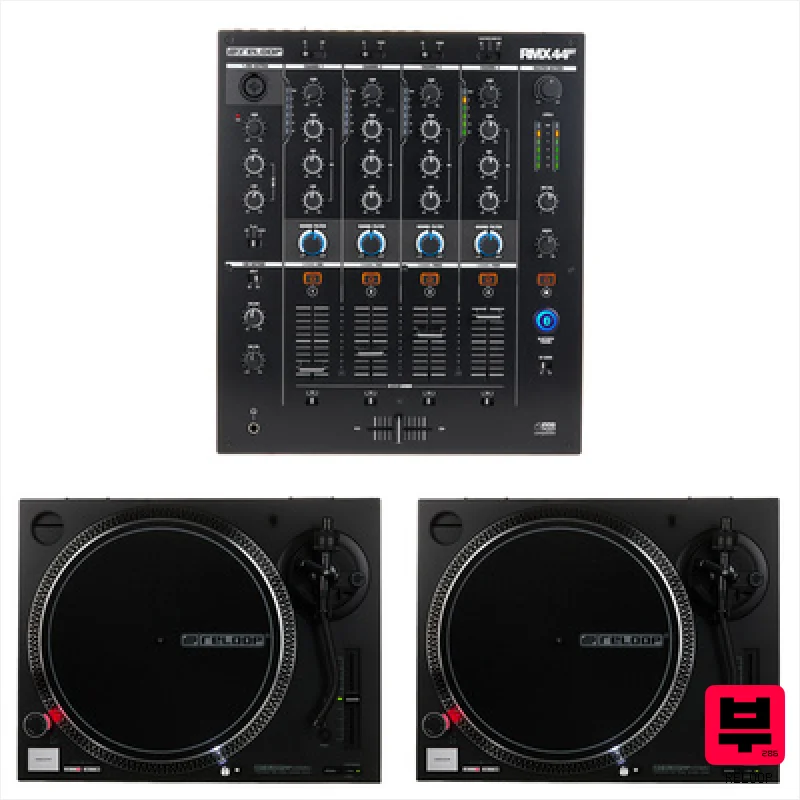
Reloop RMX-44BT 4-Channel DJ Mixer with BluetoothRMX-44BT · Reloop · 2 finishes68Stable$386€343$386€343Check ↗
- 19
Reloop RMX-60 DigitalReloop · 2 finishes51Stable$595€529$595€529Check ↗
- 20
Behringer DDM4000 Professional 4-Channel Digital DJ Mixer with SamplerDDM4000 · Behringer · 3 finishes65Stable$372€331$372€331Check ↗
- 21
Union Audio orbit.2 LE Rotary MixerUnion Audio43Stable$1,124€999$1,124€999Check ↗
- 22
Union Audio orbit.2 LE fx Rotary MixerUnion Audio43Stable$1,237€1,099$1,237€1,099Check ↗
- 23
Omnitronic TRM-222Omnitronic45↑ 4.6%$618€549$618€549Check ↗
- 24
Ecler NUO 2.0Ecler · 2 finishes53↓ 3.9%$449€399$449€399Check ↗
- 25
Reloop RMX-22i 2-Channel MIDI MixerRMX-22i · Reloop56↑ 7.0%$359€319$359€319Check ↗
- 26
Omnitronic CM-5300Omnitronic47Stable$463€411$463€411Check ↗
- 27
Omnitronic TRM-402Omnitronic49↓ 5.0%$426€379$426€379Check ↗
- 28
Allen & Heath Xone 24Allen & Heath · 3 finishes50↓ 2.5%$394€350$394€350Check ↗
- 29
Omnitronic TRM-202 MK3Omnitronic · 2 finishes55↓ 4.3%$303€269$303€269Check ↗
- 30
DAP-Audio CORE MIX-4 USBDAP-Audio41↓ 0.9%$512€455$512€455Check ↗
- 31
Allen & Heath Xone 24CAllen & Heath39↓ 0.6%$528€469$528€469Check ↗
- 32
Behringer DJX900USB 5-Channel DJ Mixer USBDJX900USB · Behringer57Stable$224€199$224€199Check ↗
- 33
Behringer Pro Mixer DX2000USB 7-channel DJ Mixer with USB InterfaceDX2000USB · Behringer55Stable$250€222$250€222Check ↗
- 34
the t.mix 201-USB Play Bundlethe t.mix30Stable$607€539$607€539Check ↗
- 35
Omnitronic PM-404FOmnitronic47Stable$291€259$291€259Check ↗
- 36
Omnitronic PM-444PiOmnitronic48↓ 1.5%$224€199$224€199Check ↗
- 37
Omnitronic PM-322POmnitronic47Stable$201€179$201€179Check ↗
- 38
Reloop RMX-30 BTReloop45Stable$224€199$224€199Check ↗
- 39
DAP-Audio CORE ClubDAP-Audio41Stable$242€215$242€215Check ↗
- 40
Reloop PTB-2Reloop38Stable$280€249$280€249Check ↗
- 41
Reloop RMX-10BT 2-Channel DJ Mixer with BluetoothRMX-10BT · Reloop65Stable$145€129$145€129Check ↗
- 42
Omnitronic PM-202FOmnitronic · 3 finishes57↓ 0.7%$160€142$160€142Check ↗
- 43
Omnitronic GNOME 202P BlackOmnitronic · 2 finishes53Stable$86€76$86€76Check ↗
- 44
Omnitronic PM-222Omnitronic · 2 finishes53Stable$107€95$107€95Check ↗
- 45
Behringer Pro Mixer DX626 3-Channel DJ MixerDX626 · Behringer50Stable$117€104$117€104Check ↗
- 46
Omnitronic PM-422POmnitronic47Stable$200€178$200€178Check ↗
- 47
Behringer VMX1000 USBBehringer44Stable$198€176$198€176Check ↗
- 48
Numark M4 USB 3-Channel DJ MixerM 4 Black · Numark43Stable$163€145$163€145Check ↗
- 49
Behringer NOX101 2-Channel DJ Mixer VCANOX101 DJ-Mixer · Behringer42Stable$99€88$99€88Check ↗
- 50
the t.mix 201-USB Playthe t.mix42Stable$110€98$110€98Check ↗
DJ Mixers by the numbers
Measured across all 76 models we track, not a sample.
Median $512 — half of all DJ mixers here cost less.
median of 62 models · 1 kg–7 kg
median of 11 models · 10"–19"
How to choose the best DJ mixers
EQ Flexibility
Professional DJs need surgical EQ control. We're talking about more than just basic bass, mid, and treble; you need the ability to carve out space for vocals, tame harsh frequencies, and really sculpt the overall tonal balance - especially when layering tracks with differing sonic signatures.
Fader Precision & Durability
These aren't toys. You're going to be riding those faders for hours, often pushing them to their limits. A scratchy, imprecise fader will kill your flow and a flimsy one will fail you onstage - and that's a career killer. We're looking for smooth, consistent action and a build quality that can withstand the abuse.
Effects & Routing Complexity
Beyond basic effects, a professional mixer should offer flexible routing options for external effects units, cueing chains, and complex looping setups. The ability to integrate your own processing is crucial for creating a truly unique sound and adapting to different performance scenarios.
Cueing Capabilities
Accurate, low-latency cueing is absolutely paramount. You need to be able to hear subtle differences between tracks, beatmatch with precision, and monitor effects without audible artifacts. Poor cueing can make even the simplest transitions sound sloppy.
Build Quality & Reliability
This is the big one. Professional gear needs to survive the road, the sweat, and the occasional spilled drink. A mixer built from cheap plastics and questionable components will fail you when you need it most. Look for robust construction, quality connectors, and a reputation for reliability.
Buying guide
Alright, so you're not messing around anymore. You're not just throwing on a playlist and pressing play - you're crafting mixes, building energy, and shaping the vibe. You need a DJ mixer that can handle the complexity, the subtle nuances, and the sheer demands of a professional gig. This isn't about flashy lights; it's about reliable performance, intuitive playability, and a sound that won't embarrass you in front of a discerning crowd.
Don't fall for the hype. A lot of mixers look impressive on paper, but the devil's in the details. That 'extended EQ range' might just introduce unwanted noise.
That 'premium finish' might be a thin veneer over cheap components. Pay attention to the feel - does it inspire confidence? Does it allow you to express your musicality?
And be prepared to spend some money; compromises here are rarely worth it.
How the AudioFu Index works
Five measured signals and nothing else — no stars from strangers, no “tested by experts” we didn’t do. The weights are fixed and public. We don’t play these instruments; we measure the market around them.
This chart covers 76 DJ mixers from the Thomann catalogue. Before you buy, read hands-on reviews and, where you can, play it. Full methodology.
AudioFu earns a commission when you buy through our Thomann links. It never changes the order — the index does.
- Demand40%
How many of this exact model are for sale on Reverb right now — what musicians actually buy and resell.
- Lineup20%
How many finishes Thomann stocks — makers expand the models that sell.
- Price15%
Where the price has moved since we started tracking in August.
- Specs15%
How completely the maker documents it.
- Maker10%
How deep the brand’s range is in this category.
Questions
What's the deal with motorized vs. manual jog wheels?
Motorized wheels offer consistent speed and a more tactile feel for scratching, but they add complexity and potential for mechanical failure. Manual wheels are simpler and more reliable, but require more skill to beatmatch accurately. It's a personal preference, but for consistent performance, motorized is often the safer bet.
How important is headroom?
Headroom is critical. It's the amount of clean signal you can process before distortion creeps in. Low headroom means your mix will sound muddy and compressed, especially when layering multiple tracks with heavy effects. Aim for at least 96dB, ideally more.
Are digital mixers 'better' than analog mixers?
It's not about 'better,' it's about workflow. Digital mixers offer more features and flexibility, but analog mixers often have a more immediate, 'hands-on' feel. Many pros use hybrid setups, combining the best of both worlds.
What about MIDI connectivity?
MIDI connectivity allows you to control your mixer with external controllers and integrate it into a larger digital audio workstation (DAW) setup. It's a huge advantage for complex productions and live looping.
My budget is tight, where can I cut corners?
Don't compromise on fader quality or cueing capabilities. Those are fundamental to your performance. You can save money on flashy effects or unnecessary routing options, but the core functionality needs to be rock solid.