
Best Wireless Conference Systems for Educational Facilities 2026
Alright, so you're setting up a lecture hall, a debate team space, or a classroom where clear communication is absolutely critical? Forget those consumer-grade wireless mics you'd use for karaoke; we're talking about conference systems designed for intelligibility, reliability, and minimal feedback - stuff that actually holds up under pressure. A muddy, indistinct signal is a killer for learning, and nobody wants to fight with a system that's dropping out or feeding back. Let's break down what to look for in a wireless conference system for educational facilities.
Last updated: July 8, 2026 • Next update: July 15, 2026
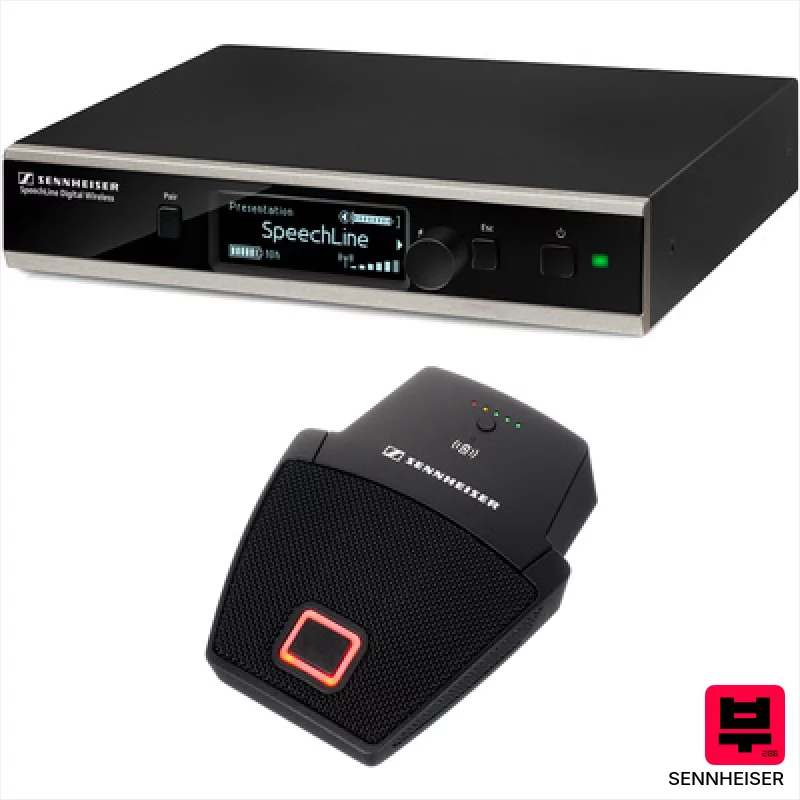
Sennheiser SL 114-S Wireless Bundle
- • Excellent boundary mic for clear table pickup, minimizing room noise.
- • Robust DW-3B construction feels very solid, professional grade.
- • Programmable micro switch adds significant flexibility in use cases.
- • Qi wireless charging is a convenient, modern touch.
- • 1.9 GHz band can be susceptible to interference in crowded RF environments.
- • Receiver size (9.5") might be restrictive for some mobile setups.
- • Boundary design limits placement options; not ideal for handheld use.
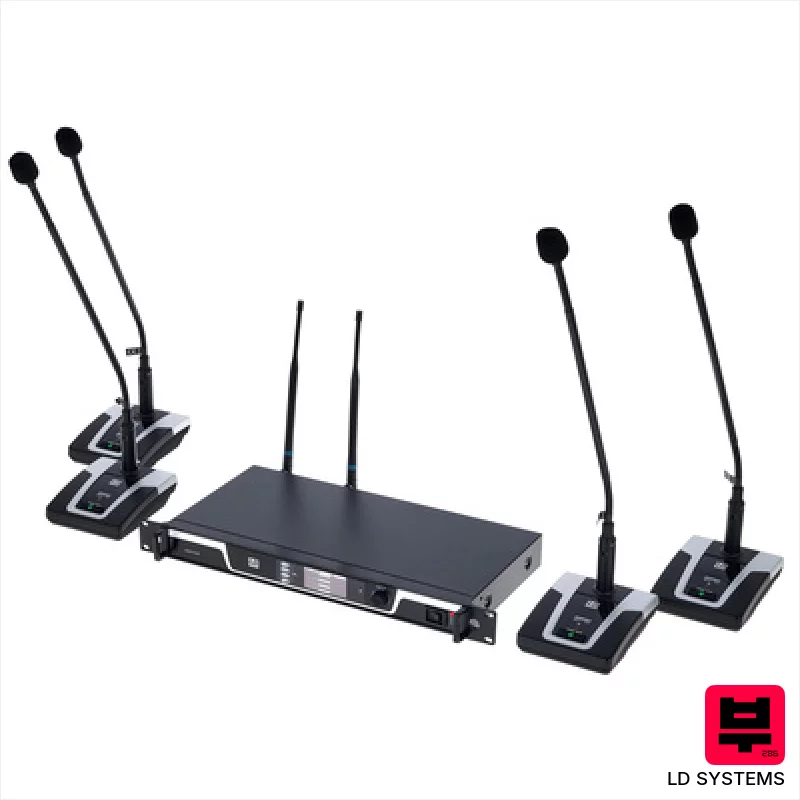
LD Systems U506 CS 4
- • Solid build quality with a robust metal chassis and stable table bases.
- • Infrared frequency synchronization is genuinely reliable and fast.
- • Gooseneck mics offer good positioning flexibility for presenters.
- • Balanced XLR outputs provide clean, professional audio signal.
- • The system's size and weight make it less portable for frequent moves.
- • Limited frequency band allocation may pose issues in densely populated RF areas.
- • Microphone unit battery life could be better, especially for extended meetings.
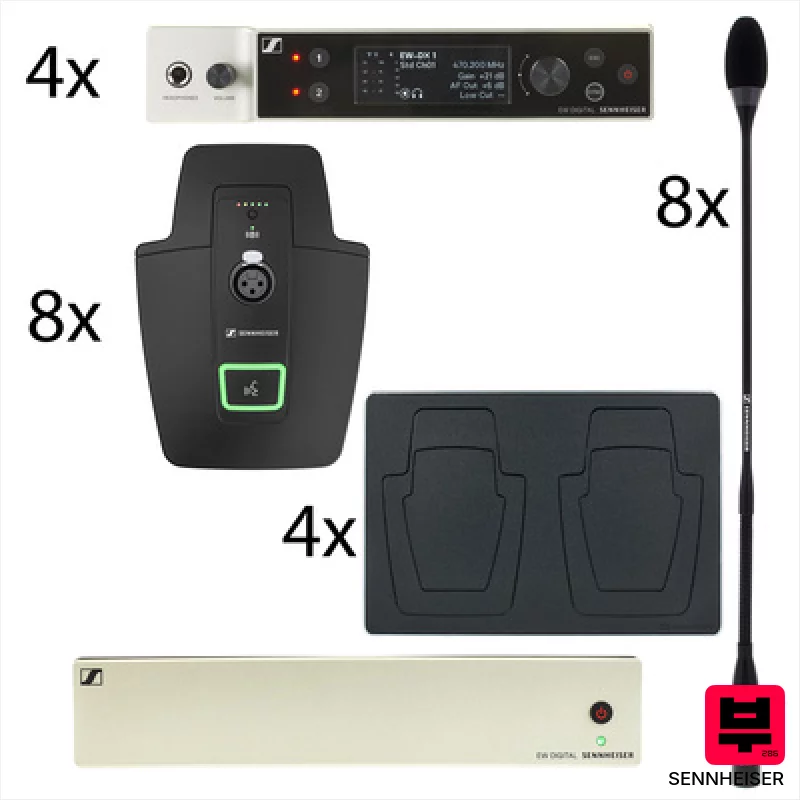
Sennheiser EW-DX 8CH Conference Set Q1-9
- • Rock-solid build quality with robust metal receiver chassis.
- • AES 256 encryption ensures exceptionally secure, private communications.
- • Dual-channel receiver minimizes interference and provides excellent reliability.
- • Table stands offer stable, adjustable mic placement for clear audio capture.
- • Premium-priced, represents a significant investment for most users.
- • Receiver size (212x44x189mm) can be cumbersome in smaller spaces.
- • Limited frequency band flexibility compared to broader wireless systems.
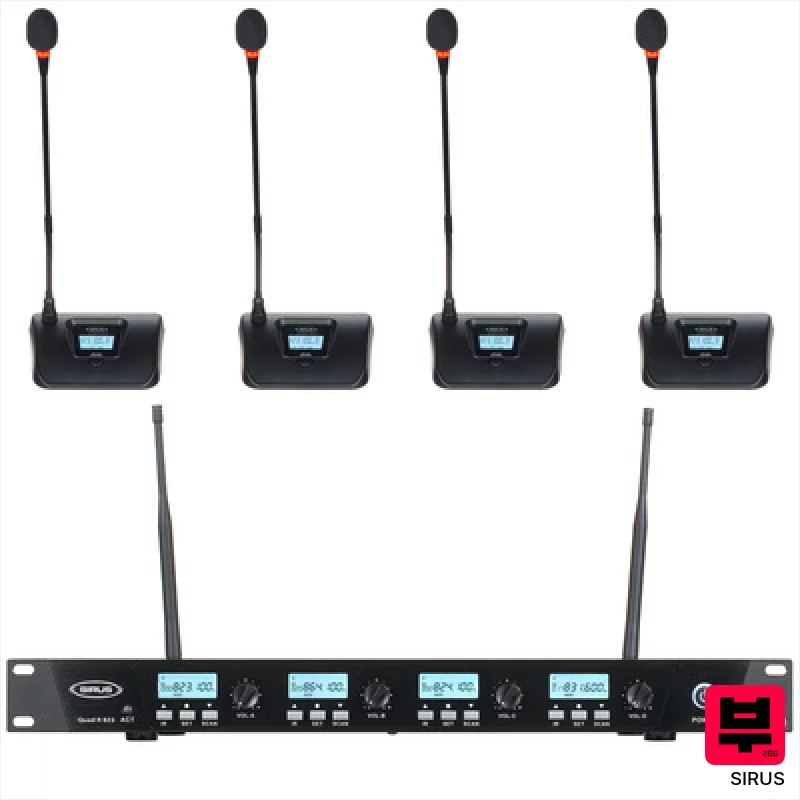
Sirus Quad R + 4C 823 Bundle
- • Rackmount design saves space, ideal for permanent conference room installations.
- • Infrared transmission simplifies channel syncing, reducing setup headaches.
- • Excellent signal-to-noise ratio ensures clear audio even in noisy environments.
- • UHF frequency range minimizes interference compared to FM systems.
- • Limited frequency range necessitates careful frequency coordination in dense RF areas.
- • External power supply adds another cable and potential point of failure.
- • Handheld and pocket transmitters sold separately, increasing overall investment.

Sennheiser EW-DX 4CH Conference Set Q1-9
- • Rock-solid build quality; feels like it'll survive a tour bus.
- • Dante connectivity offers seamless integration into professional networks.
- • AES 256 encryption provides excellent security for sensitive meetings.
- • Table stands offer stable, flexible mic positioning for presenters.
- • The receiver's weight (4.6 kg) makes rack mounting essential, not portable.
- • Premium-priced, representing a significant investment for smaller organizations.
- • Gooseneck microphones are not included, adding to the overall cost.
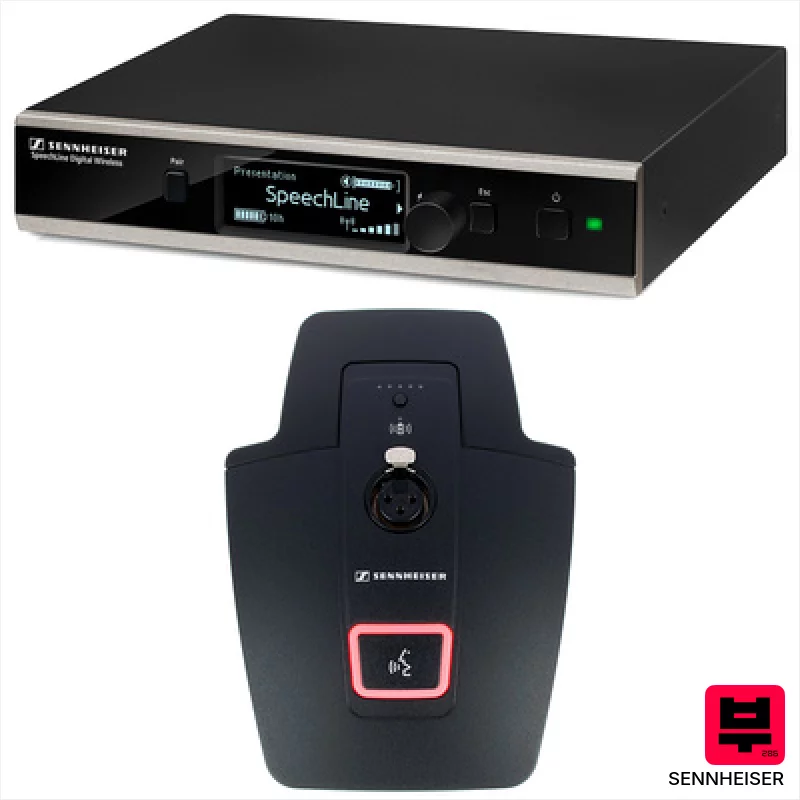
Sennheiser SL Tablestand & Receiver Set
- • Solid build quality; metal tripod feels substantial and stable.
- • 1.9 GHz digital transmission minimizes interference common in crowded RF spaces.
- • Sennheiser Cockpit Control offers granular remote monitoring and configuration.
- • Qi wireless charging adds convenience; battery life is genuinely impressive.
- • CHG2W charging base is a frustratingly separate purchase.
- • Limited frequency range restricts flexibility for complex multi-mic setups.
- • The 1.9 GHz band might have licensing/regulatory hurdles in some regions.
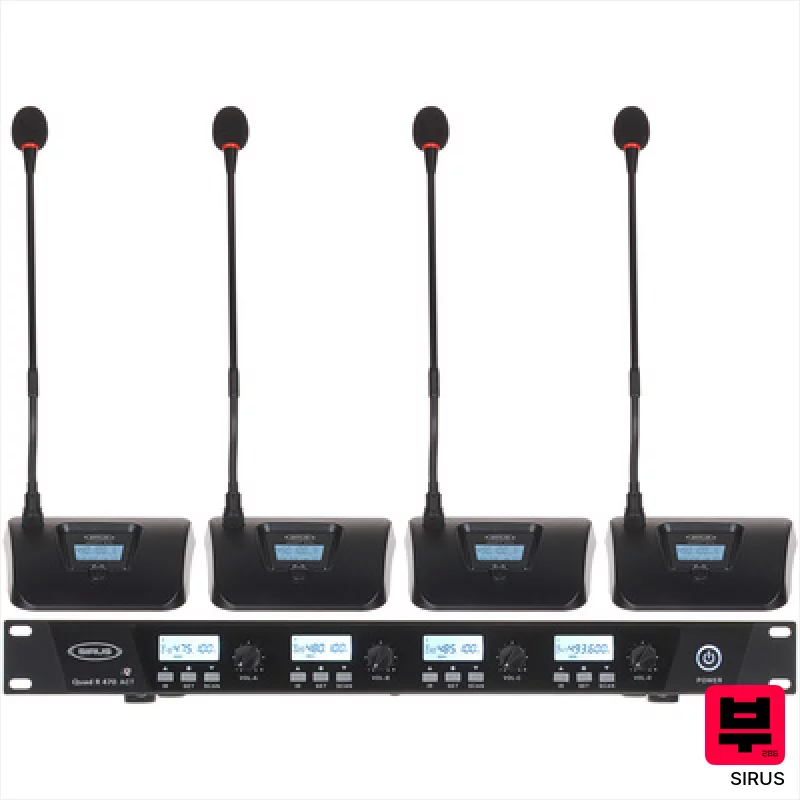
Sirus Quad R + 4C 470 Bundle
- • Excellent frequency scan simplifies setup for multi-mic environments.
- • IR transmission streamlines channel configuration across multiple transmitters.
- • Robust 1U rackmount design ensures stability in professional installations.
- • High signal-to-noise ratio minimizes background noise for clear audio.
- • 470-526 MHz band can be congested in some areas, limiting channel availability.
- • Power supply is external, adding to cable clutter and potential failure point.
- • Limited frequency range (40Hz-18kHz) may lack some high-end clarity for critical applications.

Sennheiser EW-DX 4CH Conference Set R1-9
- • Rock-solid build quality with robust metal chassis for demanding environments.
- • Dante connectivity offers seamless integration into existing digital audio networks.
- • AES 256 encryption ensures secure and private conference communications.
- • Excellent RF performance minimizes dropouts, even in crowded wireless spaces.
- • Significant investment; this is a premium-priced system for professional use.
- • Weight (approx. 2kg for the receiver) necessitates a dedicated rack space or sturdy placement.
- • Limited frequency band compared to broader UHF systems might restrict channel availability.
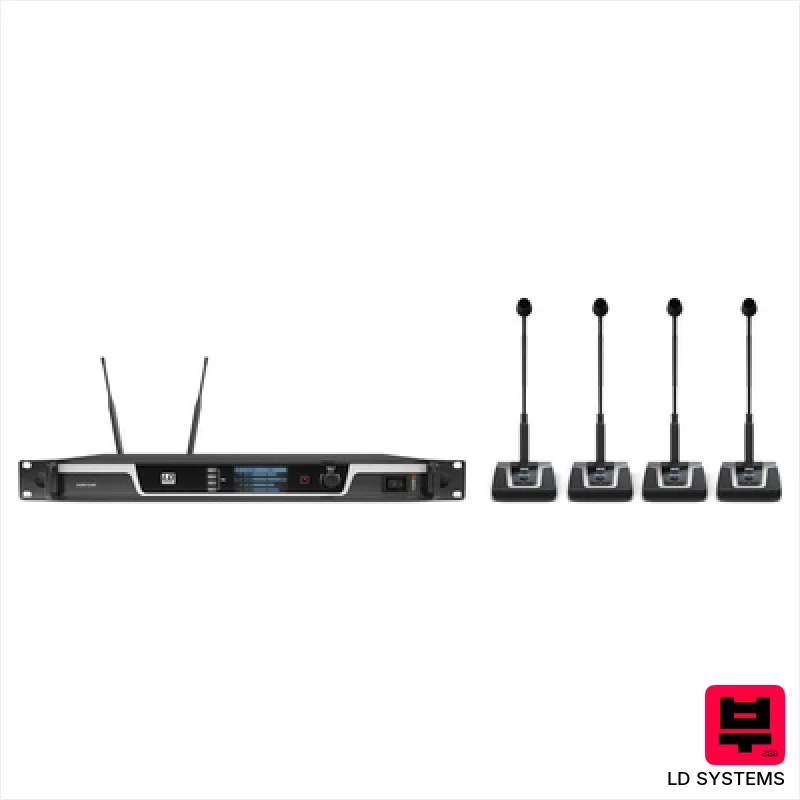
LD Systems U508 CS 4
- • Excellent true diversity UHF reception minimizes interference
- • Gooseneck mics offer stable positioning and reduced handling noise
- • Integrated inMix XLR output simplifies routing to mixers or recorders
- • OLED display provides clear, at-a-glance system status information
- • The base unit's weight makes it less portable for frequent relocation
- • Limited frequency range compared to some higher-end conference systems
- • AA batteries can become a recurring expense; consider rechargeable options

Sennheiser EW-DX 4CH Conference Set U1/5
- • Rock-solid build quality; the receiver feels substantial and well-engineered.
- • Dante connectivity offers seamless integration with modern AV infrastructure.
- • AES 256 encryption provides a high level of security for sensitive discussions.
- • Gooseneck microphone compatibility allows for flexible placement and optimal pickup.
- • The substantial weight of the receiver (approx. 2kg) requires careful rack mounting.
- • Limited frequency band allocation can pose challenges in congested RF environments.
- • High-end price point makes it a significant investment for smaller organizations.
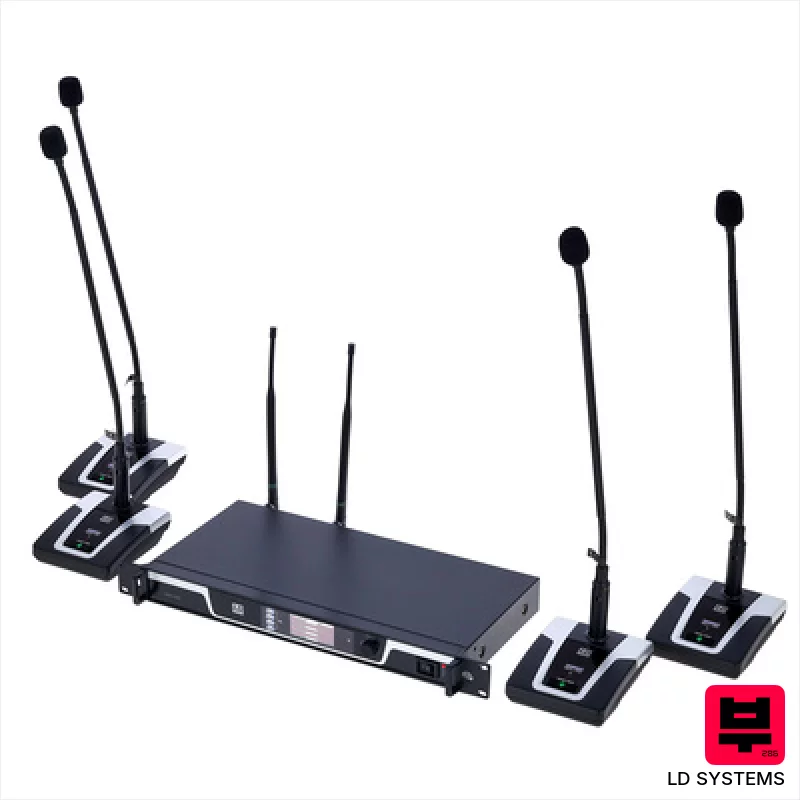
LD Systems U505 CS 4
- • Solid build quality with a professional, understated aesthetic
- • OLED display offers clear, at-a-glance system status
- • BNC antenna connectors allow for upgraded external antennas
- • 6 groups of 106 channels offer flexibility in congested RF environments
- • The system's weight (6kg) makes transport and setup cumbersome
- • 554-586 MHz band can be restrictive depending on location
- • Limited frequency range may require careful channel selection
How to Choose the Best Wireless Conference Systems
Frequency Response & Articulation
A flat, extended frequency response is key, but it's not just about having it. You need clear articulation - consonants need to be crisp, not smeared together. A system with a hyped, overly bright top end will fatigue listeners quickly; we're looking for a natural, present sound, avoiding that ice-pick harshness. Think 'present and clear' not 'aggressive and fatiguing'.
Feedback Rejection
This is the big one. Lecture halls are notorious for feedback loops. The system needs robust feedback suppression algorithms and directional microphones to minimize the chances of that screeching, ear-splitting chaos. We've been there, trust me; nothing kills a presentation faster than a runaway feedback loop.
Microphone Coverage & Channel Count
Consider the size of the space and the number of participants. More channels mean more flexibility to place mics where they're needed without interference. A system with only two channels might work for a small seminar, but a large lecture hall will need at least four, ideally more.
Dynamic Range & Headroom
You don't need massive dynamic range for spoken word, but you do need enough headroom to handle unexpected volume spikes - a sudden outburst from a student, for example. Clipping and distortion are unacceptable in a learning environment; it's distracting and unprofessional.
Build Quality & Durability
Let's be honest, these systems are going to get banged around. Robust construction and reliable components are essential. We're looking for something that can withstand daily use and occasional abuse without falling apart after a year. Cheap plastic housings and flimsy connectors are a red flag.
Buying Guide
Don't get seduced by flashy features you won't use. A simpler system, well-implemented, will always outperform a complex one that's poorly executed. Pay attention to the microphone capsules - a decent condenser mic will usually offer better clarity than a cheap dynamic, but make sure the system can handle the sensitivity. And seriously, test the system's range before you commit; a system that claims 300 feet might only get 100 in a room full of reflective surfaces.
Our Methodology
We don't just look at spec sheets here. We've spent countless hours running these systems in simulated classroom and lecture environments - testing for clarity, range, and feedback rejection. We A/B compared different systems against each other, listening critically for tonal qualities and ease of use, and paying close attention to how they handle multiple microphones in a single space, which is pretty much a given in most educational settings. It's about real-world performance, not theoretical numbers.

