AudioFu Chart · October 2026
Best Stage Pianos Under $500 2026
The top pick is Roland FP-10 88-Key Digital Portable Piano ($448). Thomann SP-120 gives you the most for the money at $179. Ranked by the AudioFu Index from 8 models across 5 brands, prices checked every night.
Last updated: October 19, 2026
Top 8
Full detail for the 8 highest AudioFu Index scores. Every other model is listed below.
-
- Weight12.3 kg
- Keys88 keys
- Key actionWeighted keys
The FP-10 is a solid entry-level stage piano, perfect for beginners or players needing a compact, portable option. While the sounds aren’t going to blow you away, the PHA-4 action is surprisingly good for the price, offering a playable and expressive experience. It's a great way to get started without a huge investment.
Pros
- PHA-4 action provides a surprisingly realistic, responsive key feel
- SuperNATURAL piano sounds offer a decent, usable tonal palette
- Compact design makes it ideal for smaller spaces and portability
Cons
- Speakers are underpowered; headphone use highly recommended for serious practice
- Limited sound selection compared to more expensive stage pianos
83AudioFu
IndexStableno change since Aug 17Aug 17$448 now$448€398 at Thomann · in stockCheck price ↗ -
- Weight11.5 kg
- Key actionWeighted keys
The P-45B is a solid entry-level stage piano – a great starting point for beginners or those needing a compact, budget-friendly option. The key action is surprisingly good for the price, but don’t expect a concert grand experience. It's perfect for students, casual players, or anyone needing a portable piano for practice or basic performances.
Pros
- Graded Hammer Standard action provides surprisingly realistic piano feel
- Compact and lightweight for portability, ideal for students or small spaces
- Built-in speakers are adequate for practice and casual playing
Cons
- The GHS action lacks the nuance and depth of higher-end weighted actions
- Limited sound palette; ten tones feel restrictive for serious players
81AudioFu
IndexStableno change since Aug 17Aug 17$370 now$370€329 at Thomann · in stockCheck price ↗ -
- Weight11.4 kg
- Keys88 keys
- Key actionWeighted keys
The B2+ is a solid entry point into the world of stage pianos, especially for students or those needing portability. The piano sounds are surprisingly good for the price, though the action won't fool a seasoned pianist. It's a great practice tool and a workable gigging option for smaller venues.
Pros
- Excellent value for an 88-key stage piano.
- Italian/German grand piano samples offer surprising realism.
- Lightweight and portable for gigging musicians.
Cons
- Key action lacks the nuance of higher-end weighted actions.
- Limited sound selection compared to more expensive stage pianos.
78AudioFu
Index↓ 6.8%since Aug 17 · lowest so far$494 · Aug 17$460 now$460€409 at Thomann · in stockCheck price ↗ -
- Weight11.1 kg
The P-145 B BT is a solid choice for students and casual players needing a portable, realistic piano experience. Its GHC action and CFIIIS sound engine are genuinely impressive for its class, making it a great value for practice and home use – just don't expect it to replace a full-sized stage piano for serious gigs.
Pros
- Excellent GHC action provides a surprisingly realistic piano feel.
- CFIIIS sound engine delivers a warm, authentic grand piano tone.
- Compact size and lightweight design enhance portability significantly.
Cons
- Built-in speakers are adequate but lack dynamic range for performance.
- Limited effects offer less sonic shaping than higher-end stage pianos.
68AudioFu
IndexStableno change since Aug 17Aug 17$444 now$444€395 at Thomann · in stockCheck price ↗ -
- Weight6 kg
The Korg Liano is a remarkably portable and affordable entry point into the world of stage pianos. It's a solid choice for students, bedroom players, or anyone needing a lightweight option for occasional gigs where a full-sized, weighted action isn't essential. Don't expect studio-quality sounds or a nuanced feel, but for the price, it's hard to argue with its practicality.
Pros
- Lightweight design (6kg) makes it truly portable for gigging musicians.
- Included damper pedal is a nice touch for expressive playing.
- Velocity-sensitive keys offer a surprising level of dynamic control.
Cons
- The plastic key action feels budget-oriented; lacks the depth of a weighted action.
- Limited 8 voices restrict versatility for advanced or diverse musical styles.
59AudioFu
IndexStableno change since Aug 17Aug 17$354 now$354€315 at Thomann · in stockCheck price ↗ -
- Weight12.5 kg
- Key actionWeighted keys
The Thomann DP-28 Plus is a surprisingly capable entry-level stage piano, offering a decent weighted action and useful features for the price. It's an excellent choice for beginners or students needing a functional, portable instrument for practice and basic performance. Don't expect premium sound quality, but it’s hard to beat the value proposition.
Pros
- Solid weighted action provides a surprisingly realistic piano feel
- Twinova mode allows for dual piano lessons or performance versatility
- Comprehensive connectivity including MIDI Out and USB host functionality
Cons
- Sound engine lacks the nuance and depth of higher-end stage pianos
- Plastic casing feels budget-oriented, impacting long-term durability
-
- Weight6.2 kg
- Key actionWeighted keys
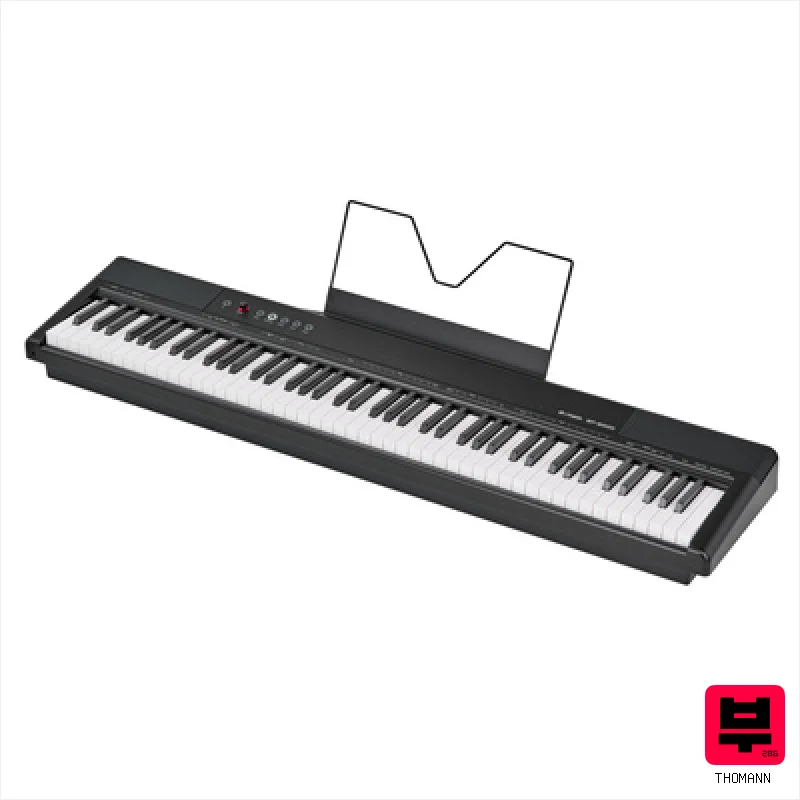
The Thomann SP-120 is a fantastic entry point for beginners or those needing a compact, affordable stage piano. It's surprisingly versatile for practice and basic performance, especially if you're on a tight budget and need something easily transportable – think students, songwriters, or occasional gigging.
Pros
- Surprisingly good sound for the price range, usable across genres
- Lightweight and portable – ideal for gigging or lessons
- Complete package: includes sustain pedal, power supply, music stand
Cons
- Lightly weighted keys lack the feel of a proper acoustic piano action
- Limited sound selection – not for advanced users seeking nuanced tones
47AudioFu
IndexStableno change since Aug 17Aug 17$179 now$179€159 at Thomann · in stockCheck price ↗ -
- Weight14.8 kg
- Key actionWeighted keys
The KaE1-LB is a surprisingly capable entry-level stage piano. It's a great choice for students, gigging musicians on a budget, or anyone needing a portable and self-contained performance instrument. The action is decent for the price, and the Bluetooth connectivity is a real bonus.
Pros
- Solid H1 action provides surprisingly good dynamic response.
- Compact design and battery power offer excellent portability.
- Decent onboard sounds cover a wide range of performance needs.
Cons
- H1 action lacks the nuanced feel of higher-end hammer actions.
- Built-in speakers are adequate, but not ideal for larger venues.
46AudioFu
Index↓ 2.5%since Aug 17 · lowest so far$449 · Aug 17$438 now$438€389 at Thomann · in stockCheck price ↗
Stage Pianos by the numbers
Measured across all 17 models we track, not a sample.
Median $438 — half of all stage pianos here cost less.
median of 17 models · 6 kg–14.8 kg
most common · 15 models
How to choose the best stage pianos
Action
Forget graded hammer action; that's a pipe dream at this price. We're looking for something playable - a decent weighting and some semblance of responsiveness. A sluggish action will kill your dynamics and articulation.
Sound Engine/Piano Voicings
Don't expect pristine Steinway samples. You'll be working with emulations, and compromises are made. We're hunting for pianos with a usable range of tones - something that can handle rock, blues, and maybe even a bit of jazz without sounding utterly sterile.
Polyphony
64 voices is the bare minimum these days. Anything less and you'll hear dropouts when things get busy - a major headache in a band setting. More polyphony means more layers and complex chords without glitches.
Connectivity
MIDI out is a must for expanding your rig. USB MIDI is a bonus for easy computer integration. Don't get stuck with something that's a digital dead-end.
Build Quality/Portability
Let's be honest, these aren't built tanks. We're assessing how well they'll hold up to gigging - and how easy they are to haul around. A flimsy plastic case and rattly keys aren't ideal.
Buying guide
Alright, so you need a stage piano but your budget's tighter than a snare drum head. Believe me, I've been there. Finding something that cuts through a band mix, feels decent under your fingers, and doesn't sound like a tin can requires some serious sifting. This isn't about chasing flagship features; it's about maximizing that sweet spot of bang-for-your-buck in the under-$500 range.
At this price point, you're making trade-offs. The action will likely be the biggest compromise - don't expect concert-hall feel. Sound quality will be decent, but don't anticipate breathtaking realism.
Focus on versatility - a piano that can handle multiple genres and gig situations is more valuable than a 'perfect' piano that sounds amazing but can only do one thing.
How the AudioFu Index works
Five measured signals and nothing else — no stars from strangers, no “tested by experts” we didn’t do. The weights are fixed and public. We don’t play these instruments; we measure the market around them.
This chart covers 17 stage pianos from the Thomann catalogue. Before you buy, read hands-on reviews and, where you can, play it. Full methodology.
AudioFu earns a commission when you buy through our Thomann links. It never changes the order — the index does.
- Demand40%
How many of this exact model are for sale on Reverb right now — what musicians actually buy and resell.
- Lineup20%
How many finishes Thomann stocks — makers expand the models that sell.
- Price15%
Where the price has moved since we started tracking in August.
- Specs15%
How completely the maker documents it.
- Maker10%
How deep the brand’s range is in this category.
Questions
Can I realistically expect a 'piano-like' feel?
Not really. The action will be lighter and less nuanced than a proper weighted action. Think of it more like a synth action that tries to mimic piano feel - it's a compromise.
How important is polyphony?
Pretty important. 64 voices is the floor. Anything less and you'll hear notes drop out during busier passages, especially if you're layering sounds.
What about the sounds - are they any good?
They're serviceable. Don't expect boutique samples. Look for pianos with a decent range of voicings - a bright honky-tonk, a mellow upright, something in between. Layering with other sounds is your friend.
Will this piano cut through the mix live?
It'll require some tweaking. EQ is your best friend. A little bit of added presence in the upper mids can help it poke through the guitars and drums. Don't expect it to be a sonic powerhouse.
Is it worth spending a little more?
Maybe. An extra $100 can sometimes get you a slightly better action or a more robust build, but diminishing returns are real. Consider your priorities - better action or more sounds?