AudioFu Chart · October 2026
Best Stage Pianos for Beginner 2026
The top pick is Yamaha P-45 Digital Piano ($370). Thomann SP-120 gives you the most for the money at $179. Yamaha P-225 88-key Digital Piano leads the high end. Ranked by the AudioFu Index from 69 models across 13 brands, prices checked every night.
Last updated: October 19, 2026
Top 10
Full detail for the 10 highest AudioFu Index scores. Every other model is listed below.
-
- Weight11.5 kg
- Key actionWeighted keys
The P-45B is a solid entry-level stage piano – a great starting point for beginners or those needing a compact, budget-friendly option. The key action is surprisingly good for the price, but don’t expect a concert grand experience. It's perfect for students, casual players, or anyone needing a portable piano for practice or basic performances.
Pros
- Graded Hammer Standard action provides surprisingly realistic piano feel
- Compact and lightweight for portability, ideal for students or small spaces
- Built-in speakers are adequate for practice and casual playing
Cons
- The GHS action lacks the nuance and depth of higher-end weighted actions
- Limited sound palette; ten tones feel restrictive for serious players
81AudioFu
IndexStableno change since Aug 17Aug 17$370 now$370€329 at Thomann · in stockCheck price ↗ -
- Weight12.3 kg
- Keys88 keys
- Key actionWeighted keys
The FP-10 is a solid entry-level stage piano, perfect for beginners or players needing a compact, portable option. While the sounds aren’t going to blow you away, the PHA-4 action is surprisingly good for the price, offering a playable and expressive experience. It's a great way to get started without a huge investment.
Pros
- PHA-4 action provides a surprisingly realistic, responsive key feel
- SuperNATURAL piano sounds offer a decent, usable tonal palette
- Compact design makes it ideal for smaller spaces and portability
Cons
- Speakers are underpowered; headphone use highly recommended for serious practice
- Limited sound selection compared to more expensive stage pianos
83AudioFu
IndexStableno change since Aug 17Aug 17$448 now$448€398 at Thomann · in stockCheck price ↗ -
- Weight11.4 kg
- Keys88 keys
- Key actionWeighted keys
The B2+ is a solid entry point into the world of stage pianos, especially for students or those needing portability. The piano sounds are surprisingly good for the price, though the action won't fool a seasoned pianist. It's a great practice tool and a workable gigging option for smaller venues.
Pros
- Excellent value for an 88-key stage piano.
- Italian/German grand piano samples offer surprising realism.
- Lightweight and portable for gigging musicians.
Cons
- Key action lacks the nuance of higher-end weighted actions.
- Limited sound selection compared to more expensive stage pianos.
78AudioFu
Index↓ 6.8%since Aug 17 · lowest so far$494 · Aug 17$460 now$460€409 at Thomann · in stockCheck price ↗ -
- Weight6.2 kg
- Key actionWeighted keys
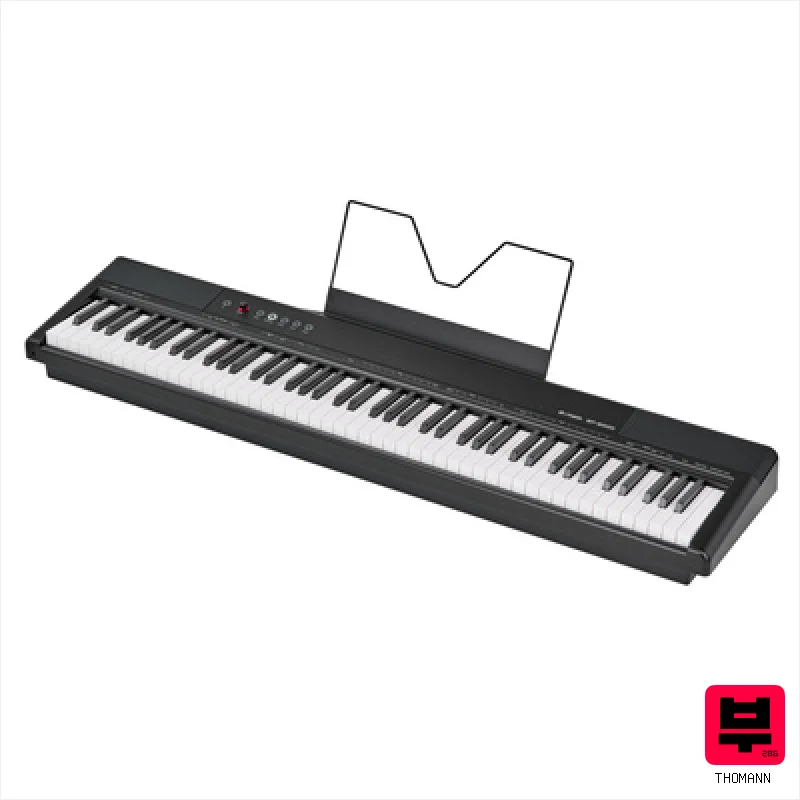
The Thomann SP-120 is a fantastic entry point for beginners or those needing a compact, affordable stage piano. It's surprisingly versatile for practice and basic performance, especially if you're on a tight budget and need something easily transportable – think students, songwriters, or occasional gigging.
Pros
- Surprisingly good sound for the price range, usable across genres
- Lightweight and portable – ideal for gigging or lessons
- Complete package: includes sustain pedal, power supply, music stand
Cons
- Lightly weighted keys lack the feel of a proper acoustic piano action
- Limited sound selection – not for advanced users seeking nuanced tones
47AudioFu
IndexStableno change since Aug 17Aug 17$179 now$179€159 at Thomann · in stockCheck price ↗ -
- Weight11.1 kg
The P-145 B BT is a solid choice for students and casual players needing a portable, realistic piano experience. Its GHC action and CFIIIS sound engine are genuinely impressive for its class, making it a great value for practice and home use – just don't expect it to replace a full-sized stage piano for serious gigs.
Pros
- Excellent GHC action provides a surprisingly realistic piano feel.
- CFIIIS sound engine delivers a warm, authentic grand piano tone.
- Compact size and lightweight design enhance portability significantly.
Cons
- Built-in speakers are adequate but lack dynamic range for performance.
- Limited effects offer less sonic shaping than higher-end stage pianos.
68AudioFu
IndexStableno change since Aug 17Aug 17$444 now$444€395 at Thomann · in stockCheck price ↗ -
- Weight6 kg
The Korg Liano is a remarkably portable and affordable entry point into the world of stage pianos. It's a solid choice for students, bedroom players, or anyone needing a lightweight option for occasional gigs where a full-sized, weighted action isn't essential. Don't expect studio-quality sounds or a nuanced feel, but for the price, it's hard to argue with its practicality.
Pros
- Lightweight design (6kg) makes it truly portable for gigging musicians.
- Included damper pedal is a nice touch for expressive playing.
- Velocity-sensitive keys offer a surprising level of dynamic control.
Cons
- The plastic key action feels budget-oriented; lacks the depth of a weighted action.
- Limited 8 voices restrict versatility for advanced or diverse musical styles.
59AudioFu
IndexStableno change since Aug 17Aug 17$354 now$354€315 at Thomann · in stockCheck price ↗ -
- Weight11.5 kg
The P-225 is a solid entry-level stage piano; the action is surprisingly good for its size and price point. It's a great option for students, beginners, or anyone needing a portable piano with a decent piano sound – just don't expect to fill a concert hall with those speakers.
Pros
- Excellent GHC action provides a surprisingly realistic piano feel.
- VRM Lite engine delivers a warm, nuanced CFX piano sound.
- Compact design and lightweight build make it highly portable.
Cons
- Built-in speakers lack power and low-end response for performance.
- Limited sound selection compared to higher-end stage pianos.
80AudioFu
IndexStableno change since Aug 17Aug 17$632 now$632€562 at Thomann · in stockCheck price ↗ -
- Weight12.5 kg
- Key actionWeighted keys
The Thomann DP-28 Plus is a surprisingly capable entry-level stage piano, offering a decent weighted action and useful features for the price. It's an excellent choice for beginners or students needing a functional, portable instrument for practice and basic performance. Don't expect premium sound quality, but it’s hard to beat the value proposition.
Pros
- Solid weighted action provides a surprisingly realistic piano feel
- Twinova mode allows for dual piano lessons or performance versatility
- Comprehensive connectivity including MIDI Out and USB host functionality
Cons
- Sound engine lacks the nuance and depth of higher-end stage pianos
- Plastic casing feels budget-oriented, impacting long-term durability
-
- Weight16 kg
- Key actionWeighted keys
The Korg D1 is a surprisingly capable entry-level stage piano. It's a great option for students, beginners, or anyone needing a compact and portable instrument for practice or basic gigging – the RH3 action is much better than you'd expect at this price point, making it feel more premium than it is.
Pros
- RH3 action provides surprisingly realistic weighted piano feel
- Compact size makes it ideal for smaller spaces and transport
- Solid build quality for a piano in its price range; feels stable
Cons
- RH3 key action lacks the nuance of higher-end hammer actions
- Limited sound selection; lacks advanced sound editing capabilities
62AudioFu
IndexStableno change since Aug 17Aug 17$562 now$562€499 at Thomann · in stockCheck price ↗ -
- Weight14.8 kg
- Key actionWeighted keys
The KaE1-LB is a surprisingly capable entry-level stage piano. It's a great choice for students, gigging musicians on a budget, or anyone needing a portable and self-contained performance instrument. The action is decent for the price, and the Bluetooth connectivity is a real bonus.
Pros
- Solid H1 action provides surprisingly good dynamic response.
- Compact design and battery power offer excellent portability.
- Decent onboard sounds cover a wide range of performance needs.
Cons
- H1 action lacks the nuanced feel of higher-end hammer actions.
- Built-in speakers are adequate, but not ideal for larger venues.
46AudioFu
Index↓ 2.5%since Aug 17 · lowest so far$449 · Aug 17$438 now$438€389 at Thomann · in stockCheck price ↗
All 69 stage pianos
Same index, same nightly prices — compact. Colour options of one model share a row. Tap a photo to zoom.
- 11
Korg SP-280SP-280 BK · Korg · 3 finishes57Stable$640€569$640€569Check ↗
- 12
Studiologic Numa Compact 2x 88-Key Semi-Weighted PianoNuma Compact SE · Studiologic · 2 finishes55Stable$625€555$625€555Check ↗
- 13
Korg Liano Live!Korg41↓ 2.0%$550€489$550€489Check ↗
- 14
Roland FP-90X 88-Key Digital Portable PianoFP-90X BK · Roland · 6 finishes85↓ 2.9%$2,074€1,843$2,074€1,843Check ↗
- 15
Roland FP-40 88-Key Digital PianoFP-40 WH · Roland · 6 finishes81↓ 13.7%$854€759$854€759Check ↗
- 16
Roland V-Stage 76 Digital Stage PianoV-Stage 76 · Roland70↓ 2.5%$3,047€2,708$3,047€2,708Check ↗
- 17
Kawai ES920 88-Key Digital PianoES-920 B · Kawai · 4 finishes69Stable$1,406€1,249$1,406€1,249Check ↗
- 18
Yamaha P-S500 88-Key Digital PianoP-S500 WH · Yamaha · 4 finishes68Stable$1,664€1,479$1,664€1,479Check ↗
- 19
Casio PX-S6000 Privia 88-Key Digital PianoPX-S6000 · Casio · 2 finishes66Stable$1,428€1,269$1,428€1,269Check ↗
- 20
Yamaha CP88 Stage PianoCP88 · Yamaha65Stable$2,625€2,333$2,625€2,333Check ↗
- 21
Roland RD-2000EX 88-Key Digital PianoRD-2000 EX · Roland64↓ 0.8%$2,677€2,379$2,677€2,379Check ↗
- 22
Roland V-Stage 88 Digital Stage PianoV-Stage 88 · Roland64↑ 1.3%$3,420€3,039$3,420€3,039Check ↗
- 23
Kawai MP7SE 88-Key Digital Stage PianoMP-7 SE · Kawai · 2 finishes62Stable$1,625€1,444$1,625€1,444Check ↗
- 24
Roland RD-08 88-Key Digital Stage PianoRD-08 · Roland61Stable$899€799$899€799Check ↗
- 25
Roland FP-E50 88-Key Digital PianoFP-E50 · Roland60↑ 0.6%$787€699$787€699Check ↗
- 26
Roland RD-88EX 88-Key Digital Stage PianoRD-88 EX · Roland60Stable$1,394€1,239$1,394€1,239Check ↗
- 27
Korg Grandstage X 88-Key Digital PianoGrandstage X · Korg60Stable$2,249€1,999$2,249€1,999Check ↗
- 28
Studiologic Numa X GT 88-Key Digital PianoNuma X Piano GT · Studiologic · 2 finishes59Stable$2,013€1,789$2,013€1,789Check ↗
- 29
Yamaha CP73 73-Key Digital Stage PianoCP73 · Yamaha58Stable$2,114€1,879$2,114€1,879Check ↗
- 30
Kawai MP11SE 88-Key Digital Stage PianoMP-11 SE · Kawai · 2 finishes57Stable$2,430€2,159$2,430€2,159Check ↗
- 31
Kawai ES-520 BKawai · 4 finishes53Stable$1,011€898$1,011€898Check ↗
- 32
Rhodes Mk 8-73 FX ClassicRhodes · 4 finishes53↓ 3.9%$14,065€12,499$14,065€12,499Check ↗
- 33
Clavia Nord Piano 6 88Clavia Nord52↓ 6.1%$3,712€3,299$3,712€3,299Check ↗
- 34
Korg SV-2 73Korg · 4 finishes51↓ 4.0%$1,799€1,599$1,799€1,599Check ↗
- 35
Viscount Legend `70s Compact EXViscount · 2 finishes51Stable$2,565€2,279$2,565€2,279Check ↗
- 36
Crumar Seventeen 73-Key Digital PianoSeventeen · Crumar50Stable$1,451€1,289$1,451€1,289Check ↗
- 37
Clavia Nord Electro 7 HPClavia Nord50Stable$3,352€2,979$3,352€2,979Check ↗
- 38
Clavia Nord Piano 6 73Clavia Nord50Stable$3,487€3,099$3,487€3,099Check ↗
- 39
Crumar ParsifalCrumar47Stable$1,439€1,279$1,439€1,279Check ↗
- 40
Dexibell Vivo S8MDexibell · 2 finishes46Stable$2,587€2,299$2,587€2,299Check ↗
- 41
Viscount Legend '70s Artist WViscount · 2 finishes46Stable$2,688€2,389$2,688€2,389Check ↗
- 42
Casio PX-S7000 Privia 88-Key Digital PianoPX-S7000 WE Set · Casio · 3 finishes46Stable$2,925€2,599$2,925€2,599Check ↗
- 43
Kurzweil KaP1-WHKurzweil · 2 finishes45Stable$899€799$899€799Check ↗
- 44
Clavia Nord Stage 4 CompactClavia Nord45Stable$4,248€3,775$4,248€3,775Check ↗
- 45
Clavia Nord Stage 4 73Clavia Nord45Stable$4,600€4,088$4,600€4,088Check ↗
- 46
Clavia Nord Stage 4 88Clavia Nord45Stable$4,811€4,275$4,811€4,275Check ↗
- 47
Crumar Seven 73-Key Electric PianoSeven · Crumar43Stable$2,047€1,819$2,047€1,819Check ↗
- 48
Rhodes Stage 61Rhodes43Stable$8,022€7,129$8,022€7,129Check ↗
- 49
Rhodes Stage 61 Launch EditionRhodes43Stable$8,664€7,699$8,664€7,699Check ↗
- 50
Rhodes Mk 8/80AERhodes43Stable$21,942€19,499$21,942€19,499Check ↗
Stage Pianos by the numbers
Measured across all 132 models we track, not a sample.
Median $1,625 — half of all stage pianos here cost less.
median of 130 models · 8.4 kg–26 kg
median of 51 models · 73–88
most common · 64 models
How to choose the best stage pianos
Action
A good action is everything. You want something that's responsive and feels close to an acoustic piano, even if it's weighted plastic. A mushy, unresponsive action will kill your technique before you even start - and you'll be fighting it onstage.
Sound Engine & Voicing
Beginners often get caught up in the number of sounds, but quality trumps quantity. Look for a piano with a handful of genuinely good sounds - a usable acoustic piano, a decent electric piano (Rhodes or Wurlitzer), and maybe an organ or synth voice. Don't chase the "massive sound library" - focus on tones that inspire you.
Ease of Use
Complex menus and convoluted effects chains are a nightmare for beginners. You want something intuitive to navigate, with sounds you can access quickly. Spending 30 minutes tweaking a reverb isn't how you learn to play.
Portability
Let's be realistic - you'll probably be moving this thing around. Gigging, rehearsals, even just moving it from your bedroom to the living room. Weight and size matter, especially if you're on your own.
Connectivity
Basic connectivity is essential: MIDI in/out, sustain pedal input, and at least one decent quality line output for plugging into a PA or amp. USB connectivity for connecting to a computer for recording is a huge bonus for capturing ideas.
Buying guide
So, you're getting into the world of stage pianos? Awesome! It's a huge step up from a basic keyboard, letting you nail those Rhodes tones, vintage electric pianos, and piano sounds that cut through a band mix. But picking your first stage piano can be overwhelming - there's a lot of gear out there. Let's cut through the noise and find something that'll actually inspire you to play, without breaking the bank or frying your brain with menus.
Don't fall for the "more is more" trap. Many stage pianos pack in features you won't use for years. The biggest corner that gets cut on cheaper models is almost always the action - it's hard to fake a good feel.
Spending a bit more on a model with a decent weighted action will pay dividends in the long run. Also, listen critically to the sounds through headphones and a PA - what sounds amazing in your bedroom might disappear in a band mix.
How the AudioFu Index works
Five measured signals and nothing else — no stars from strangers, no “tested by experts” we didn’t do. The weights are fixed and public. We don’t play these instruments; we measure the market around them.
This chart covers 132 stage pianos from the Thomann catalogue. Before you buy, read hands-on reviews and, where you can, play it. Full methodology.
AudioFu earns a commission when you buy through our Thomann links. It never changes the order — the index does.
- Demand40%
How many of this exact model are for sale on Reverb right now — what musicians actually buy and resell.
- Lineup20%
How many finishes Thomann stocks — makers expand the models that sell.
- Price15%
Where the price has moved since we started tracking in August.
- Specs15%
How completely the maker documents it.
- Maker10%
How deep the brand’s range is in this category.
Questions
What's the difference between a stage piano and a digital piano?
Digital pianos are usually designed for home practice - they prioritize realism and often have furniture-style cabinets. Stage pianos are built for gigging, prioritizing portability and sound quality through a PA system.
Do I need a weighted key action?
Absolutely. A non-weighted action won't develop your technique properly, and it'll feel weird when you eventually play an acoustic piano. There are different types of weighted actions - graded hammer action is the most realistic, but can be heavier. Start with something manageable.
How important is the number of sounds?
Not that important, especially as a beginner. A few high-quality sounds are better than a hundred mediocre ones. Focus on finding tones that inspire you to play.
Can I record with a stage piano?
Most stage pianos have USB connectivity, allowing you to connect to a computer and record MIDI data. You'll need a DAW (Digital Audio Workstation) software on your computer to turn those MIDI notes into actual sounds.
What's a 'velocity sensitivity'?
Velocity sensitivity determines how the volume of a note changes based on how hard you hit the key. A good stage piano has a wide velocity range - meaning you can play really soft, subtle notes and loud, powerful ones, just like on an acoustic piano.