
To choose a digital piano, check six things in this order: the key action, polyphony, the piano sound, the speakers, the pedals and the connections. The first one decides whether the piano helps or hurts a beginner's playing; the last one only matters for what you want to do with it later.
If you're still deciding between a keyboard and a digital piano, read digital piano vs keyboard first. For budgets, see how much a digital piano costs.
1. Key action: 88 weighted keys
Look for 88 keys with a hammer action, ideally "graded" or "scaled", which means the low keys are heavier than the high ones, as on an acoustic piano. Avoid "semi-weighted" or "touch-sensitive" keys if the goal is learning piano.
Casio CDP-S110 BK, $336
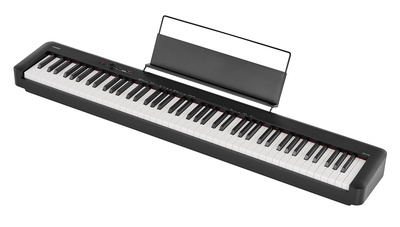
88 keys with Casio's scaled hammer action at entry price. #4 of 25 compact digital pianos.
2. Polyphony: 128 notes or more
Polyphony is how many notes the piano can sound at once. With the sustain pedal down, notes pile up quickly, and a piano with 64-note polyphony can cut off old notes in fast pieces. 128 or more is comfortable; 192 and 256 are common in the next price step.
Kawai ES-120 B, $674
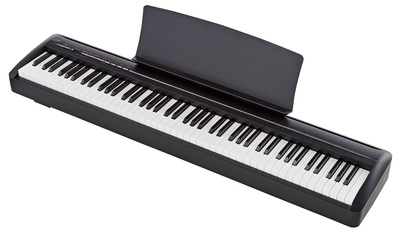
192-note polyphony, Kawai's compact hammer action and 25 sounds in a portable body. #6 of 48 general digital pianos.
3. The piano sound
Every brand samples a real grand piano. Listen to the middle and the bass, played softly and loudly: a good sample changes tone, not just volume, as you play harder. Yamaha (CFX), Kawai and Roland have the strongest reputations here.
4. Speakers
Built-in speakers decide how the piano sounds without headphones. Portable models have small speakers that point down or back; cabinet pianos have larger ones aimed at the player.
Korg C1 Air BK Set, $1,068

A slim cabinet piano with three pedals and speakers in the body, sold as a set. #2 of 25 compact digital pianos.
5. Pedals: one or three
Beginners need one good sustain pedal; the cheap square switch that comes with many portable pianos is worth replacing. Cabinet pianos have three pedals built in, and some portables accept a three-pedal unit.
6. Connections
USB to a computer or tablet opens up learning apps and recording. Two headphone outputs let a teacher and a student play together. Bluetooth audio lets you play along with songs from a phone.
Yamaha P-525 B, $1,784
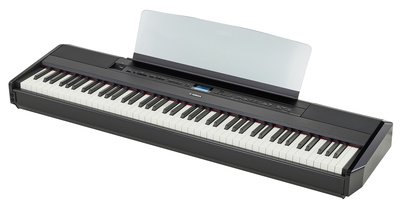
Wooden keys with escapement, 256-note polyphony and 542 sounds including the CFX and Bösendorfer grands: the portable for players who have outgrown entry models. #7 of 25 compact digital pianos.
Questions
What is the most important thing when buying a digital piano?
The keys: 88 weighted keys with a hammer action. Everything else can be fixed with headphones, a better pedal or an app.
How much polyphony does a beginner need?
64 notes is enough for most beginner pieces; 128 or more avoids cut-off notes with the sustain pedal.
Which digital piano brand is best?
Yamaha, Kawai, Roland and Casio all make good beginner pianos. In our rankings Casio offers the most for the money at entry level; Yamaha and Kawai have the widest choice above $1,000.
How we picked. Every product comes from an AudioFu ranking, scored on demand, price, specs and brand; specs are taken from Thomann's product data. Prices are converted from euros at the European Central Bank rate and updated every night, as are the ranks.
Share this story

Denis Kataev runs AudioFu. Every night the site records the prices of more than 38,000 instruments and studio tools at Thomann, and he writes about what those numbers show: what got cheaper, what just arrived, and which discounts are real.
All stories by Denis Kataev →


