AudioFu
AudioFu Chart · October 2026
Best Sennheiser Transmitters 2026
The top pick is Sennheiser XSW 1-825-A Handheld Mic Wireless System - A Band (5480572… ($156). Sennheiser Spectera Base Station leads the high end. Ranked by the AudioFu Index from 70 models, prices checked every night.
Last updated: October 12, 2026
Top 10
Full detail for the 10 highest AudioFu Index scores. Every other model is listed below.
-
Sennheiser XSW 1-825-A Handheld Mic Wireless System - A Band (5480572…
SK-XSW-E-Band · Sennheiser
46 for sale on Reverb1 finish at Thomann
This little Sennheiser transmitter is a solid workhorse for vocalists and presenters who already use the XSW system. It’s built like a tank and offers dependable wireless performance, making it perfect for reliable on-stage or presentation use where you need a compact, dependable solution.
Pros
- Robust metal housing offers excellent drop protection for stage use
- Sennheiser’s reliable RF performance minimizes dropouts and interference
- Compact size and lightweight design for comfortable pocket carry
Cons
- AA battery dependency can be inconvenient compared to rechargeable options
- Limited channel count necessitates careful frequency coordination in dense RF environments
-
Sennheiser XSW 1-825-A Handheld Mic Wireless System - A Band (5480572…
SK-XSW-GB-Band · Sennheiser
46 for sale on Reverb1 finish at Thomann
This little Sennheiser is a workhorse for vocalists and instrumentalists needing reliable wireless. It’s a fantastic addition to an existing XSW system, offering pro-grade performance without the complexity of higher-end wireless setups. Perfect for working musicians needing dependable, budget-friendly wireless freedom.
Pros
- Robust metal housing provides excellent stage durability.
- Seamless integration with Sennheiser's XSW series wireless systems.
- GB-Band frequency allocation offers reliable signal in many regions.
Cons
- AA battery dependency can be inconvenient for extended gigs.
- Limited frequency band compared to wider spectrum systems.
61AudioFu
IndexStableno change since Aug 14Aug 14$156 now$156€139 at Thomann · in stockCheck price ↗ -
Sennheiser e906 Supercardioid Dynamic Instrument Microphone
XSW-D Instrument TX · Sennheiser
40 for sale on Reverb1 finish at Thomann
The XSW-D Instrument TX is a solid, budget-friendly wireless option for gigging musicians. It's perfect for solo acoustic players or anyone needing a reliable, straightforward way to ditch the cable – the build quality is surprisingly good for the price point and the sound is clean and present.
Pros
- Robust metal housing inspires confidence on stage.
- Clear, focused sound reproduction for acoustic instruments.
- Simple pairing process with XSW-D receivers minimizes setup time.
Cons
- Limited frequency options compared to higher-end Sennheiser systems.
- Single transmitter restricts multi-instrumental setups without additional purchases.
60AudioFu
IndexStableno change since Aug 14Aug 14$189 now$189€169 at Thomann · in stockCheck price ↗ -
Sennheiser XSW 1-825-A Handheld Mic Wireless System - A Band (5480572…
SK-XSW-A-Band · Sennheiser
46 for sale on Reverb1 finish at Thomann
This SK-XSW-A-Band is a solid, dependable bodypack for vocalists or instrumentalists needing wireless freedom. It's a no-nonsense performer, especially valuable if you’re already invested in the Sennheiser XSW ecosystem; the robust build and reliable RF make it a workhorse for live gigs and rehearsals.
Pros
- Robust metal housing offers excellent stage durability.
- Sennheiser’s proven RF performance minimizes dropouts and interference.
- Compact bodypack design allows for discreet placement under clothing.
Cons
- AA battery power is less convenient than rechargeable options.
- A-band frequency allocation can be limited in some regions.
-
Sennheiser XSW 1-825-A Handheld Mic Wireless System - A Band (5480572…
SK-XSW-B-Band · Sennheiser
46 for sale on Reverb1 finish at Thomann
This SK-XSW-B-Band is a solid, dependable wireless option for vocalists or instrumentalists already using the XSW series. It's built like a tank, integrates flawlessly, and keeps things simple – perfect for gigging musicians needing reliable wireless without the complexity of higher-end systems.
Pros
- Robust metal housing provides excellent stage durability.
- B-Band frequency offers reliable operation in many regions.
- Seamless integration with existing Sennheiser XSW systems.
Cons
- AA battery power is less convenient than rechargeable options.
- B-Band frequency range can be congested in some areas.
-
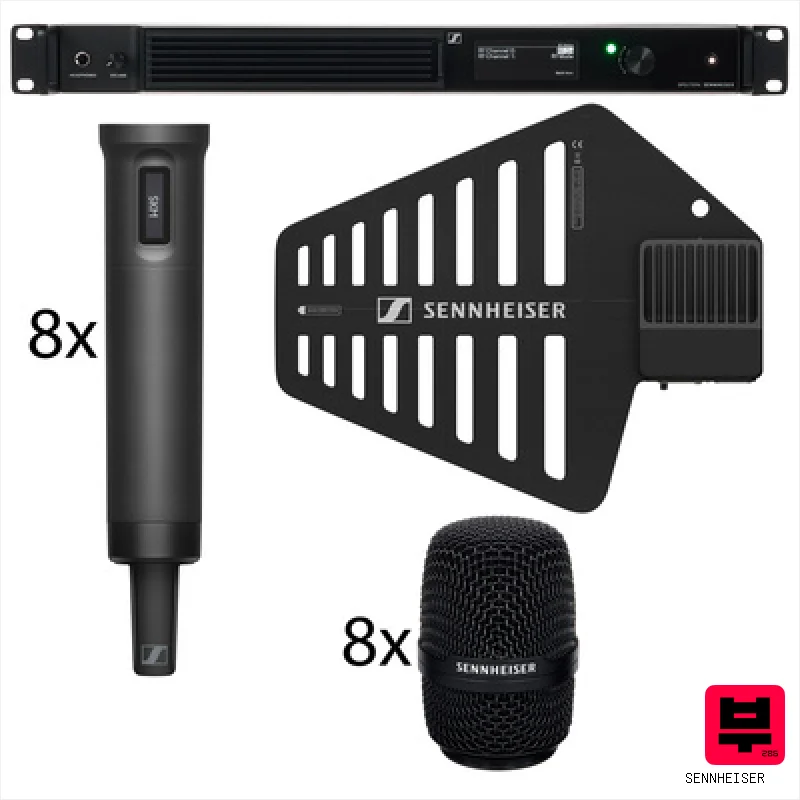
- Size19"
The Spectera Base Station is a powerhouse for demanding wireless audio applications. It's built for broadcast, live sound, and theatrical productions needing serious RF density and network integration – think large-scale events where signal reliability is paramount. The redundant connections and antenna options really shine in those situations.
Pros
- Rock-solid build quality, typical of Sennheiser’s professional line.
- Redundant Dante/MADI connections offer unparalleled network integration.
- Multiple antenna options provide flexible coverage and spectrum expansion.
Cons
- Extremely premium-priced, limiting it to high-end broadcast and theater.
- Requires LinkDesk software and regional licensing for full functionality.
48AudioFu
IndexStableno change since Aug 14Aug 14$11,200 now$11,200€9,995 at Thomann · in stockCheck price ↗ -
The Spectera SEK 1G4 is a serious piece of kit for professionals needing rock-solid wireless audio. The dual transmission capability is fantastic for monitoring and stage use, and the build is clearly designed to withstand the rigors of touring. This is really for bands, presenters, or anyone needing dependable, high-quality wireless with a premium price tag.
Pros
- Robust, road-worthy build quality; feels incredibly solid.
- Simultaneous in-ear and mic/line transmission is a workflow game-changer.
- Impedance-matched headphone amp delivers clean, powerful audio to the performer.
Cons
- High-end price point makes it inaccessible for many budget-conscious users.
- Requires separate battery purchase, adding to the overall investment.
44AudioFu
Index↓ 10.8%since Aug 14 · lowest so far$2,240 · Aug 14$1,998 now$1,998€1,783 at Thomann · in stockCheck price ↗ -
The SK AVX is a solid, reliable wireless bodypack – great for presenters, interviewers, or anyone needing a straightforward, dependable wireless solution. It's easy to set up and use, and the encryption is a real bonus for sensitive audio. It's a well-rounded package that strikes a good balance between features and affordability.
Pros
- Excellent auto-frequency management simplifies setup significantly.
- AES 256 encryption provides a reliable, secure signal.
- Compact and lightweight design minimizes bodypack discomfort.
Cons
- Limited frequency range can be restrictive in congested RF environments.
- Lacks advanced features found in higher-end Sennheiser systems.
-
- Weight0.2 kg
This Sennheiser SL Boundary 114-S DW-3B is a solid choice for stage performers, presenters, or anyone needing a discreet, wireless boundary mic. It's designed to work seamlessly with the DW-3B ecosystem, offering excellent RF performance and smart features. Just be mindful of its boundary mic limitations; it thrives in controlled acoustic environments.
Pros
- 1.9 GHz band offers robust interference rejection in crowded RF environments.
- Half-cardioid pattern minimizes off-axis feedback, ideal for stage use.
- Programmable micro switch adds versatility for talkback or instant mute.
Cons
- Boundary mics inherently lack directional control, prone to room reflections.
- DW-3B system dependency limits flexibility; not standalone operation.
42AudioFu
Index↑ 13.9%since Aug 14$884 · Aug 14$1,007 now$1,007€899 at Thomann · in stockCheck price ↗ -
This little Sennheiser is a real workhorse for vocalists and presenters needing wireless freedom. The digital transmission keeps things clean and the dual inputs make it incredibly versatile – a great option for those needing to plug in everything from a dynamic mic to a headset. It's a reliable system, especially for smaller venues or broadcast setups.
Pros
- Digital clarity minimizes noise, crucial for live vocal performance.
- Dual inputs (XLR/3.5mm) offer unmatched microphone compatibility.
- Low 1.9ms latency ensures natural, responsive stage feel.
Cons
- AA battery power is inconvenient for prolonged, professional use.
- Limited frequency band necessitates careful coordination in crowded RF environments.
39AudioFu
Index↓ 12.4%since Aug 14 · lowest so far$390 · Aug 14$342 now$342€305 at Thomann · in stockCheck price ↗
All 70 transmitters
Same index, same nightly prices — compact. Colour options of one model share a row. Tap a photo to zoom.
- 11
Sennheiser SKM 6000 BK-A1-A4Sennheiser · 3 finishes39↓ 4.2%$2,352€2,099$2,352€2,099Check ↗
- 12
Sennheiser EW-D SK Y1-3Sennheiser38↓ 9.7%$301€269$301€269Check ↗
- 13
Sennheiser EW-D SK R1-6Sennheiser38↓ 9.7%$301€269$301€269Check ↗
- 14
Sennheiser EW-D SKM-S Y1-3Sennheiser36↓ 6.4%$313€279$313€279Check ↗
- 15
Sennheiser EW-D SKM-S S7-10Sennheiser36↓ 6.4%$313€279$313€279Check ↗
- 16
Sennheiser EW-D SKM-S S1-7Sennheiser36↓ 6.4%$313€279$313€279Check ↗
- 17
Sennheiser EW-D SKM-S R4-9Sennheiser36↓ 6.4%$313€279$313€279Check ↗
- 18
Sennheiser EW-DX SK U1/5Sennheiser36↓ 6.4%$492€439$492€439Check ↗
- 19
Sennheiser SK 6212 BK-B1-B4Sennheiser · 2 finishes36Stable$2,790€2,490$2,790€2,490Check ↗
- 20
Sennheiser SKM 835-XSW-GB-BandSennheiser35↓ 4.2%$257€229$257€229Check ↗
- 21
Sennheiser EW-D SK R4-9Sennheiser35↓ 3.6%$301€269$301€269Check ↗
- 22
Sennheiser EW-D SK U1/5Sennheiser35↓ 3.5%$313€279$313€279Check ↗
- 23
Sennheiser EW-D SKM-S R1-6Sennheiser35↓ 3.0%$324€289$324€289Check ↗
- 24
Sennheiser EW-D SKM-S Q1-6Sennheiser35↓ 3.0%$324€289$324€289Check ↗
- 25
Sennheiser EW-D SK S1-7Sennheiser35↓ 3.0%$324€289$324€289Check ↗
- 26
Sennheiser EW-D SK Q1-6Sennheiser35↓ 3.0%$324€289$324€289Check ↗
- 27
Sennheiser EW-DP SKP Q1-6Sennheiser35↓ 2.6%$380€339$380€339Check ↗
- 28
Sennheiser EW-DX SKM-S R1-9Sennheiser35↓ 4.3%$503€449$503€449Check ↗
- 29
Sennheiser EW-DX SKM Q1-9Sennheiser35↓ 4.3%$503€449$503€449Check ↗
- 30
Sennheiser EW-DX SKM U1/5Sennheiser34↓ 1.1%$503€449$503€449Check ↗
- 31
Sennheiser EW-DX SKM S2-10Sennheiser34↓ 2.2%$503€449$503€449Check ↗
- 32
Sennheiser EW-DX SK R1-9Sennheiser34↓ 2.1%$514€459$514€459Check ↗
- 33
Sennheiser XSW-D XLR female TXSennheiser33Stable$201€179$201€179Check ↗
- 34
Sennheiser SKM 825-XSW-E-BandSennheiser33Stable$212€189$212€189Check ↗
- 35
Sennheiser SKM 825-XSW-B-BandSennheiser33Stable$212€189$212€189Check ↗
- 36
Sennheiser SKM 825-XSW-GB-BandSennheiser33Stable$212€189$212€189Check ↗
- 37
Sennheiser SKM 835-XSW-E-BandSennheiser33Stable$268€239$268€239Check ↗
- 38
Sennheiser SKM 835-XSW-B-BandSennheiser33Stable$268€239$268€239Check ↗
- 39
Sennheiser SKM 835-XSW-A-BandSennheiser33Stable$268€239$268€239Check ↗
- 40
Sennheiser SKM 865-XSW-E-BandSennheiser33Stable$324€289$324€289Check ↗
- 41
Sennheiser SKM 865-XSW-B-BandSennheiser33Stable$324€289$324€289Check ↗
- 42
Sennheiser EW-D SK S7-10Sennheiser33Stable$324€289$324€289Check ↗
- 43
Sennheiser EW-D SKM-S U1/5Sennheiser33Stable$334€298$334€298Check ↗
- 44
Sennheiser EW-DP SKP R1-6Sennheiser33Stable$390€348$390€348Check ↗
- 45
Sennheiser SL Bodypack DW-3 EUSennheiser33Stable$514€459$514€459Check ↗
- 46
Sennheiser EW-DX SK Q1-9Sennheiser33↑ 1.7%$526€469$526€469Check ↗
- 47
Sennheiser EW-DX SKM-S S2-10Sennheiser33↑ 1.5%$526€469$526€469Check ↗
- 48
Sennheiser SKM 835 AVXSennheiser33Stable$526€469$526€469Check ↗
- 49
Sennheiser EW-DX SK 3-pin Q1-9Sennheiser33Stable$537€479$537€479Check ↗
- 50
Sennheiser SKM 835S AVXSennheiser33Stable$555€495$555€495Check ↗
- 51
Sennheiser SK 6000 BK A1-A4Sennheiser33Stable$2,230€1,990$2,230€1,990Check ↗
- 52
Sennheiser SKM 865-XSW-GB-BandSennheiser32↑ 3.5%$335€299$335€299Check ↗
- 53
Sennheiser SKM 865-XSW-A-BandSennheiser32↑ 3.5%$335€299$335€299Check ↗
- 54
Sennheiser EW-DX SKM R1-9Sennheiser32↑ 2.2%$526€469$526€469Check ↗
- 55
Sennheiser EW-DX SKM-S U1/5Sennheiser32↑ 2.2%$526€469$526€469Check ↗
- 56
Sennheiser EW-DX SK 3-pin U1/5Sennheiser32↑ 2.1%$537€479$537€479Check ↗
- 57
Sennheiser EW-DX SK 3-pin R1-9Sennheiser32↑ 4.0%$558€498$558€498Check ↗
- 58
Sennheiser EW-DX TS 3-pin U1/5Sennheiser32↑ 3.3%$839€749$839€749Check ↗
- 59
Sennheiser EW-DX TS 3-pin Q1-9Sennheiser32↑ 3.3%$839€749$839€749Check ↗
- 60
Sennheiser XSW-D Mini Jack TXSennheiser31↑ 5.9%$201€179$201€179Check ↗
- 61
Sennheiser SKM 825-XSW-A-BandSennheiser31↑ 5.3%$223€199$223€199Check ↗
- 62
Sennheiser EW-DX SK S2-10Sennheiser31↑ 4.6%$514€459$514€459Check ↗
- 63
Sennheiser SL Handheld 865 DW-3 EUSennheiser31↑ 6.2%$772€689$772€689Check ↗
- 64
Sennheiser EW-DX TS 3-pin R1-9Sennheiser30↑ 7.1%$839€749$839€749Check ↗
- 65
Sennheiser EW-DX SK 3-pin S2-10Sennheiser29↑ 10.4%$593€529$593€529Check ↗
- 66
Sennheiser EW-DX SKM-S Q1-9Sennheiser28↑ 11.9%$526€469$526€469Check ↗
- 67
Sennheiser EW-DX SK 3-pin Y1-3Sennheiser28↑ 12.5%$604€539$604€539Check ↗
- 68
Sennheiser SL Tablestand 133-S DW 3Sennheiser27↑ 14.5%$895€799$895€799Check ↗
- 69
Sennheiser SL Handheld DW-3 EUSennheiser26↑ 15.6%$582€519$582€519Check ↗
- 70
Sennheiser SL Bodypack ME2 Kit DW-3Sennheiser18↑ 6.1%$582€519$582€519Check ↗
Transmitters by the numbers
Measured across all 325 models we track, not a sample.
Median $503 — half of all transmitters here cost less.
median of 32 models · 0.06 kg–1.1 kg
median of 19 models · 9.5"–19"
How to choose the best transmitters
Frequency Stability
Sennheiser transmitters are known for staying put on their assigned frequency. This is crucial for avoiding dropouts and that awful, stuttering sound when other signals bleed in - especially in crowded venues or near RF interference.
Dynamic Range
A good transmitter doesn't just pass the signal; it handles the peaks and valleys of a dynamic performance. Sennheiser's typically offer excellent dynamic range, letting you capture subtle nuances without clipping during those screaming vocal moments or crushing drum hits.
Build Quality & Durability
Sennheiser gear feels solid. The metal chassis on many of their transmitters can take a beating - crucial for gigging musicians who aren't exactly known for gentle handling. This isn't just about aesthetics; it's about longevity.
Audio Transparency
The best wireless systems are transparent - you shouldn't hear the transmitter doing anything. Sennheiser's consistently deliver a clean, uncolored signal that lets your mic's natural tone shine through, preserving the articulation and detail you've worked to achieve.
Intermodulation Distortion (IMD)
This is the real killer of wireless audio - unwanted artifacts caused by multiple transmitters operating nearby. Sennheiser transmitters generally exhibit low IMD, minimizing that muddy, indistinct sound that plagues many competing systems.
Buying guide
Okay, so you're wireless. Smart move - less cable clutter, more freedom on stage. But slapping any old transmitter on your mic isn't gonna cut it. Sennheiser's been doing wireless right for decades, and they've built a reputation for rock-solid reliability and a clear, articulate signal - not that brittle, ice-picky tone you get with some cheaper systems. Let's break down their best options for serious musicians.
Don't cheap out here. Seriously. A cheap transmitter will cost you more in frustration and missed gigs than a decent Sennheiser.
Consider the frequency band you need (2.4GHz is generally less congested, but has shorter range). Also, pay attention to the power output - higher output equals longer range, but also increases the risk of interference. And factor in the cost of compatible receivers - it's a system, not just a transmitter.
How the AudioFu Index works
Five measured signals and nothing else — no stars from strangers, no “tested by experts” we didn’t do. The weights are fixed and public. We don’t play these instruments; we measure the market around them.
This chart covers 76 transmitters from the Thomann catalogue (of 325 in the category). Before you buy, read hands-on reviews and, where you can, play it. Full methodology.
AudioFu earns a commission when you buy through our Thomann links. It never changes the order — the index does.
- Demand40%
How many of this exact model are for sale on Reverb right now — what musicians actually buy and resell.
- Lineup20%
How many finishes Thomann stocks — makers expand the models that sell.
- Price15%
Where the price has moved since we started tracking in August.
- Specs15%
How completely the maker documents it.
- Maker10%
How deep the brand’s range is in this category.
Questions
What's the difference between the Evolution and Digital series?
The Evolution series (like the EW100G3) is tried-and-true UHF analog. The Digital series (like the AX) uses 2.4GHz and offers digital encryption for security - great for broadcast or situations where you need to prevent signal theft. Digital offers more channels in a smaller bandwidth, but range can be affected by obstacles.
How long does the battery last?
Depends on the model and usage, but expect anywhere from 6-10 hours of continuous use. Always carry spares, especially for longer gigs - Murphy's Law applies.
Can I use any microphone with a Sennheiser transmitter?
Most Sennheiser transmitters use a standard 3.5mm connector. However, some mics might require an adapter. Check the transmitter's specs to be sure.
What's the deal with frequency coordination?
Automatic frequency coordination is a lifesaver. It scans for available frequencies and automatically selects a clear channel, minimizing interference. Manual frequency select is for the advanced user who knows their RF environment.
Are Sennheiser transmitters easy to set up?
Generally, yes. They're designed to be user-friendly, but reading the manual (yes, actually reading it) is always a good idea, especially if you're dealing with multiple transmitters and receivers.