
Best Mandolins 2026
So, you're looking for a mandolin? It's a deceptively simple instrument - eight strings, a teardrop shape - but getting a good one that sings and cuts through a bluegrass band or records well is more involved than it looks. Forget the cheap department store specials; those are usually a frustrating experience. Let's break down what you need to know to find a mandolin that'll inspire you and actually sound good in a real-world setting.
Last updated: October 7, 2026
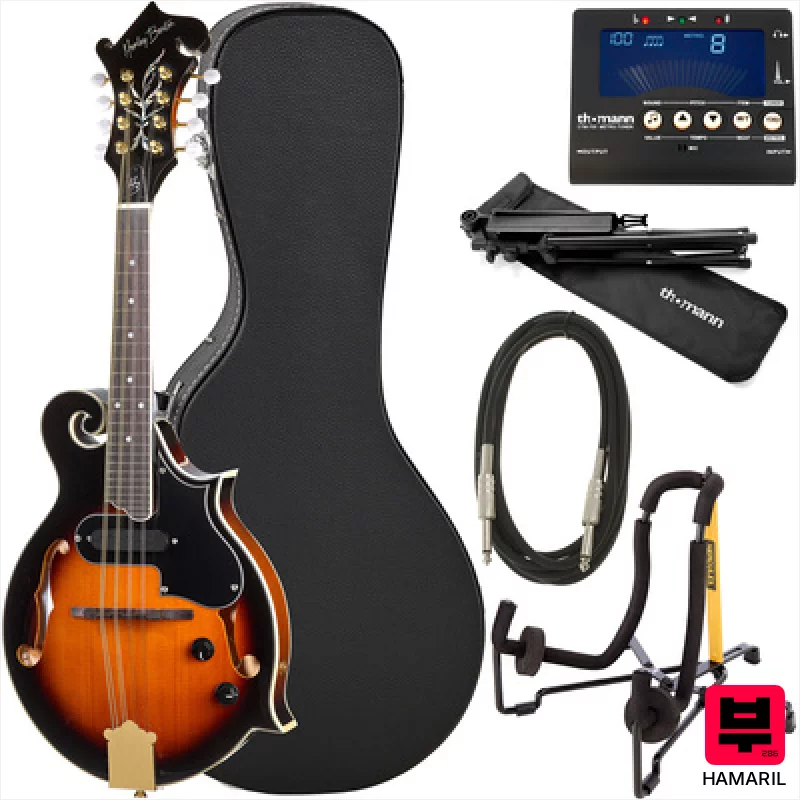
Hamaril Mandolin Set
- • Florentine body offers excellent projection and a classic bluegrass aesthetic.
- • Spruce top contributes a bright, responsive tone suitable for a variety of styles.
- • Magnetic single-coil pickups provide a usable amplified sound, surprisingly versatile.
- • Solid, sturdy case protects the mandolin from damage during transport and storage.
- • Basswood body can lack the tonal complexity of more premium tonewoods.
- • Teak neck, while playable, might feel a bit less refined than maple.
- • Limited onboard controls offer less sonic shaping compared to higher-end models.
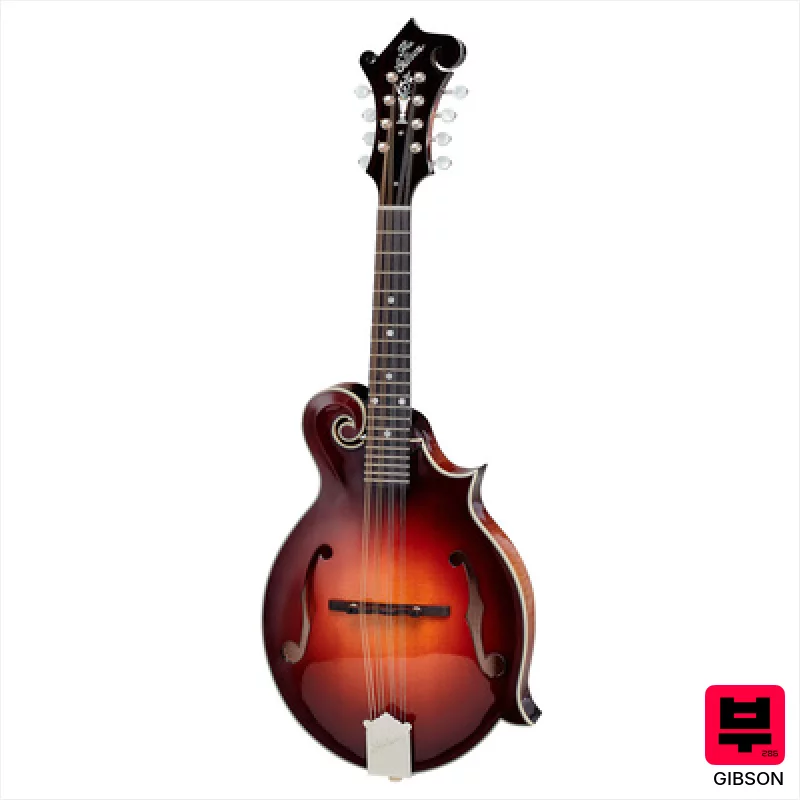
Gibson Custom F-5G Dark Burst
- • Exceptional Sitka spruce top yields clear, responsive projection.
- • Flame maple back and sides offer focused, warm tonal complexity.
- • Wide-thin neck profile provides comfortable, fast playing for varied hands.
- • Impeccable Gibson Custom craftsmanship ensures exceptional build quality and longevity.
- • The Dark Burst finish, while beautiful, can be prone to fingerprints and smudging.
- • The scale length might feel slightly short for players accustomed to longer instruments.
- • Premium-priced, limiting accessibility for many aspiring bluegrass musicians.
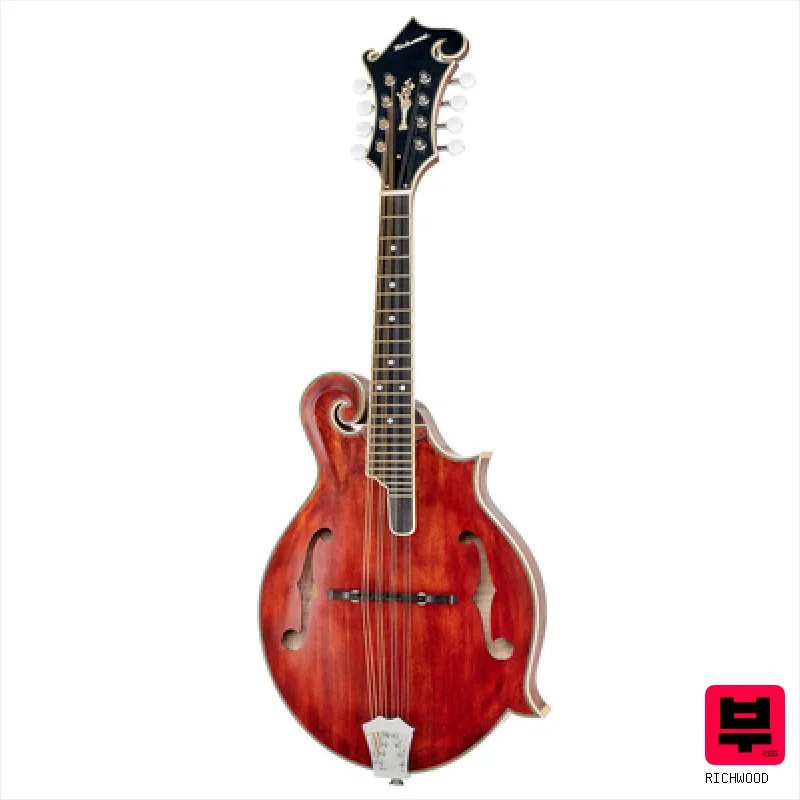
Richwood RMF-220-WN F-Style
- • Solid spruce top delivers bright, cutting bluegrass tone
- • Flamed maple back and sides add visual warmth
- • Ebony fingerboard provides smooth playability
- • 2-Way adjustable truss rod ensures stable tuning
- • Heavy solid wood construction may be difficult for beginners
- • Lacks onboard electronics or pickup options
- • Limited to standard 8-string G-D-A-E tuning

Richwood RMF-80-Nt Mandoline
- • Solid wood construction delivers a surprisingly resonant and warm tone.
- • Ebony fingerboard and bone nut enhance playability and sustain.
- • 2-way adjustable truss rod allows for precise neck relief adjustments.
- • Vintage-style tuners offer reliable tuning stability and a classic aesthetic.
- • The natural matte finish might feel a bit plain for some players.
- • Mahogany back and sides can limit the top-end sparkle compared to maple.
- • While playable, the 28.5mm nut width might feel a bit wide for smaller hands.
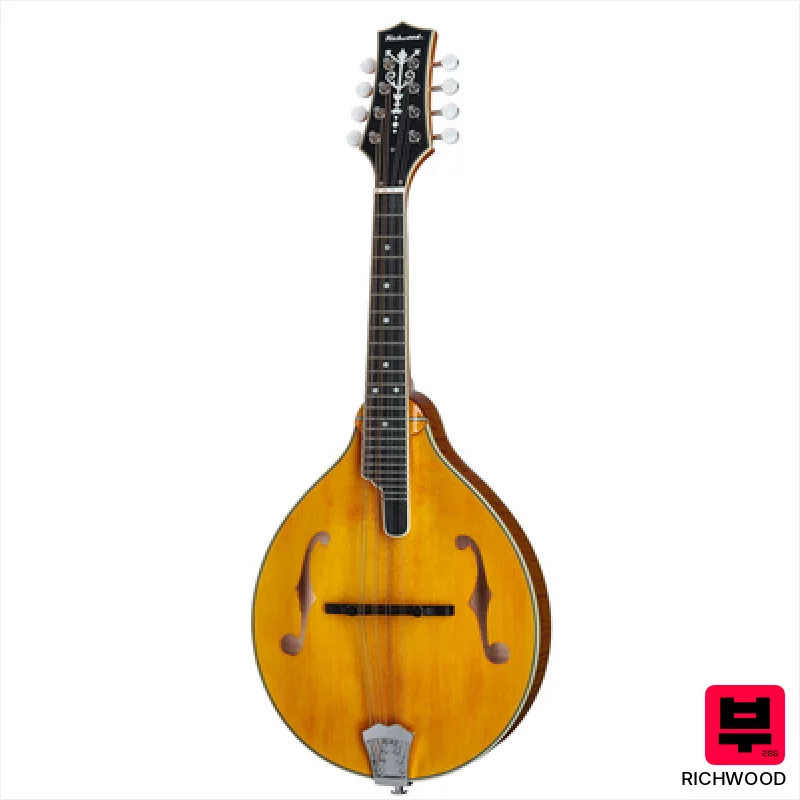
Richwood RMA-110-VS A-Style
- • Solid spruce top delivers a surprisingly bright, responsive tone.
- • Ebony fingerboard offers smooth playability and excellent note definition.
- • Flamed maple back and sides add visual appeal and warmth to the sound.
- • 2-way adjustable truss rod allows for easy neck relief adjustments.
- • Vintage style tuners can feel a bit soft and imprecise for advanced players.
- • Ivoride binding, while functional, isn’t quite the same as true ivory.
- • Solid maple construction can make it a little less forgiving of less-than-perfect technique.
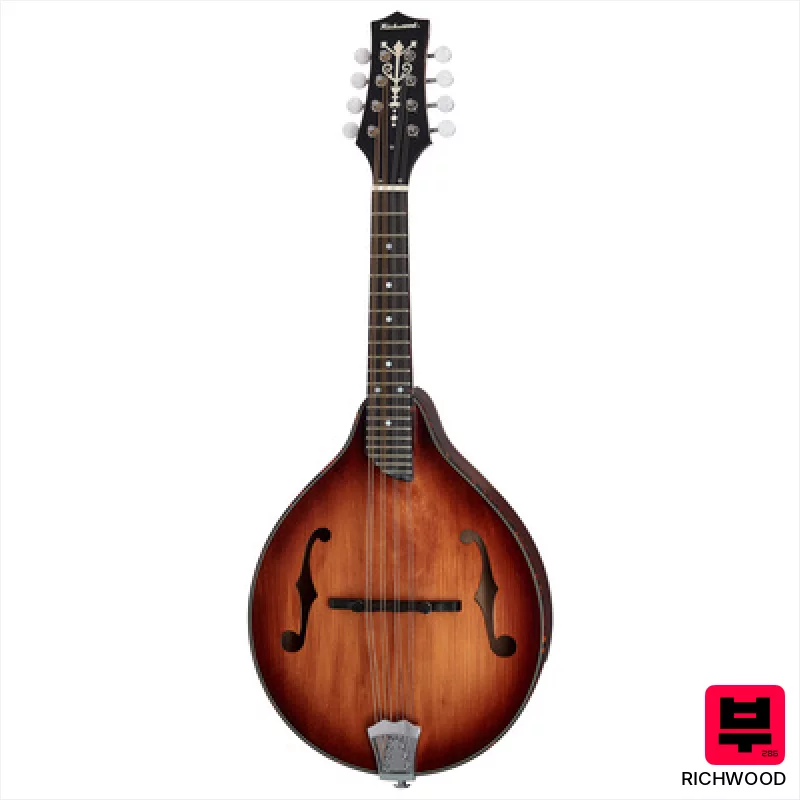
Richwood RMA-90-NT Mandoline
- • Solid spruce top delivers a bright, responsive, and clear tone.
- • Ebony fingerboard provides a smooth, fast playing experience.
- • Solid maple back and sides offer excellent projection and sustain.
- • Vintage-style machine heads allow for precise and stable tuning.
- • Walnut tint finish might be a bit too dark for some players' preferences.
- • Solid construction can make it slightly heavier than some A-style mandolins.
- • While versatile, it's primarily geared towards bluegrass and folk styles.

Harley Benton HBMA-100 VS w/Bag
- • Spruce top delivers surprisingly bright and resonant projection for the price.
- • Teak neck provides a comfortable, stable feel and good sustain.
- • Blackwood fingerboard and bridge contribute to a warmer tonal character.
- • Gig bag is genuinely useful, well-padded, and offers backpack carrying option.
- • Basswood body, while functional, lacks the tonal complexity of maple or mahogany.
- • Factory strings are basic and will likely need an immediate upgrade for optimal tone.
- • Cream binding application is a bit uneven, showing budget-conscious construction.

Harley Benton HBMA-100 VS
- • Spruce top delivers surprisingly bright and articulate bluegrass tones.
- • Teak neck provides a comfortable, stable platform for easy playing.
- • Blackwood fingerboard and bridge contribute to a decent sustain and tone.
- • Gold-plated hardware adds a touch of class and resists corrosion well.
- • Basswood body lacks the resonance of traditional mandolin woods like maple.
- • Factory strings are serviceable, but an upgrade will dramatically improve tone.
- • Cream binding application can be inconsistent, affecting aesthetic appeal.

Harley Benton HBMA-50E Mandoline BK w/Bag
- • Spruce top provides a bright, responsive tone ideal for bluegrass.
- • Magnetic single-coil pickup delivers a surprisingly punchy, amplified sound.
- • Teak neck offers a comfortable playing experience with good stability.
- • Included gig bag and cable provide immediate playability and portability.
- • Basswood body lacks the tonal complexity of more premium woods.
- • Blackwood fretboard, while decent, may show wear faster than ebony.
- • 30mm nut width feels wider than traditional mandolins; adjustment might be needed.

Harley Benton HBMA-50E Mandoline VS w/Bag
- • Spruce top delivers a surprisingly bright and resonant tone for the price.
- • Magnetic pickups offer a unique electric mandolin sound, usable for rock and folk.
- • Nato neck provides a stable platform for comfortable playing and tuning stability.
- • Gigbag is well-padded and practical for transport and protection.
- • Basswood body lacks the tonal complexity of more premium woods like maple.
- • Blackwood fretboard (Pinus Radiata) may show wear faster than ebony.
- • 30mm nut width feels wider than traditional mandolins; takes getting used to.

Harley Benton HBMA-50E Mandoline BK
- • Spruce top delivers a surprisingly bright and articulate tone for the price.
- • Magnetic single-coil pickup offers a usable, amplified bluegrass sound.
- • Teak neck provides a decent playing feel; surprisingly stable for its class.
- • Blackwood fretboard and bridge contribute to a more refined aesthetic than expected.
- • Basswood body lacks resonance; feels somewhat 'dead' acoustically.
- • Chrome hardware feels budget-oriented and may exhibit finish imperfections.
- • 30mm nut width can feel wide for players accustomed to narrower mandolin necks.

Harley Benton HBMA-50E Mandoline VS
- • Spruce top delivers a surprisingly bright and articulate tone for the price.
- • Magnetic pickups offer a unique, amplified mandolin voice suitable for electric genres.
- • Nato neck provides a playable feel, exhibiting decent stability and comfortable action.
- • Blackwood fretboard, while not the highest grade, adds a touch of refinement and warmth.
- • Basswood body lacks the resonance and tonal complexity of more premium woods.
- • Blackwood bridge may be a softer wood, potentially requiring more frequent maintenance.
- • Chrome hardware feels a little cheap and may corrode with humidity over time.

Harley Benton HBMA-50 Mandoline BK w/Bag
- • Spruce top offers a surprisingly bright and responsive fundamental tone.
- • Teak neck provides decent stability and a playable, comfortable feel.
- • Blackwood fretboard, while Pinus radiata, is smoothly finished for ease of playing.
- • The included gig bag is genuinely well-padded and practical for transport.
- • Basswood body lacks tonal complexity; sounds somewhat 'boxy' without amplification.
- • Chrome hardware feels budget-grade; may corrode with humidity over time.
- • 30mm nut width is wider than many mandolins, potentially challenging for smaller hands.

Harley Benton HBMA-50 Mandoline VS w/Bag
- • Spruce top provides a surprisingly bright and responsive tone for the price.
- • Teak neck offers a stable platform and decent playability, a step up from cheaper options.
- • The included gig bag is genuinely useful, offering good protection and portability.
- • Vintage Sunburst finish looks far better than the basic models, adding aesthetic appeal.
- • Basswood body lacks the resonance and tonal complexity of maple or mahogany.
- • Blackwood (Pinus radiata) fretboard is a cost-saving measure; expect slightly rougher feel.
- • Chrome hardware feels a little cheap and may corrode if not properly cared for.

Harley Benton HBMA-50 Mandoline BK
- • Spruce top delivers surprisingly bright and articulate tone for the price.
- • Teak neck provides a comfortable, stable feel for easier playing.
- • Blackwood fretboard offers a smooth playing surface, reducing string noise.
- • Chrome hardware adds a touch of class and should hold up reasonably well.
- • Basswood body lacks the resonance and tonal complexity of mahogany or maple.
- • Pinus radiata blackwood fretboard is a lower-grade wood, potentially prone to wear.
- • High-gloss finish can be a fingerprint magnet and may feel a bit plasticky.
Every mandolins that matches
64 models match this page. The 15 above are covered in detail; the rest are listed here with their published specifications.
| # | Model | Specifications | Price |
|---|---|---|---|
| 16 | Harley Benton HBMA-50 Mandoline VS | Nut width 30 mm (1.18") · Scale 350 mm (13.78") · Frets 20 frets · Body Basswood body | $66 |
| 17 | Gold Tone GME-4 E-Mandoline | Scale 352 mm (13.86") · Frets 20 frets · Body Alder body · Fingerboard Maple fingerboard | $596 |
| 18 | Ibanez M522S-BS | Nut width 30 mm (1.18") · Scale 350 mm (13.78") · Body Maple body · Fingerboard Laurel fingerboard | $517 |
| 19 | Ibanez M522S-DVS | Nut width 30 mm (1.18") · Scale 350 mm (13.78") · Body Maple body · Fingerboard Laurel fingerboard | $438 |
| 20 | Ibanez M510-OVS | Nut width 30 mm (1.18") · Scale 350 mm (13.78") · Body Mahogany body · Fingerboard Laurel fingerboard | $269 |
| 21 | Harley Benton MA-500 SB w/Bag | Scale 350 mm (13.78") · Frets 20 frets · Body Basswood body · Fingerboard Laurel fingerboard | $202 |
| 22 | Harley Benton MA-500 VS Bluegrass Series | Scale 350 mm (13.78") · Frets 20 frets · Body Basswood body · Fingerboard Laurel fingerboard | $134 |
| 23 | Gold Tone F6-Plus | Nut width 44.4 mm (1.75") · Scale 380 mm (14.96") · Frets 21 frets | $1,441 |
| 24 | Gold Tone A-6 Mando Guitar TS | Nut width 46 mm (1.81") · Scale 381 mm (15") · Frets 21 frets | $619 |
| 25 | Gewa VGS Mandoline F-2 Premium | Nut width 30 mm (1.18") · Scale 350 mm (13.78") · Frets 24 frets | $512 |
| 26 | Gewa VGS Mandoline A-Antique | Nut width 30 mm (1.18") · Scale 350 mm (13.78") · Frets 20 frets | $438 |
| 27 | Harley Benton HBMA-100E- VS | Nut width 30 mm (1.18") · Scale 350 mm (13.78") · Frets 20 frets | $223 |
| 28 | Gibson 1923 F-5 Master Model Rei. CB | Scale 353.1 mm (13.9") · Frets 29 frets · Fingerboard Ebony fingerboard | $24,565 |
| 29 | Gibson Sierra Hull F-5G VOS SB | Scale 353 mm (13.9") · Frets 20 frets · Fingerboard Ebony fingerboard | $9,239 |
| 30 | Ortega RMF200PF Mandoline | Scale 350 mm (13.78") · Frets 24 frets · Fingerboard Maple fingerboard | $1,385 |
| 31 | Ortega RMFE200PF Mandoline | Scale 350 mm (13.78") · Frets 24 frets · Fingerboard Maple fingerboard | $1,385 |
| 32 | Ortega RMAE200PF Mandoline | Scale 350 mm (13.78") · Frets 20 frets · Fingerboard Maple fingerboard | $1,002 |
| 33 | Ortega RMFE100AVO | Scale 345 mm (13.58") · Frets 24 frets · Fingerboard Ebony fingerboard | $945 |
| 34 | Ortega RMA200PF Mandoline | Scale 350 mm (13.78") · Frets 20 frets · Fingerboard Maple fingerboard | $906 |
| 35 | Gold Tone GM-10 Frypan Mandoline w/Case | Scale 349 mm (13.74") · Frets 18 frets · Fingerboard Ebony fingerboard | $833 |
| 36 | Epiphone F-5 Studio WR Satin | Scale 353 mm (13.9") · Frets 20 frets · Fingerboard Laurel fingerboard | $675 |
| 37 | Ortega RMFE90TS | Scale 345 mm (13.58") · Frets 24 frets · Fingerboard Rosewood fingerboard | $675 |
| 38 | Gold Tone GME-5 E-Mandoline | Scale 349 mm (13.74") · Frets 20 frets · Body Alder body | $652 |
| 39 | Epiphone F-5 Studio VS Satin | Scale 353 mm (13.9") · Frets 20 frets · Fingerboard Laurel fingerboard | $596 |
| 40 | Richwood RMF-100-VS Mandoline | Scale 350 mm (13.78") · Frets 24 frets · Fingerboard Ebony fingerboard | $540 |
| 41 | Ortega RMFE30-WB | Scale 350 mm (13.78") · Frets 22 frets · Fingerboard Rosewood fingerboard | $371 |
| 42 | Ortega RMF30-WB | Scale 350 mm (13.78") · Frets 24 frets · Fingerboard Rosewood fingerboard | $314 |
| 43 | Ortega RMAE30-WB | Scale 350 mm (13.78") · Frets 20 frets · Fingerboard Rosewood fingerboard | $247 |
| 44 | Ortega RMA30-WB LH | Scale 350 mm (13.78") · Frets 20 frets · Fingerboard Rosewood fingerboard | $240 |
| 45 | Ortega RMA30-WB | Scale 350 mm (13.78") · Frets 20 frets · Fingerboard Rosewood fingerboard | $201 |
| 46 | Ortega RMA31-WSB | Scale 350 mm (13.78") · Frets 20 frets · Fingerboard Rosewood fingerboard | $179 |
| 47 | The Loar LM-700 F-Mandolin VS | Scale 350 mm (13.78") · Frets 29 frets | $1,126 |
| 48 | Gold Tone F-6 | Nut width 44.4 mm (1.75") · Scale 378 mm (14.88") | $731 |
| 49 | The Loar LM-590-MS | Scale 349 mm (13.74") · Frets 20 frets | $619 |
| 50 | Ortega RMFE40SBK | Scale 345 mm (13.58") · Frets 24 frets | $517 |
| 51 | The Loar LM-310F-BRB | Scale 349 mm (13.74") · Frets 20 frets | $405 |
| 52 | Ortega RMAE40SBK-L | Scale 345 mm (13.58") · Frets 20 frets | $385 |
| 53 | The Loar LM-110 Honey Creek BRB | Scale 353 mm (13.9") · Frets 20 frets | $303 |
| 54 | Recording King RFM-3-TS Mandoline | Scale 348 mm (13.7") · Frets 20 frets | $258 |
| 55 | Recording King RFM-3-BK Mandoline | Scale 348 mm (13.7") · Frets 20 frets | $258 |
| 56 | Recording King RAM-3-TS Mandoline | Scale 348 mm (13.7") · Frets 20 frets | $202 |
| 57 | Richwood RMA-60-VS A-Style Mandoline | Nut width 31 mm (1.22") · Scale 350 mm (13.78") | $202 |
| 58 | Recording King RAM-3-BK Mandoline | Scale 348 mm (13.7") · Frets 20 frets | $168 |
| 59 | Epiphone Mandobird Vintage Sunburst | Strings 4-string · Fingerboard Laurel fingerboard | $375 |
| 60 | The Loar LM-520-VS | Scale 350 mm (13.78") | $652 |
| 61 | The Loar LM-310E-BRB | Scale 353 mm (13.9") | $562 |
| 62 | The Loar LM-110E-BRB | Scale 353 mm (13.9") | $450 |
| 63 | Richwood RMF-60-VS F-Style Mandoline | Scale 350 mm (13.78") | $337 |
| 64 | Ibanez M510E-BS | Nut width 30 mm (1.18") | $269 |
Mandolins by the numbers
Measured across all 64 models in this category, so «wide», «short» or «expensive» mean something you can check.
How to Choose the Best Mandolins
Construction (Solid vs. Laminated Wood
Solid wood tops - usually spruce - vibrate more freely and offer better tonal complexity and responsiveness, but they're pricier. Laminated woods are more stable and cheaper, but you'll sacrifice some sustain and richness. For gigging, a solid top is worth the investment.
Tonewoods
Spruce is the standard for the top, giving you that classic bright bluegrass tone. Mahogany offers a warmer, woodier sound. Maple tends to be punchy and clear. The back and sides wood choice significantly impacts the overall tone and projection.
Bracing Pattern
The internal bracing affects the mandolin's tone and structural integrity. Modern 'X' bracing is common, but older, more traditional patterns can offer a unique sonic character. It's a subtle difference, but experienced players will hear it.
Neck Profile & Action
A comfortable neck profile is critical for fast playing and avoiding fatigue. Lower action (string height) makes it easier to play but can lead to fret buzz if not properly set up. A good setup is essential, regardless of the mandolin's price.
Hardware & Tailpiece
A quality tailpiece can improve sustain and tuning stability. Cheap tailpieces often feel flimsy and can contribute to a dull tone. Upgrading hardware is a relatively inexpensive way to improve the overall feel and sound of a mandolin.
Buying Guide
Don't be swayed by flashy finishes or low prices. A mandolin's tone is all about the wood and construction, and that costs money. Be wary of mandolins with overly bright, ice-picky high-end - that usually indicates poor construction or cheap materials. Spend a little more for a solid-top instrument with a good setup; you'll thank yourself when you're gigging or tracking in the studio.
How This List Is Built
We don't play these instruments — we're a catalog, not a review desk, and we'd rather say so than pretend otherwise. This page covers 64 mandolins from the Thomann catalogue, which is the largest single source of specification data in this category: 15 in detail, the rest listed with their specifications.
Position is computed, not curated. We parse the manufacturer's own description into actual values — nut width, scale, fret count, fingerboard radius, size, alloy — and rank on them: how many specifications a model has published, how many of them are measurable numbers, and how precisely it meets this page's criterion. A product image adds a little. Price is not a ranking signal: it tells you nothing about whether a neck fits your hand. The same inputs always produce the same order, so nothing here is shuffled to look fresh.
What this list is good for: narrowing a category down to a shortlist by spec and budget. What it isn't: a substitute for hearing an instrument. Before you buy, read hands-on reviews and, where you can, play it. Full methodology.

