
Every pedal lists three numbers next to its power jack: voltage, polarity and current. The first two are almost always the same; the third varies a lot. Here is what pedals at Thomann list, in the descriptions that give a current draw:
| Pedal type | With a listed draw | Median | 9 in 10 draw up to |
|---|---|---|---|
| Drive pedals | 373 | 20 mA | 120 mA |
| Delay | 100 | 130 mA | 350 mA |
| Reverb | 78 | 115 mA | 350 mA |
| Multi-effects | 60 | 600 mA | 2,500 mA |
Analog drive pedals sip power. Digital delays and reverbs need several times more.
The three numbers
Voltage. Most pedals run on 9 V DC. Some take 12 or 18 V, which gives more headroom; never feed a pedal more than its label says.
Polarity. The standard is center negative with a 2.1 mm barrel plug, the Boss style. Some pedals, often vintage-style fuzzes, are center positive and need a converter cable.
Current. The supply's output has to give at least what the pedal draws. More is fine: the pedal only takes what it needs. Too little and it hums, crackles or doesn't start.
Isolated or daisy chain?
A daisy chain is one adapter with a cable that splits to several pedals. It's cheap, but all pedals share one ground, and mixing digital and analog pedals on it often brings hum and whine.
An isolated supply gives each pedal its own separate output. It costs more and stops most of that noise. Thomann had 198 power supply products in stock, adapters and cables included; 82 of them are described as isolated, at a median of $154.
How to size one
1. List your pedals and their draws from the labels or manuals.
2. Check each pedal against the output it will use: a 300 mA reverb needs an output of 300 mA or more.
3. Count outputs and leave one or two spare for the next pedal.
4. Note any 12 or 18 V pedals, and any center-positive ones.
Three isolated supplies
Walrus Audio Canvas Power 8, $285
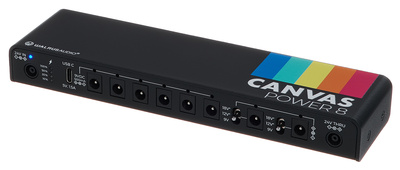
Eight isolated outputs of 500 mA each, two of them switchable to 12 or 18 V, slim enough to fit under small Pedaltrain boards, and a link output for expansion modules. It ranks first of 180 power supplies. #1 of 179 guitar effect power supplies.
MXR M239 Mini Iso-Brick, $127
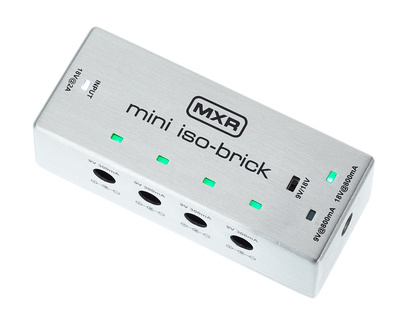
Five isolated outputs: four of 9 V at 300 mA and one of 9 or 18 V at 800 mA, with a status light for each and cables included. It ranks 12th. #13 of 179 guitar effect power supplies.
Harley Benton PowerPlant Junior, $43
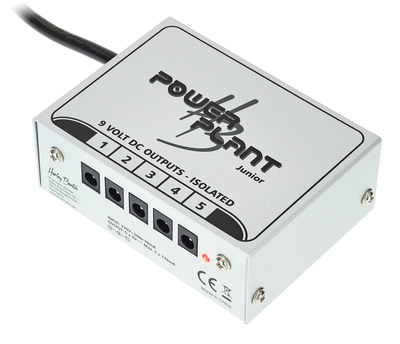
Five galvanically isolated 9 V outputs of 120 mA each, with a cable set. Enough for a board of analog pedals; a digital reverb may want more than 120 mA. #55 of 179 guitar effect power supplies.
Where the numbers come from. Every pedal and power supply Thomann had in stock on November 9, 2026, from its partner feed. Current draws are read from the descriptions that list one, as power consumption or current draw. Isolated supplies are those whose description says so. Places are from our power supply ranking. Prices are Thomann's US prices.
Share this story

Denis Kataev runs AudioFu. Every night the site records the prices of more than 38,000 instruments and studio tools at Thomann, and he writes about what those numbers show: what got cheaper, what just arrived, and which discounts are real.
All stories by Denis Kataev →


