
Every pedal changes the signal it gets from the one before it. That is the whole logic of pedal order: a delay repeats whatever reaches it, so if the delay comes before the distortion, the repeats get distorted too. The standard chain puts the pedals that shape your basic tone first and the ones that add space last.
The standard order
| # | Pedal | Why here |
|---|---|---|
| 1 | Tuner | Gets the cleanest signal, and can mute everything after it while you tune |
| 2 | Wah and filters | React best to the dynamics of the raw guitar |
| 3 | Compressor | Evens out the signal before it hits the drive |
| 4 | Overdrive, distortion, fuzz | The core of your tone |
| 5 | Noise gate | Cleans up the hiss the drive just added |
| 6 | Chorus, phaser, flanger | Move the already-shaped tone |
| 7 | Delay | Repeats the finished sound |
| 8 | Reverb | The room around everything |
| 9 | Looper | Records the whole chain as you hear it |
The pedals that shape the tone: 1 to 5
Dunlop Cry Baby GCB95, $159

The classic wah. Early in the chain it sweeps the clean guitar, and the drive after it turns the sweep into a vocal, cutting sound. #2 of 74 wah pedals.
A compressor such as the Boss CS-3 at $121 goes before the drive so that quiet and loud notes hit it at a similar level.
Boss DS-1X, $175

Boss's digital take on the DS-1 distortion. Several drives can go in a row: a lighter overdrive before a heavier one usually sounds better than the other way round. #1 of 545 distortion pedals.
The pedals that add space: 6 to 9
Modulation like the MXR Phase 90 ($104) comes after the drive, so it moves the distorted sound instead of being smeared by it.
MXR Carbon Copy, $193
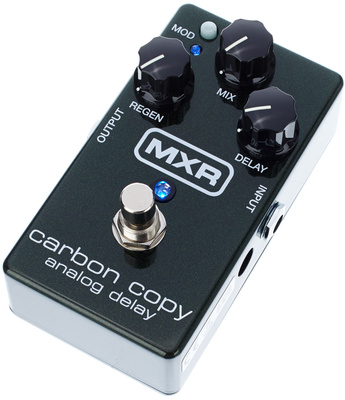
An analog delay with up to 600 ms of repeats. After the drive, the repeats stay clean and separate; before it, they turn into mush. #5 of 150 delay / echo pedals.
Electro-Harmonix Holy Grail Nano, $132
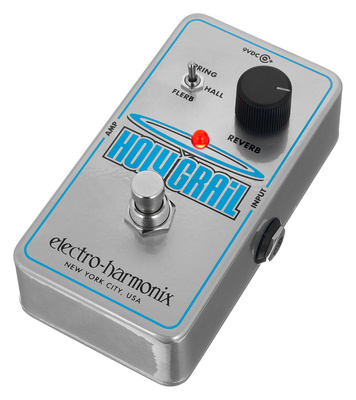
Reverb goes after the delay, because in a real room, echoes also reverberate. #5 of 124 reverb pedals.
At the very end, a looper such as the Boss RC-1 ($118) records exactly what the audience hears.
The effects loop
Many amps have an effects loop: a send and a return between the preamp and the power amp. If you get your distortion from the amp rather than from pedals, put modulation, delay and reverb in the loop. In front of the amp they would be distorted by its preamp; in the loop they come after it, just like in the chain above.
Three exceptions worth trying
- Fuzz before the wah. Many vintage-style fuzz pedals sound right only when they see the guitar's pickups directly, so fuzz goes first, sometimes even before the tuner.
- Compressor after the drive. It flattens the distorted signal into long, even sustain, at the cost of more noise.
- Reverb before delay. The repeats come out as washed-out clouds instead of clean echoes, a classic ambient sound.
The rule of thumb: tone first, space last. Everything else is taste, and pedal cables are cheap enough to try every order you can think of.
Where the numbers come from. Prices from Thomann's partner feed on October 31, 2026, which we read every night. The pedals shown are among the highest-ranked in their category under $200 in our AudioFu Index.
Share this story

Denis Kataev runs AudioFu. Every night the site records the prices of more than 38,000 instruments and studio tools at Thomann, and he writes about what those numbers show: what got cheaper, what just arrived, and which discounts are real.
All stories by Denis Kataev →


