
On November 9, 2026, Thomann had 572 drive pedals in stock. Sorted by their names and descriptions, 302 are overdrives, 132 fuzzes and 117 distortions; the rest are boosts and preamps.
| Overdrive | Distortion | Fuzz | |
|---|---|---|---|
| In stock | 302 | 117 | 132 |
| Median | $188 | $144 | $199 |
| Under $100 | 77 | 39 | 28 |
| Most models | JHS, Tone City, Wampler | MXR, Boss, Tone City | Electro-Harmonix |
How they differ
All three clip the signal: they push it harder than the circuit can pass, and the flattened peaks are what you hear as grit. The difference is how hard and how.
Overdrive clips softly, the way a tube amp does when you turn it up. Play lightly and it cleans up, dig in and it growls; turn the guitar's volume down and it gets cleaner. It's the sound of blues, classic rock and country, and many players use it to push an amp that is already a little dirty.
Distortion clips harder. More gain, more sustain and more compression, so every note comes out at a similar level and dynamics matter less. It's the sound of hard rock, punk and metal.
Fuzz clips hardest, until the wave is close to a square. The result is thick, woolly and fizzy, with long sustain: the 1960s sound, and the wall of guitar in stoner rock and shoegaze. Fuzz circuits are often the simplest of the three, yet fuzz has the highest median price. It's a favourite of small builders.
Distortion has the lowest median, $144: the big brands sell the classics cheaply.
The classic of each
Overdrive: Boss SD-1, $87
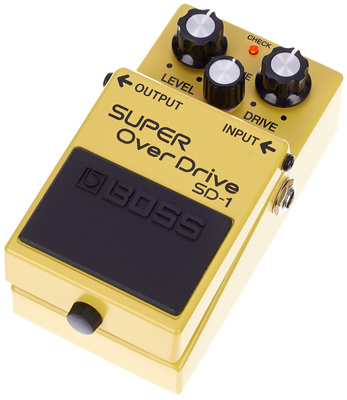
Warm, soft, tube-like overdrive with three controls: level, tone and drive. It ranks fifth of 544 drive pedals. #10 of 528 distortion pedals.
Distortion: Boss DS-1, $98
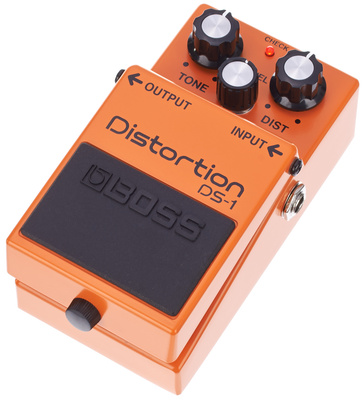
Level, distortion and tone. The description promises the attack stays clear even at full distortion, and at low settings it works as a booster. It ranks first. #1 of 528 distortion pedals.
Fuzz: Electro-Harmonix Nano Big Muff, $76

The Big Muff circuit in a smaller box, with volume, sustain and tone. It ranks sixth. #8 of 528 distortion pedals.
Which first?
- Blues, classic rock, country, or you want your amp to sound pushed: overdrive.
- Hard rock, punk, metal, on a clean amp: distortion.
- 60s rock, stoner, doom, shoegaze: fuzz.
- Not sure: an overdrive. It's the most versatile, and later you can stack it in front of a distortion for more gain.
In a chain, drive pedals usually go after the tuner, compressor and wah, and before modulation, delay and reverb. Many fuzzes like to be first, right after the guitar.
Where the numbers come from. Every pedal in Thomann's distortion pedal category in stock on November 9, 2026, from its partner feed. We sorted them as overdrive, distortion or fuzz by the type in the model name, or else by the first type named in the description; pedals that do more than one are counted once. Places are from our distortion pedal ranking. Prices are Thomann's US prices.
Share this story

Denis Kataev runs AudioFu. Every night the site records the prices of more than 38,000 instruments and studio tools at Thomann, and he writes about what those numbers show: what got cheaper, what just arrived, and which discounts are real.
All stories by Denis Kataev →


