
Every microphone turns air pressure into an electrical signal, and there are three common ways to do it. The way a mic does it decides how it sounds, what it can survive and how much it costs. At Thomann, the median dynamic microphone costs $193, the median condenser $479 and the median ribbon $1,402.
| Dynamic | Condenser | Ribbon | |
|---|---|---|---|
| How it works | A coil moves in a magnetic field | A thin diaphragm next to a charged plate | A strip of thin metal between magnets |
| Needs power | No | Yes, phantom power | Passive ribbons no, active ribbons yes |
| Sound | Focused, forgiving | Detailed, airy | Smooth, dark top end |
| Loud sources | Handles anything | Most handle a lot | Careful with blasts of air |
| Room noise | Picks up little | Picks up a lot | Picks up front and back |
| In stock at Thomann | 354 | 636 | 61 |
| Median price | $193 | $479 | $1,402 |
Dynamic: the one that survives everything
A dynamic mic is the toughest and the cheapest. It needs no power, takes the full blast of a snare drum or a guitar cabinet, and ignores much of the room around it, which is why it is the standard on stage.
Shure SM57, $124

The instrument version of the SM58, on snare drums and guitar amps on countless records and stages. #2 of 23 amp microphones.
The Sennheiser MD 421 Kompakt at $287 is the classic for toms and bass amps, and the Electro-Voice RE20 at $692 the broadcast dynamic that also works on kick drums.
Condenser: the one that hears everything
A condenser's diaphragm is light enough to follow the tiniest movement of air. That is why it is the studio choice for vocals, acoustic guitars and overheads, and also why it records your fridge, your street and the echo of your walls. It needs phantom power, which every audio interface provides.
AKG C214, $418
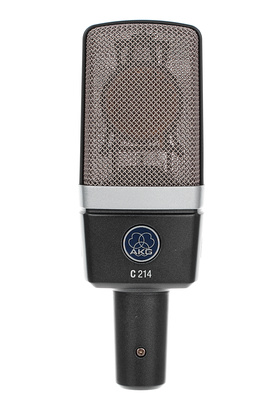
A large-diaphragm cardioid built around the capsule of AKG's C414. #9 of 217 large diaphragm microphones.
Entry condensers start very low: the Audio-Technica AT2020 is $103 and the Rode NT1 $140. Neumann's TLM 102 at $759 is the usual first step into Neumann.
Ribbon: the one that sounds like old records
A ribbon mic hangs a strip of metal a few microns thick between two magnets. Most ribbons hear equally from the front and the back (a figure-8 pattern); they roll off the harshest highs and make a bright guitar cabinet, a trumpet or a cymbal sound rounder.
Royer R-121, $1,786
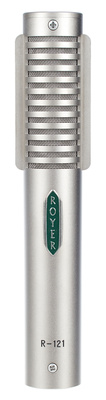
The ribbon a lot of studios put in front of guitar cabinets, and on brass and overheads. #20 of 40 ribbon microphones.
Ribbons aren't only expensive: the cheapest at Thomann, from the t.bone and Superlux, cost $111, and sE Electronics' VR1 Voodoo is $479. Two things to know: a ribbon is quieter than a condenser, so it wants a preamp with plenty of gain, and the figure-8 pattern means the back of the mic hears the room too.
Which one for what
- Vocals on stage: dynamic.
- Vocals at home, in a quiet room: condenser. In a noisy one, a dynamic (see How to choose a microphone for your voice).
- Guitar amp: dynamic, or a ribbon if you want it smoother; many engineers use both together.
- Acoustic guitar, piano, overheads: condenser.
- Brass and strings that sound too bright: ribbon.
- Kick drum, toms, bass amp: dynamic.
Where the numbers come from. Every microphone Thomann had in stock on October 31, 2026, from its partner feed, without wireless, headset, lapel and installation mics. We sorted them by type from Thomann's categories and product descriptions. Prices are Thomann's US-dollar prices.
Share this story

Denis Kataev runs AudioFu. Every night the site records the prices of more than 38,000 instruments and studio tools at Thomann, and he writes about what those numbers show: what got cheaper, what just arrived, and which discounts are real.
All stories by Denis Kataev →


