
A monophonic synth plays one note at a time: bass lines, leads, the acid squelch. A polyphonic one plays chords, so it can do pads and keyboard parts. A groovebox puts drums, synth sounds and a sequencer in one box, so it plays whole loops by itself.
On November 3, 2026, Thomann had these in stock, counting keyboard synths and desktop modules together and leaving out bundles:
| Kind | Models | Median price | Under $500 |
|---|---|---|---|
| Monophonic | 44 | $428 | 27 |
| Paraphonic (a few notes through one filter) | 16 | $419 | 9 |
| Polyphonic | 190 | $1,017 | 32 |
| Groovebox | 19 | $560 | 8 |
Polyphony costs money: every extra voice needs its own oscillators and filter, so a polysynth's median price is more than twice a monosynth's. That is also why so few polys sit under $500.
Monophonic: to learn how sound is built
A monosynth has one signal path, usually with one knob per job: oscillator, filter, envelope. Turn any of them and you hear exactly what it does, which makes it the quickest way to understand synthesis. It is also what most bass lines and leads in electronic music were made on.
Korg Monologue, $320

An analog monosynth with 25 keys, a 16-step sequencer that can also record four knob movements, 100 program slots and battery power. #6 of 211 general synthesizers.
On the desktop side, without keys, Behringer's Model D copy of the Minimoog costs $223 and its TD-3 analog bass line synth, a 303-style acid box, $111. The TD-3 is #2 of 147 sound modules in our ranking. You would play them from a MIDI keyboard or their own sequencer.
Polyphonic: to play chords
Choose a poly if you already play keys and want to play songs, or want pads and chords under your music. Four voices is the usual entry point, enough for most chords.
Korg Minilogue XD, $639
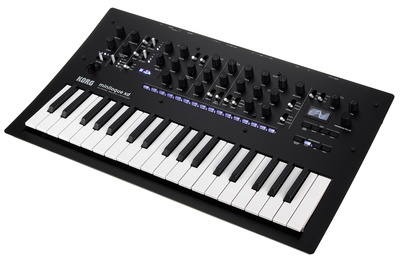
Four voices, each with two analog oscillators plus a digital one for FM and wavetables, 37 slim keys, a sequencer and built-in delay and reverb. #10 of 211 general synthesizers.
In between sits Arturia's MicroFreak at $324, #3 of 211 synths in our ranking: a digital oscillator with many synthesis types, an analog filter and four paraphonic voices on a flat touch keyboard. Yamaha's Reface CS, $435 and also #3, is a small eight-voice polysynth with 37 mini keys that switches to mono mode.
Groovebox: to finish tracks
A groovebox is for people who want to make music more than they want to study sound. Drums, bass and chords are all inside, on a sequencer you program with pads or buttons.
Korg Electribe, $425
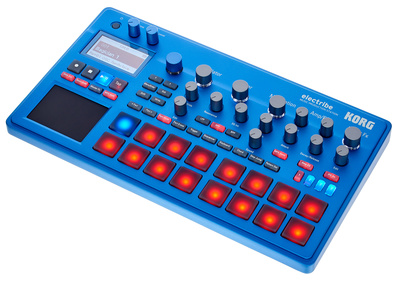
16 parts, 16 velocity pads, a 64-step sequencer, 24 voices and 70 effects, with patterns saved to an SD card. #6 of 29 groove boxes.
Roland's MC-101, $510, adds sample import and runs on batteries. At the top of the groovebox ranking sit Roland's MC-707 at $1,026 and AKAI's MPC One G2 at $930, which work more like a studio without a computer.
How to choose
- You want to understand synthesis and make bass lines: a monosynth, $150 to $500.
- You play keys and want chords: a four-voice polysynth, about $500 to $700 at the entry level.
- You want finished loops without a computer: a groovebox, $400 to $600 to start.
- You already make music in a DAW: a monosynth or a poly, whichever matches the part you are missing. The computer is your groovebox already.
Whatever you choose, check that it has MIDI or USB. A first synth stops being the only one sooner than you think, and the second has to talk to it.
Where the numbers come from. Every synthesizer, desktop sound module and groovebox Thomann had in stock on November 3, 2026, from its partner feed, without bundles and cases. Monophonic, paraphonic and polyphonic are taken from the voice counts in Thomann's descriptions; 102 models don't state them clearly and are left out of the table. Places are from our rankings of synthesizers, sound modules and grooveboxes.
Share this story

Denis Kataev runs AudioFu. Every night the site records the prices of more than 38,000 instruments and studio tools at Thomann, and he writes about what those numbers show: what got cheaper, what just arrived, and which discounts are real.
All stories by Denis Kataev →


