AudioFu Chart · October 2026
Best Wireless Audiotransmitters for Professional 2026
The top pick is Mipro ACT-800 MM-100 Quad Set 5UA ($7,537). Xvive U3 Wireless Microphone System gives you the most for the money at $421. Ranked by the AudioFu Index from 42 models across 20 brands, prices checked every night.
Last updated: October 19, 2026
Top 10
Full detail for the 10 highest AudioFu Index scores. Every other model is listed below.
-
- Weight2.6 kg
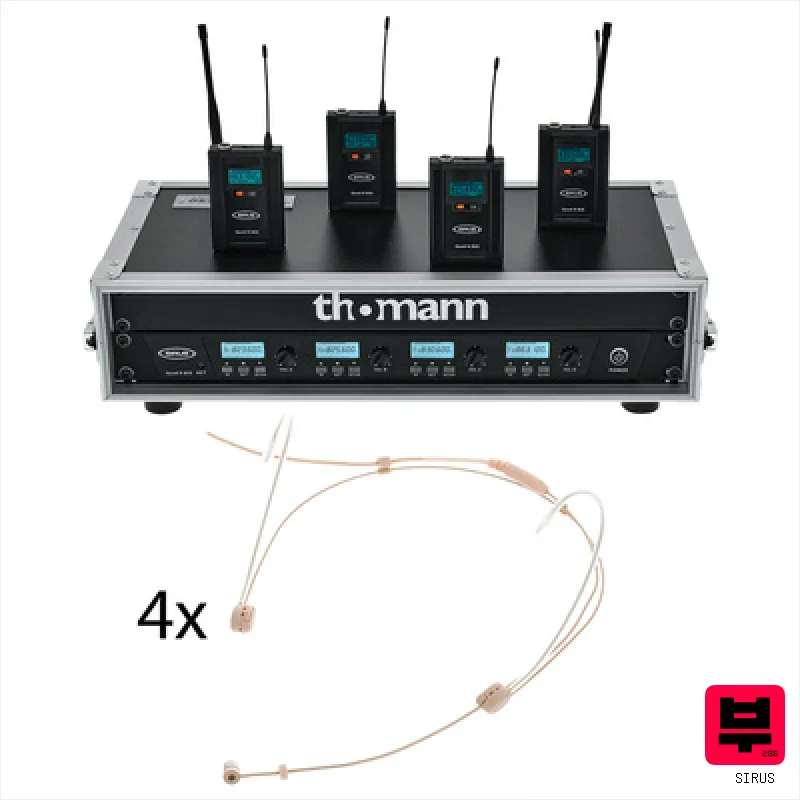
This Mipro quad set is a serious piece of kit for live sound engineers and broadcast professionals needing rock-solid wireless performance. The wide bandwidth and digital features make it a great choice for venues with challenging RF conditions. It’s a workhorse system, built to handle demanding gigs and deliver pristine audio.
Pros
- Exceptional 72MHz bandwidth offers unmatched channel flexibility.
- ACT automatic channel targeting simplifies setup in crowded RF environments.
- AES/EBU digital output caters to professional recording setups.
Cons
- Premium-priced, representing a significant investment for most users.
- Limited frequency range compared to some competing systems.
28AudioFu
IndexStableno change since Aug 17Aug 17$7,537 now$7,537€6,698 at Thomann · in stockCheck price ↗ -
- Size19"
- Weight0.97 kg
This is a game-changer for large institutions like universities or hospitals needing a scalable, reliable audio distribution system. It cleverly leverages existing WiFi infrastructure to deliver crystal-clear audio directly to users' headphones or hearing aids, effectively transforming smartphones into personal listening devices. It’s a high-end solution, but the management and scalability features are truly compelling.
Pros
- Excellent audio clarity via WiFi, minimizing RF interference common in crowded spaces
- Dante connectivity offers seamless integration with existing networked audio systems
- MobileConnect Manager provides centralized control and monitoring for large deployments
Cons
- Premium-priced, representing a significant investment for smaller organizations
- Reliance on WiFi infrastructure necessitates robust network coverage and security
50AudioFu
IndexStableno change since Aug 17Aug 17$5,512 now$5,512€4,898 at Thomann · in stockCheck price ↗ -
This system packs eight receivers and one transmitter into a single box that weighs about nine kilograms. It lets you run two separate audio feeds, either as stereo or two mono channels. The IP44 rating means you can use it outdoors without worrying about rain or dirt. It is a solid choice for venues needing reliable wireless coverage.
Pros
- Handles two independent mono or stereo audio channels easily
- IP44 rated receiver protects against rain and dust well
- Adjustable delay up to 800 ms reduces echo effects
Cons
- Frequency response listed only for 470 to 506 Hz
- No battery life duration information provided in text
32AudioFu
IndexStableno change since Aug 17Aug 17$5,512 now$5,512€4,898 at Thomann · in stockCheck price ↗ -
Listen Technologies LW-120-02-09 hearing loop Set
Not on Reverb yet1 finish at Thomann
- Weight0.59 kg
This Listen Technologies system is a serious piece of kit for large-scale accessibility and interpreting needs. The WiFi streaming approach is smart for scalability and the app customization is a real bonus for organizations wanting to add branding. It's premium-priced and requires some tech savvy to get running smoothly, but delivers a powerful solution.
Pros
- Dual-channel flexibility accommodates diverse audio needs.
- WiFi streaming offers scalability beyond traditional looping.
- Listen Everywhere app allows for custom branding opportunities.
Cons
- High initial investment makes it less accessible for smaller venues.
- Network dependency introduces potential latency and reliability concerns.
25AudioFu
IndexStableno change since Aug 17Aug 17$4,274 now$4,274€3,798 at Thomann · in stockCheck price ↗ -
This is a solid choice if you need two wireless mics that won't let your audio get intercepted. The metal body feels professional, and the quick setup via IR saves a lot of time. Just keep in mind you'll need to buy AA batteries or buy the optional power kit. It works well for live sound where security and reliability matter most.
Pros
- Sturdy aluminium housing protects against bumps and drops on stage.
- 256-bit AES 256-CTR encryption keeps your audio signal completely secure.
- Fast IR setup lets you get broadcasting in seconds without fiddling.
Cons
- Rechargeable battery life is unknown; relies on disposable AA cells.
- No dedicated USB-C power option; needs external DC adapter or batteries.
17AudioFu
Index↑ 2.7%since Aug 17$4,219 · Aug 17$4,331 now$4,331€3,849 at Thomann · in stockCheck price ↗ -
Listen Technologies LW-120-02-09 Conference Set
Not on Reverb yet1 finish at Thomann
- Weight0.59 kg
This Listen Technologies system is a serious piece of kit for venues needing scalable, WiFi-based audio distribution. It’s a solid choice for conference interpreting, large church services, or any situation where you need to deliver clear audio to a huge audience via their smartphones – just be mindful of the network's stability and potential latency.
Pros
- Scalable user capacity of 500 is exceptional for large events.
- WiFi streaming offers flexibility beyond dedicated receiver hardware.
- Customizable app provides branding and informational opportunities.
Cons
- 40-60ms latency can be noticeable for real-time critical applications.
- Reliance on user's smartphones introduces potential device compatibility issues.
25AudioFu
Index↑ 1.1%since Aug 17$3,936 · Aug 17$3,978 now$3,978€3,535 at Thomann · in stockCheck price ↗ -
- Weight0.91 kg
This bundle gives you two receivers and a full kit for solid venue use. It is a practical choice when you need multiple channels without buying parts separately. The description confirms the hardware but leaves out key specs like range and battery life.
Pros
- Includes two receivers for multi-channel setups
- Comes with a complete transmission kit
- Designed for reliable venue performance
Cons
- Lacks detailed frequency band specifications
- No stated range distance in the text
40AudioFu
IndexStableno change since Oct 17Oct 17$3,486 now$3,486€3,098 at Thomann · in stockCheck price ↗ -
Xvive U3 Wireless Microphone System
U3D Dual Wireless for PA/DJ · XVive
32 for sale on Reverb6 finishes at Thomann
The XVive U3D is a solid, practical wireless solution for DJs and vocalists needing a straightforward, reliable setup. Its digital transmission and low latency make it ideal for tight performances, and the integrated battery is a huge convenience. This is a great choice for smaller venues or mobile setups where simplicity and ease of use are key.
Pros
- Excellent 2.4GHz digital clarity, avoiding common RF interference.
- Rugged ABS housing offers good protection for live performance use.
- Low latency (<5ms) ensures tight synchronization for DJs and vocalists.
Cons
- The ABS housing, while durable, lacks the premium feel of metal alternatives.
- Limited channel selection (6) might restrict use in densely populated RF environments.
79AudioFu
Index↓ 2.9%since Aug 17 · lowest so far$433 · Aug 17$421 now$421€374 at Thomann · in stockCheck price ↗ -
The XVive U35D is a surprisingly capable and convenient dual wireless system. It’s a great option for DJs, smaller bands, or anyone needing flexible microphone solutions without the hassle of batteries or cables. The low latency makes it feel incredibly responsive for live performance.
Pros
- Excellent dynamic range ensures clean, clear audio even in loud environments.
- 5.8 GHz band minimizes interference compared to congested 2.4 GHz systems.
- Battery-free operation simplifies setup and eliminates external power needs.
Cons
- 30m range can be limiting for larger venues or complex stage layouts.
- Lack of XLR outputs on the transmitters restricts connection options.
44AudioFu
IndexStableno change since Aug 17Aug 17$483 now$483€429 at Thomann · in stockCheck price ↗ -
- Weight0.08 kg
The LWR-1050-E0 is a solid receiver for environments where you're already using the ListenWIFI system—think conferences, classrooms, or places needing simultaneous translation. It's discreet, easy to use, and provides a reliable audio link, but don't expect it to be a standalone wireless solution; it's built to work *with* the ListenWIFI infrastructure.
Pros
- Compact and lightweight design for comfortable extended use.
- Dual-band WiFi (2.4/5GHz) offers flexibility in crowded environments.
- Clear LED display provides at-a-glance status information.
Cons
- Reliance on ListenWIFI server limits standalone operation and portability.
- Latency, while acceptable, can be noticeable in highly sensitive applications.
42AudioFu
IndexStableno change since Aug 17Aug 17$448 now$448€398 at Thomann · in stockCheck price ↗
All 42 wireless audiotransmitters
Same index, same nightly prices — compact. Colour options of one model share a row. Tap a photo to zoom.
- 11
Listen Technologies LW-120-02-09Listen Technologies42Stable$1,573€1,398$1,573€1,398Check ↗
- 12
Listen Technologies LW-160-02-03Listen Technologies42Stable$2,023€1,798$2,023€1,798Check ↗
- 13
Listen Technologies Listen LW-210-04-03Listen Technologies42Stable$3,149€2,798$3,149€2,798Check ↗
- 14
Spottune StreamSpottune37Stable$595€529$595€529Check ↗
- 15
Sennheiser ME 36W MZH Series Hypercardioid / Lobar Shotgun Condenser…ME36/MZFS EW-D Stand Set Q1-6 · Sennheiser35↑ 1.5%$1,552€1,379$1,552€1,379Check ↗
- 16
UNiKA PRO-BT5UNiKA37Stable$314€279$314€279Check ↗
- 17
Tascam RX-BT10MKIITascam29Stable$358€318$358€318Check ↗
- 18
Radial Engineering BT-Pro V2Radial Engineering29Stable$448€398$448€398Check ↗
- 19
Alto Professional Stealth 1 Wireless XLR SystemStealth 1 · Alto55↓ 2.1%$106€94$106€94Check ↗
- 20
Dillinger Labs StreetheartDillinger Labs38Stable$250€222$250€222Check ↗
- 21
Dillinger Labs DaniDillinger Labs38Stable$250€222$250€222Check ↗
- 22
Sennheiser XSW-D Presentation Base SetSennheiser28Stable$302€268$302€268Check ↗
- 23
Positive Grid Spark LINK Wireless Guitar SystemSpark Link XLR · Positive Grid45Stable$145€129$145€129Check ↗
- 24
Sennheiser EW-DP EK SKP U1/5 BundleSennheiser20↑ 4.2%$726€645$726€645Check ↗
- 25
Sennheiser EW-DP EK SKP R1-6 BundleSennheiser20↑ 3.0%$775€689$775€689Check ↗
- 26
Sennheiser EW-DP EK SKP Q1-6 BundleSennheiser19↑ 6.2%$775€689$775€689Check ↗
- 27
RF Venue RF-PA-KITRF Venue19Stable$2,248€1,998$2,248€1,998Check ↗
- 28
Xvive U6 Compact Wireless Microphone SystemU6 Compact Wireless Mic Syst. · XVive45Stable$111€99$111€99Check ↗
- 29
Sennheiser XSW-D Portable Base SetSennheiser21Stable$291€259$291€259Check ↗
- 30
the t.bone free2bthe t.bone · 2 finishes35Stable$111€99$111€99Check ↗
- 31
DAP-Audio COM-ARTDAP-Audio32↓ 6.3%$100€89$100€89Check ↗
- 32
Sirus Stereo Link 5.8 BundleSirus19Stable$144€128$144€128Check ↗
- 33
Alto Professional Bluetooth Total 2-Channel Bluetooth ReceiverBluetooth Total 2 · Alto52Stable$51€45$51€45Check ↗
- 34
XVive P3 Bluetooth Audio ReceiverXVive · 2 finishes41Stable$55€49$55€49Check ↗
- 35
Fun Generation Wireless Plug & PlayFun Generation38Stable$89€79$89€79Check ↗
- 36
TIE Studio TBT-1TIE Studio37Stable$44€39$44€39Check ↗
- 37
Sirus Stereo Link 5.8 RXSirus · 2 finishes36Stable$73€65$73€65Check ↗
- 38
Alto Bluetooth UltimateAlto32Stable$78€69$78€69Check ↗
- 39
Omnitronic BDT-5.0 Bluetooth TransceiverOmnitronic31Stable$42€37$42€37Check ↗
- 40
Fun Generation BT ReceiverFun Generation31Stable$44€39$44€39Check ↗
- 41
Omnitronic BDT-5.2 Bluetooth TransceiverOmnitronic31Stable$51€45$51€45Check ↗
- 42
Swissonic Bluetooth ReceiverSwissonic29Stable$33€29$33€29Check ↗
Wireless Audiotransmitters by the numbers
Measured across all 54 models we track, not a sample.
Median $258 — half of all wireless audiotransmitters here cost less.
median of 19 models · 0.06 kg–2.6 kg
How to choose the best wireless audiotransmitters
Frequency Band & Channel Count
Crucial. UHF is standard, but wider bandwidth and more channels give you more flexibility to avoid interference, especially in crowded RF environments like festivals or multi-band gigs. Think about how many other bands are competing for airspace.
Dynamic Range & Signal-to-Noise Ratio
This dictates how much headroom you have before noise creeps in. A weak signal buried in noise is useless, even if it's technically 'wireless.' You need clean, articulate audio, especially for nuanced vocals or instruments with subtle dynamics.
Latency
A tiny delay can throw off your timing and feel, especially for wind instruments or tight vocal harmonies. Pro systems aim for sub-2ms latency; anything higher is noticeable and distracting. It's not just about the sound; it's about the feel.
Build Quality & Ergonomics
You're going to be relying on this gear. It needs to withstand the rigors of gigging - bumps, drops, sweat. Bodypacks should be comfortable to wear for hours, and controls should be intuitive, even in low-light conditions. Cheap plastic and flimsy construction are a recipe for disaster.
Power & Battery Life
A system that dies mid-song is embarrassing. Look for long battery life (at least 8 hours of continuous use) and consider rechargeable options. Power management features - like low-battery warnings - are a big plus.
Buying guide
Okay, so you're ready to ditch the mic cable and go wireless. Smart move, especially if you're doing anything beyond bedroom practice. But 'wireless' isn't a one-size-fits-all thing - a cheap system from Amazon ain't gonna cut it when you need to cut through a loud band or deliver a nuanced vocal performance in a studio. Let's talk about what professionals actually need in a wireless audio transmitter, and which systems deliver.
Don't chase the cheapest option; you'll end up paying for it in frustration and missed gigs. Prioritize frequency agility and a solid signal. A slightly higher upfront investment in a reputable brand - Shure, Sennheiser, AKG - often saves money in the long run by avoiding constant repairs or replacements.
Consider the total system cost, including microphones and receivers, and factor in potential licensing fees for certain frequency bands.
How the AudioFu Index works
Five measured signals and nothing else — no stars from strangers, no “tested by experts” we didn’t do. The weights are fixed and public. We don’t play these instruments; we measure the market around them.
This chart covers 54 wireless audiotransmitters from the Thomann catalogue. Before you buy, read hands-on reviews and, where you can, play it. Full methodology.
AudioFu earns a commission when you buy through our Thomann links. It never changes the order — the index does.
- Demand40%
How many of this exact model are for sale on Reverb right now — what musicians actually buy and resell.
- Lineup20%
How many finishes Thomann stocks — makers expand the models that sell.
- Price15%
Where the price has moved since we started tracking in August.
- Specs15%
How completely the maker documents it.
- Maker10%
How deep the brand’s range is in this category.
Questions
What's the deal with frequency coordination?
It's essential. If you're gigging in areas with lots of wireless systems, you need a way to find a clean frequency that isn't being used by anyone else. Some systems auto-scan, others require manual coordination - the latter offers more control but takes more time.
Can I use any microphone with a wireless system?
Technically, yes, but not all mics are created equal. Dynamic mics are generally more robust, but condenser mics offer greater detail and sensitivity. Make sure the transmitter's power output is appropriate for the mic's impedance and sensitivity - mismatching can lead to distortion or a weak signal.
What about digital wireless systems?
Digital systems offer potentially lower latency and better audio quality, but they often come with a higher price tag and can be more complex to set up. They also require more bandwidth, which can be a limitation in some areas.
How do I deal with RF interference?
It's inevitable. Try changing frequencies, repositioning the receiver, and minimizing obstructions between the transmitter and receiver. A directional antenna on the receiver can help reject interference from unwanted sources.
Are there any licensing requirements?
It depends on your location and the frequency band you're using. In some areas, you may need to register your wireless equipment with regulatory agencies. Check your local regulations to avoid fines or legal issues.