
Best VCA Modules for Audio Processing 2026
So you're diving into modular audio processing, huh? VCAs aren't just for volume control; they're the heart of dynamic shaping, amplitude modulation, and creative chaos. Picking the right VCA module isn't about specs; it's about how it feels and how it responds to your signals, especially when you're trying to sculpt a screaming lead or subtly tame a runaway bass. Let's break down some VCA modules that'll actually do what you need them to do.
Last updated: July 15, 2026 • Next update: July 22, 2026
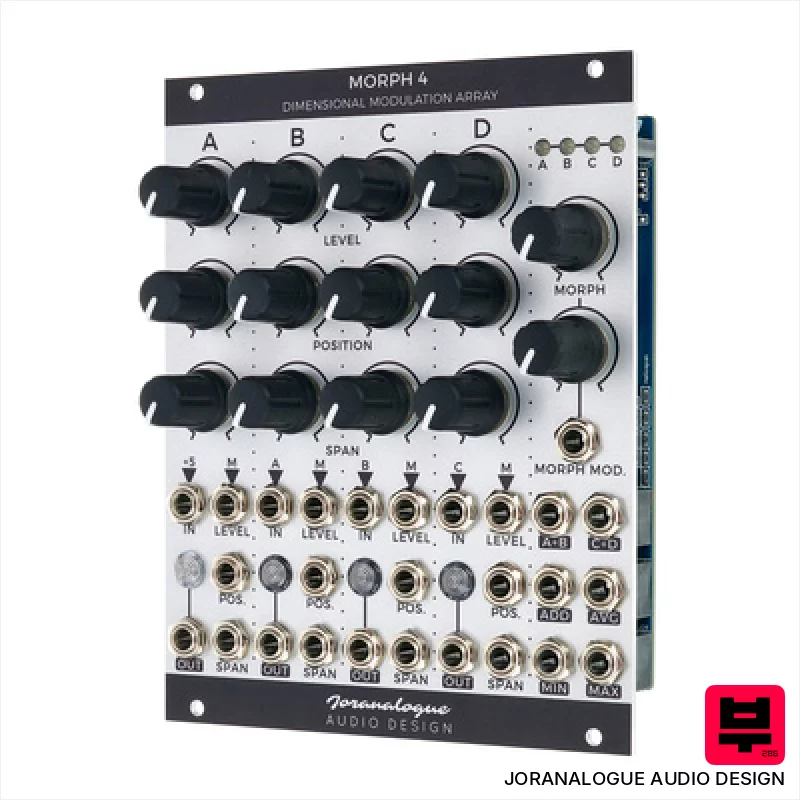
Joranalogue Audio Design Morph 4
- • Joranalogue's signature clean, precise VCA response delivers excellent signal integrity.
- • Morph control offers truly unique, dynamic mixing possibilities beyond simple crossfades.
- • Six mixing outputs provide immense routing flexibility for complex soundscapes.
- • Compact 20HP footprint maximizes space in densely populated Eurorack racks.
- • Power draw is relatively high, requiring a robust power supply.
- • Limited individual channel EQ or filtering capabilities.
- • Morph control, while creative, can be challenging to master for subtle adjustments.

Verbos Electronics Amp & Tone
- • Discrete op-amp design yields a uniquely warm, musical distortion.
- • Linear/exponential CV options offer exceptional modulation flexibility.
- • Low-pass filter's resonance provides satisfying, self-oscillating character.
- • Compact 10HP footprint maximizes space in dense modular systems.
- • The input gain control can be overly sensitive, requiring careful calibration.
- • Filter character, while pleasant, isn't as aggressive as some dedicated filters.
- • Limited filter types – a simple low-pass only.

Bastl Instruments Aikido
- • Solid build quality with Bastl’s signature robust panel finish.
- • Envelope follower offers creative sidechaining and dynamic control.
- • Spectral follower provides unique rhythmic and textural possibilities.
- • Flexible routing options expand sonic experimentation potential.
- • Limited routing beyond the basic four channels.
- • 120mA draw per rail can be significant in power-constrained systems.
- • The gain at 6dB per VCA can be a bit aggressive for subtle level changes.

ADDAC 802 VCA Quintet Mixing Console
- • Excellent channel isolation for clean, layered signals.
- • Linear/logarithmic VCA response offers tonal flexibility.
- • Pre/Post outputs allow for complex routing and processing.
- • Compact 12HP footprint maximizes modular space.
- • Gain controls could benefit from finer resolution.
- • Limited headroom; may clip with very hot signals.
- • The Link input functionality is somewhat basic.

Tiptop Audio Octogain
- • Robust metal chassis provides excellent physical protection.
- • Polytip connectivity offers streamlined polyphonic routing.
- • Individual channel volume controls allow precise mixing.
- • Separate even/odd outputs enable creative signal processing.
- • 16HP footprint can be restrictive in smaller racks.
- • Analogue design limits dynamic range compared to digital alternatives.
- • Clipping LED provides limited warning – requires careful gain staging.
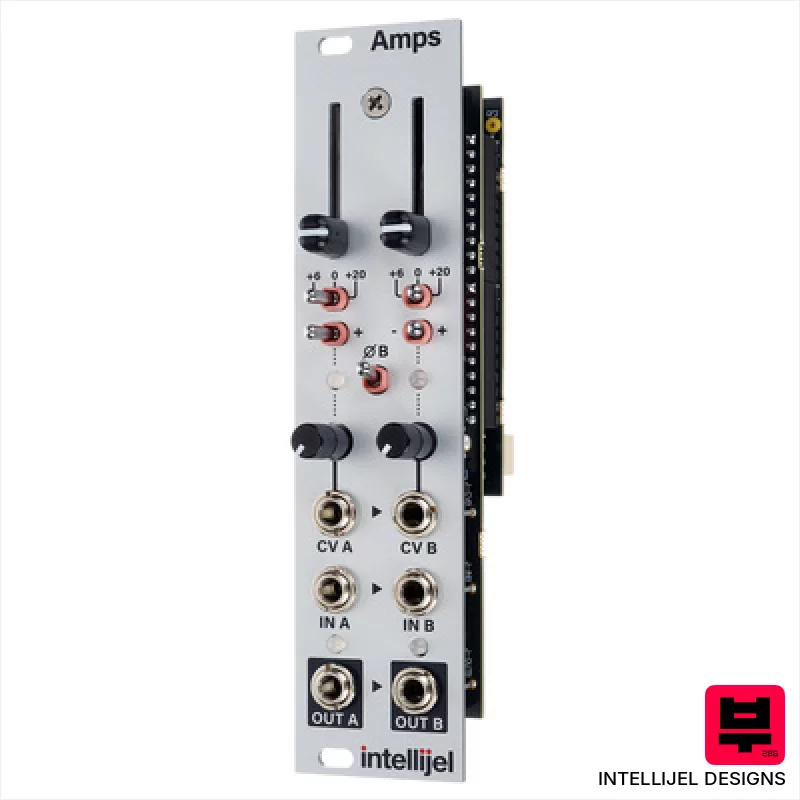
Intellijel Designs Amps
- • Exceptional flexibility for creative signal routing and modulation.
- • The boost switches provide a surprisingly useful and musical gain stage.
- • Compact 6HP footprint maximizes space in tight Eurorack systems.
- • Solid Intellijel build quality; feels robust and well-engineered.
- • Limited headroom when boosting significantly; can introduce noticeable distortion.
- • Bias controls can be fiddly to adjust precisely for subtle level changes.
- • Phase rotation on Channel B can be unpredictable in complex routing scenarios.
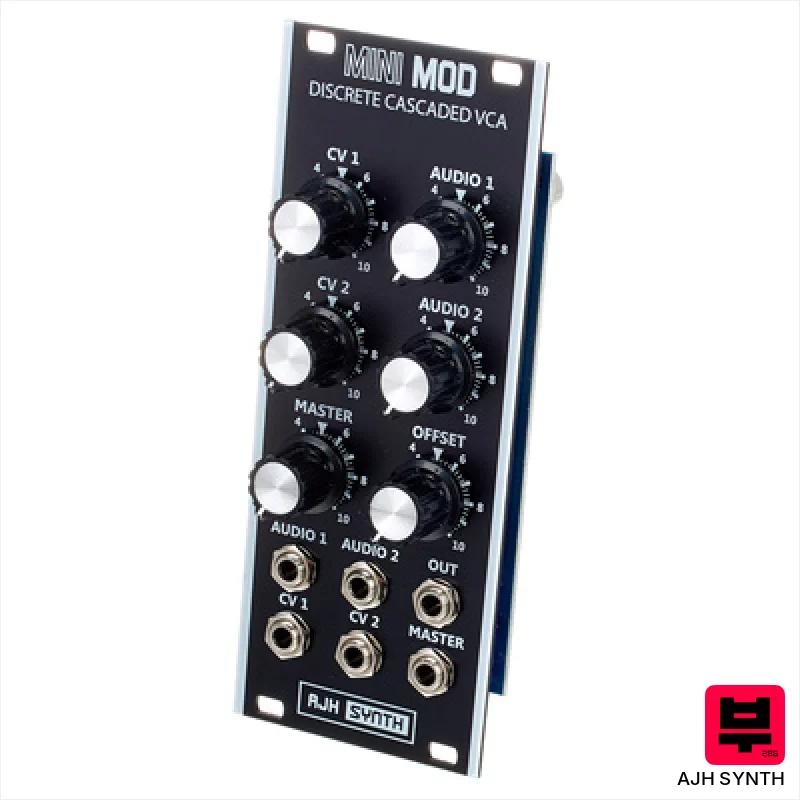
AJH Synth MiniMod VCA black
- • Discrete design recreates Model-D VCA character beautifully
- • Offset control offers nuanced dynamic shaping possibilities
- • High-gain mode adds welcome harmonic richness and grit
- • Compact 10HP footprint maximizes modular space efficiency
- • Limited to two VCAs; expands complexity but lacks scalability
- • Current draw is moderate, consider power budget carefully
- • Offset control can be fiddly without precise calibration

Vostok Instruments Ceres
- • Excellent channel normalization simplifies complex routing scenarios.
- • Linear VCA response offers predictable and clean gain reduction.
- • Compact 10HP footprint maximizes space in tight Eurorack cases.
- • Robust build quality typical of Vostok, feels solid and dependable.
- • Limited mixer functionality; lacks EQ or panning capabilities.
- • Normalization, while convenient, can introduce unwanted signal bleed.
- • No attenuators on CV inputs restrict CV signal manipulation.

Cosmotronic Delta-V Silver
- • Versatile function generator offering surprising sound design possibilities.
- • Adjustable characteristic curves provide nuanced envelope shaping.
- • Bipolar attenuator allows for precise signal manipulation and modulation.
- • Compact 10HP footprint maximizes space in crowded Eurorack racks.
- • Limited number of channels compared to larger function generators.
- • 70mA power draw can be significant for smaller power supplies.
- • The silver finish might show fingerprints and smudges easily.

Weston Precision Audio SV1 Dual/Stereo VCA
- • Clean, vintage outputs offer flexible tonal shaping options.
- • Zero-cross detection eliminates unwanted clicks, crucial for clean modulation.
- • Compact 12HP footprint maximizes space in dense modular systems.
- • Robust build quality; Weston’s known for durable, reliable modules.
- • Limited headroom; +6dB boost can introduce noticeable distortion easily.
- • Power draw is moderate, potentially impacting PSU capacity in larger racks.
- • Lacks finer control; attenuators are basic, not stepped or precise.
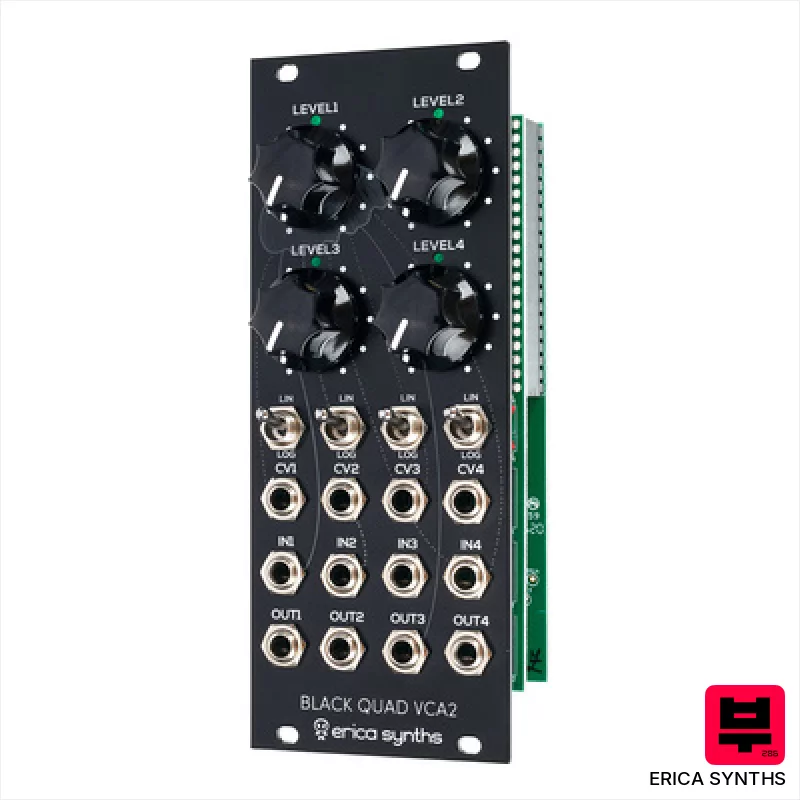
Erica Synths Black Quad VCA V2
- • Excellent signal integrity, maintaining clarity even at high levels
- • Flexible CV response options (log/exp) add significant modulation possibilities
- • Pre-emphasis/de-emphasis provides unique tonal shaping potential
- • Solid build quality with robust knobs and reliable internal components
- • 10TE width can be restrictive in smaller Eurorack cases
- • Normalization, while useful, can be a source of confusion for beginners
- • Limited routing flexibility compared to more complex mixer/VCA modules
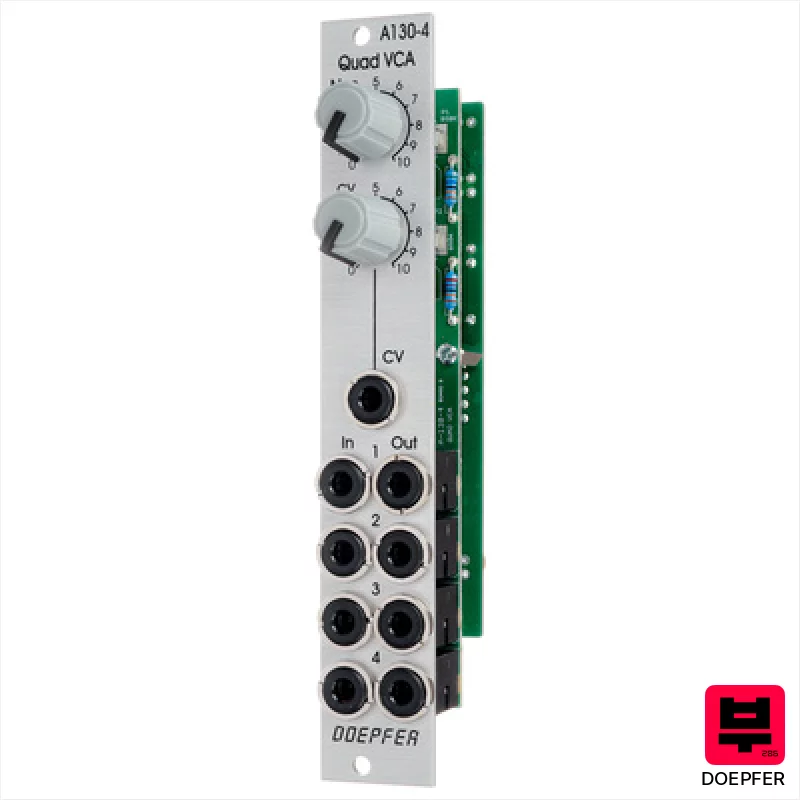
Doepfer A-130-4
- • Solid Doepfer build quality; feels robust and reliable.
- • Linear response offers predictable, clean signal shaping.
- • Bias control allows for subtle or extreme gain reduction.
- • Four channels expand flexibility for complex modulation.
- • Limited CV input range can restrict modulation depth.
- • 4HP width can be restrictive in tight Eurorack setups.
- • Basic feature set; lacks advanced features like logarithmic response.
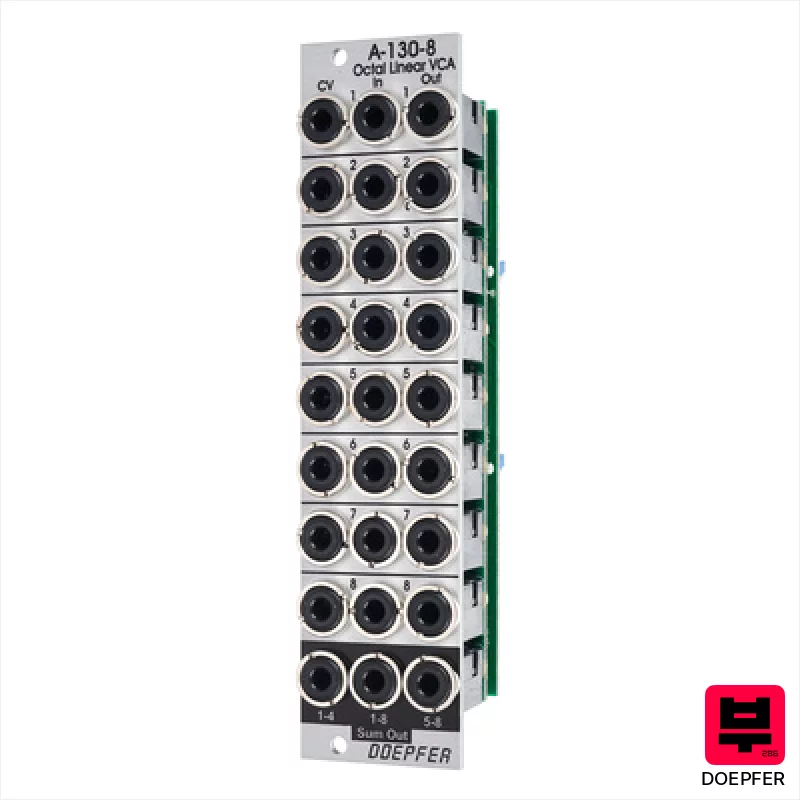
Doepfer A-130-8
- • Solid Doepfer build quality; reliable and durable for years.
- • Linear response provides predictable and useful modulation shaping.
- • Summing outputs simplify complex signal routing and gain staging.
- • Compact 6HP footprint maximizes space in dense modular systems.
- • Limited individual VCA control; lacks per-channel attenuation.
- • Linear response can be sterile for certain audio applications.
- • 50mA current draw can be significant in power-constrained racks.

Intellijel Designs Quad VCA
- • Excellent headroom with the +6dB boost, a real game changer.
- • Normalization simplifies patching for quick, dynamic mixing.
- • Curve control offers unparalleled flexibility in shaping signal dynamics.
- • Intelligent LED feedback clearly shows CV signal polarity and attenuation.
- • Power draw is significant, requiring a robust PSU.
- • 12HP footprint can be limiting in smaller modular systems.
- • Lack of audio level metering can make gain-staging tricky.

XAOC Devices Lublin
- • Excellent pingable vactrol emulation adds organic, evolving textures.
- • Gain limiting ensures clean output even with aggressive CV signals.
- • Compact 6HP footprint maximizes precious modular space.
- • Dual-channel design provides flexible routing and signal shaping.
- • Exponential response curve might be limiting for linear CV applications.
- • Relatively high power draw could strain power supplies in smaller systems.
- • Limited modulation options beyond ping functionality.
How to Choose the Best VCA Modules
Tonal Character
Some VCAs introduce subtle harmonic distortion, a 'fatness' that can be great for basslines or adding warmth to pads. Others are surgically clean, which is essential for transparent gain staging and detailed processing. The sweet spot is a VCA that's clean most of the time, but has a hint of grit when pushed.
Linearity & Tracking
This is critical. A non-linear VCA will introduce unwanted colorations. Accurate tracking means your modulation sources (LFOs, envelopes) will translate faithfully to volume changes-no unexpected dips or spikes. Bad tracking ruins subtle effects.
Voltage Range & Offset
Different modules operate on different voltage ranges. A VCA with a narrow voltage range might clip easily, while one with a huge range might be hard to control with typical CV sources. Offset is just as important - you need to be able to get a true zero signal.
Response Time (Slew Rate)
Fast response is crucial for percussive sounds and tight envelopes. Slow response can create a smeared, sluggish feel, which might be desirable in some cases (think slow tremolo), but isn't always what you want. The slew rate should be adjustable if possible.
Modulation Inputs & Routing
Beyond simple CV input, look for features like attenuators, offsets, or even multiple modulation inputs to create complex amplitude modulation patterns. The more routing options, the more creative possibilities.
Buying Guide
Don't chase the 'most expensive' badge. Many cheaper VCAs cut corners on linearity, resulting in a muddy or unpredictable sound. A well-designed, mid-range VCA will almost always outperform a budget option in a critical audio processing role. Also, pay attention to power requirements - a hungry VCA can draw down a small PSU quickly.
Our Methodology
We're not looking at datasheets here. We've spent countless hours patching these VCAs into a variety of setups - everything from subtle parallel compression in a recording chain to mangling drums live on stage. We A/B compared them against each other, against classic hardware, and judged them on how they actually sound and behave under pressure, not just on paper.

