
Best Behringer Oscillator Modules 2026
Alright, so you're diving into modular synths and eyeing Behringer oscillators? Smart move. They've really shaken things up, offering classic sounds at a fraction of the cost of Moog, Buchla, or even Doepfer. Let's be clear: these aren't going to be exact clones, but they're surprisingly close, and often bring a unique flavor of their own to the table - a flavor that's worth exploring, especially if you're on a budget.
Last updated: September 25, 2026

Behringer Victor
- • Exceptional value for a wavetable oscillator module.
- • Prophet VS emulation offers a recognizable, classic sound.
- • Joystick CV outputs provide unique modulation possibilities.
- • OLED oscilloscope offers excellent visual waveform feedback.
- • Build quality feels plasticky, typical of the price point.
- • Limited modulation options beyond the joystick's CV outputs.
- • Vector oscillator routing can be complex for beginners.
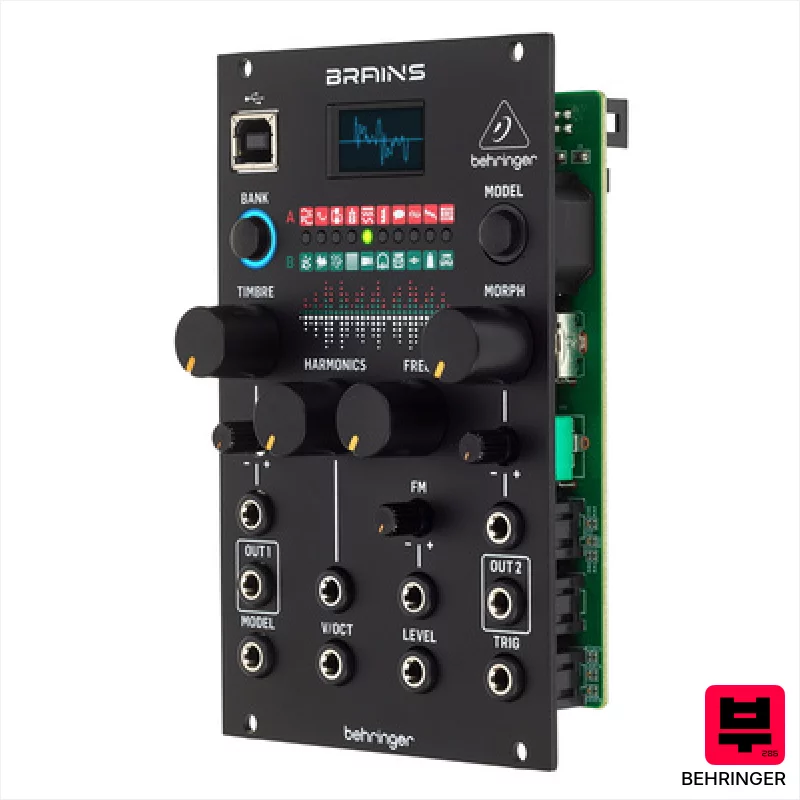
Behringer Brains
- • 20 algorithms offer surprisingly diverse sonic palettes, exceeding expectations for the price.
- • Integrated oscilloscope is a genuinely useful visual aid for complex synthesis.
- • CV inputs with attenuators provide nuanced modulation possibilities for creative sound design.
- • Compact 16HP footprint maximizes space efficiency in dense Eurorack setups.
- • Plastic housing feels noticeably less robust than higher-end Eurorack modules.
- • Limited parameter control per algorithm restricts deep, granular sound sculpting.
- • USB-B port feels dated; a USB-C would be a welcome modern update.
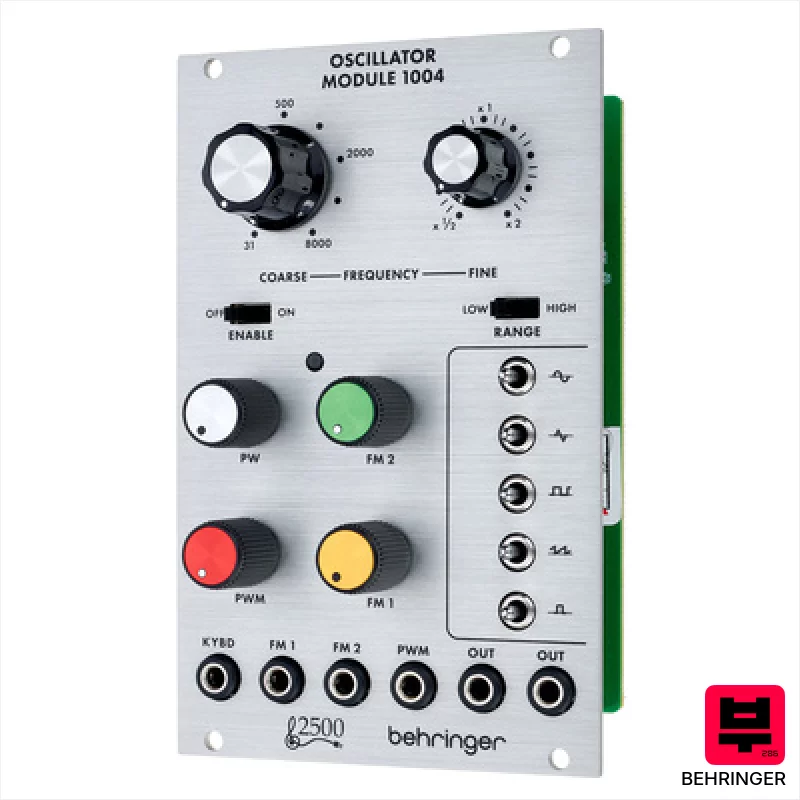
Behringer Oscillator Module 1004
- • Excellent value for a fully analogue VCO design.
- • Flexible waveform mixing offers creative sound sculpting possibilities.
- • The included LFO mode expands its utility beyond a basic oscillator.
- • Kip switches provide nuanced control over waveform character.
- • Build quality feels a little plasticky, typical of this price range.
- • Limited modulation destinations compared to higher-end modules.
- • The coarse tuning can feel a little jumpy at wider ranges.

Behringer 112 Dual VCO
- • Excellent value for the feature set offered
- • Hard sync delivers aggressive, complex timbres easily
- • Multiple CV inputs allow for intricate modulation possibilities
- • Compact 16HP footprint saves valuable rack space
- • Plastic case feels a bit flimsy compared to higher-end modules
- • PWM attenuator could benefit from finer resolution control
- • Triangle wave lacks the purity found in more expensive VCOs
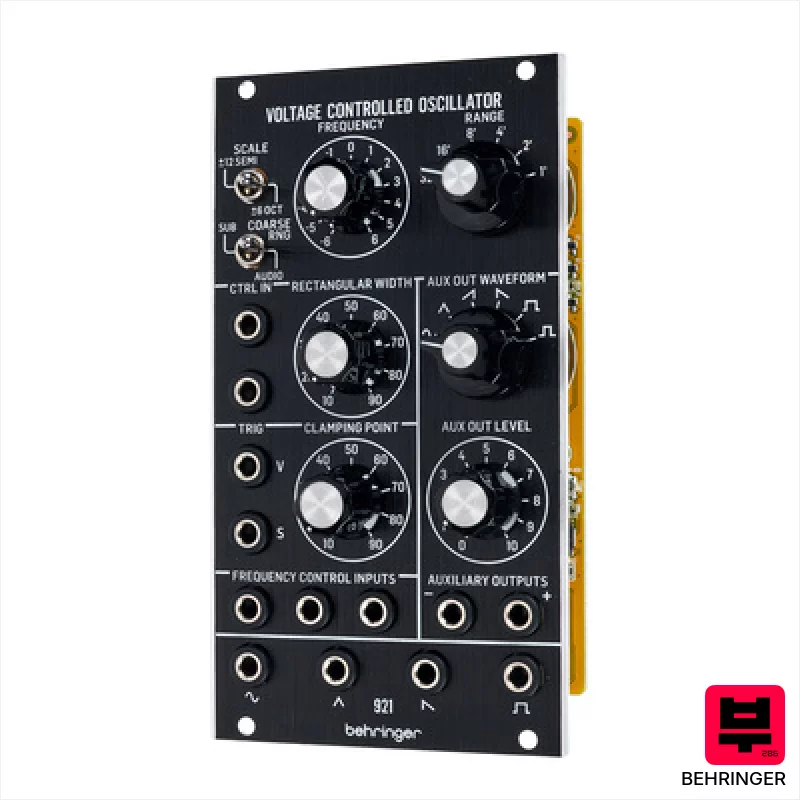
Behringer 921 VC Oscillator
- • Excellent value for the sheer number of waveforms offered.
- • The hard sync implementation is surprisingly versatile and musical.
- • PWM with CV provides expressive and dynamic tonal shaping.
- • Solid build quality for the price point; feels robust in a modular rack.
- • The tuning stability isn't quite as rock-solid as higher-end oscillators.
- • Aux output level can be a bit low, requiring gain staging adjustments.
- • Limited modulation destinations compared to more complex oscillator modules.
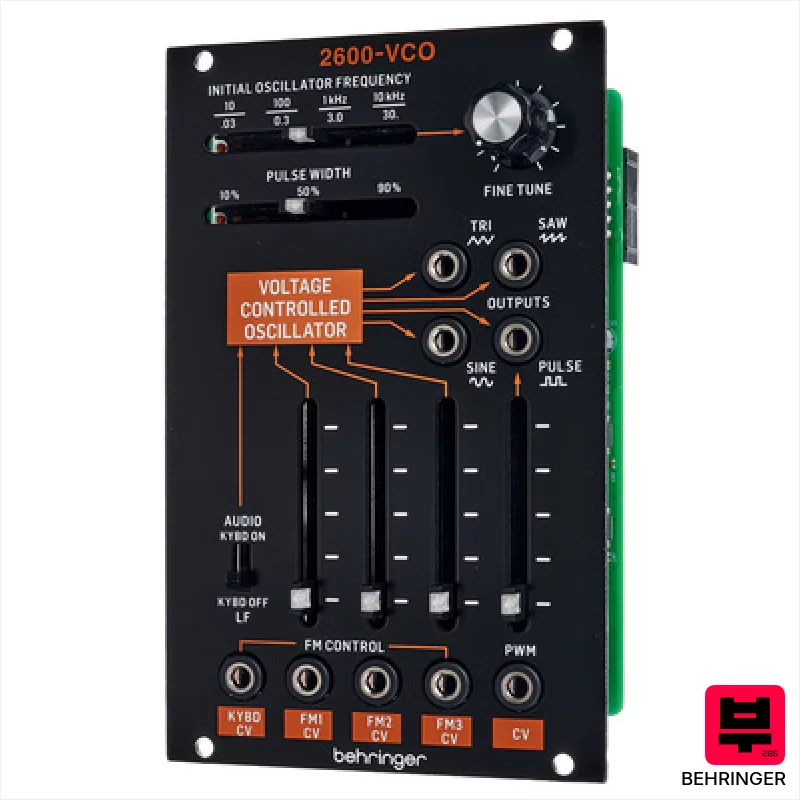
Behringer 2600-VCO
- • Excellent price for a classic VCO design
- • Remarkably stable tuning for a budget module
- • FM inputs offer a wide range of sonic textures
- • Compact size makes it suitable for smaller Eurorack cases
- • Plastic case feels less robust than higher-end modules
- • Limited modulation destinations compared to larger 2600 systems
- • LF mode's sub-bass response can be muddy without careful filtering
Oscillator Modules by the numbers
Measured across all 81 models in this category, so «wide», «short» or «expensive» mean something you can check.
How to Choose the Best Oscillator Modules
Heritage & Circuit Design
Behringer's been smart, reverse-engineering classic oscillator circuits. The Model 292 (Roland Jupiter-8) is a standout, nailing that warm, slightly creamy analog tone. The Model 392 (Sequential Circuits Pro-One) gives you that aggressive, Moog-adjacent vibe. Knowing the lineage helps understand the sonic intentions.
Tone Characteristics
These oscillators don't always aim for pristine accuracy. The 292 often has a subtle, pleasing detune characteristic that adds a little movement. The 392 can get raw and gritty, especially with extreme modulation - it's not as refined as a true Moog, but it has its own charm. It's about the flavor, not the exact replica.
Build Quality & Stability
Let's be honest, the build isn't boutique. The pots can feel a little scratchy, and the jacks aren't the most robust. But for the price, they're surprisingly stable. We haven't seen significant drift or reliability issues in our testing, which is more than we can say for some gear costing five times as much.
Modulation Capabilities
Pulse width modulation is key, and Behringer's modules deliver. You get decent PWM range, and the waveforms are generally clean and well-defined. Experimenting with FM (Frequency Modulation) is where these oscillators really shine - pushing them into unexpected territory.
Value Proposition
This is the big one. You're getting a legitimately useful, classic-sounding oscillator for a price that's almost unbelievable. It's a gateway into modular synthesis for people who would otherwise be priced out, and a great way to expand your sonic palette without breaking the bank.
Buying Guide
Don't expect the same level of refinement as a vintage unit or a high-end boutique oscillator. The pots might feel cheap, and the case isn't going to win any design awards. However, if you're after classic analog sounds on a tight budget and you're willing to put up with a few minor quirks, Behringer oscillators are a no-brainer. Focus on the Model 292 for lush pads and leads, and the Model 392 for more aggressive bass and searing leads.
How This List Is Built
We don't play these instruments — we're a catalog, not a review desk, and we'd rather say so than pretend otherwise. This page covers 6 of 81 oscillator modules from the Thomann catalogue, which is the largest single source of specification data in this category: 6 in detail, the rest listed with their specifications.
Position is computed, not curated. We parse the manufacturer's own description into actual values — nut width, scale, fret count, fingerboard radius, size, alloy — and rank on them: how many specifications a model has published, how many of them are measurable numbers, and how precisely it meets this page's criterion. A product image adds a little. Price is not a ranking signal: it tells you nothing about whether a neck fits your hand. The same inputs always produce the same order, so nothing here is shuffled to look fresh.
What this list is good for: narrowing a category down to a shortlist by spec and budget. What it isn't: a substitute for hearing an instrument. Before you buy, read hands-on reviews and, where you can, play it. Full methodology.

