AudioFu Chart · November 2026
Best 1/8 Size Classical Guitars Under $100 2026
The top pick is Yamaha GL-1 Guitalele 6-String Ukulele-Guitar ($89). Startone CG 851 1/8 gives you the most for the money at $41. Ranked by the AudioFu Index from 3 models across 3 brands, prices checked every night.
Last updated: November 21, 2026
Top 3
Full detail for the 3 highest AudioFu Index scores. Every other model is listed below.
-
Yamaha GL-1 Guitalele 6-String Ukulele-Guitar
GL1 PB · Yamaha
39 for sale on Reverb4 finishes at Thomann
- Nut width48 mm (1.89")
- Scale433 mm (17.05")
- Strings6-string
- BodyMeranti body
- FingerboardRosewood fingerboard
This is a small six-string guitarlele with a spruce top, a meranti body and a rosewood fingerboard. It has a 433 mm scale, a 48 mm nut and comes with a gig bag. It suits you if you want a compact instrument that is easy to carry and play at home or on the go.
Pros
- Spruce top is a classic tonewood for a light, responsive build
- Meranti body makes the instrument compact and easy to hold
- Rosewood fingerboard gives you a familiar, comfortable playing surface
Cons
- Suitable hard case (Art. #255989) is sold separately, not included
-
- Nut width39 mm (1.54")
- Scale465 mm (18.31")
- BodyBasswood body
- FingerboardJatoba fingerboard
If you need a guitar for a small child or a very young beginner, this one is a sensible pick. It has a basswood body, a nato neck, and a jatoba fingerboard, with nylon strings and a 465 mm scale that suits small hands. Keep in mind the gig bag is sold separately.
Pros
- Basswood body keeps the build light for small hands
- Nato neck and jatoba fingerboard give a solid pairing of materials
- 465 mm scale and 39 mm nut width suit young or beginner players
Cons
- Gig bag is not included; Art. #198578 must be bought separately
-
- Nut width48 mm (1.89")
- Scale433 mm (17.05")
- Frets17 frets
- BodySapele body
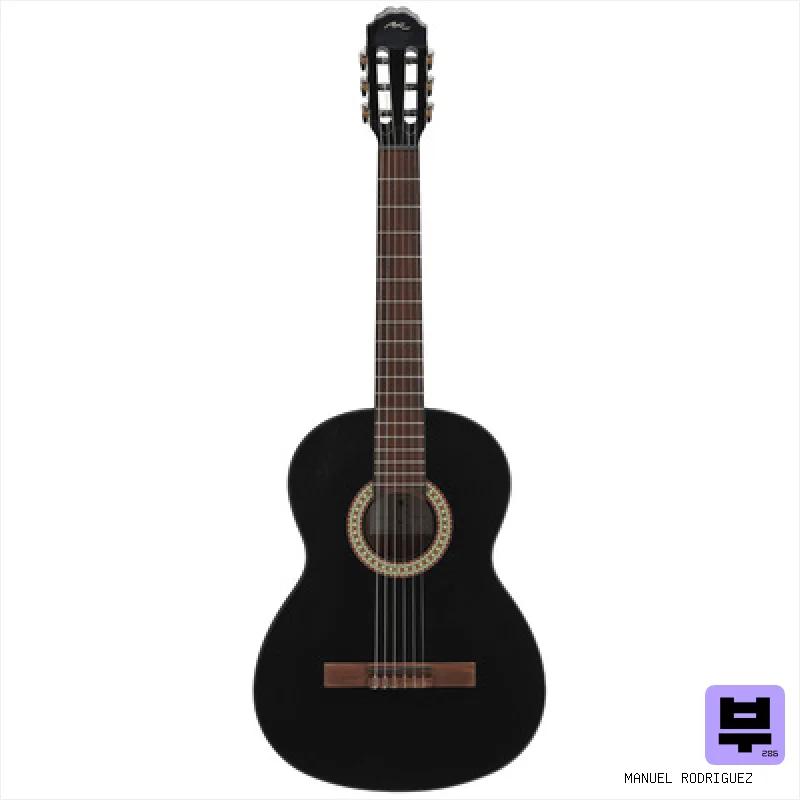
You get a small instrument with a spruce top, sapele body and walnut fretboard. It has medium tension nylon strings and a gig bag, so it is easy to take along. It suits you if you want a compact instrument that tunes like a guitar but is much smaller to hold.
Pros
- Spruce top paired with sapele body gives it a solid mix of woods on paper
- Walnut fretboard sits on an okoume neck for a classic classical guitar setup
- Comes with a gig bag, so it is ready to carry from day one
Cons
- At 1/8 size with a 433 mm scale, it suits small hands and travel rather than full-size playing
52AudioFu
Index↓ 16.9%since Aug 17 · lowest so far$65 · Aug 17$54 now$54€49 at Thomann · in stockCheck price ↗
1/8 Size Classical Guitars by the numbers
Measured across all 7 models we track, not a sample.
median of 7 models · 39 mm (1.54")–48 mm (1.89")
most common · 7 models
How to choose the best 1/8 size classical guitars
Playability (Action & Neck Profile)
Low action is crucial for beginners - high action kills motivation. A comfortable neck profile, even on a small guitar, makes a huge difference in ease of playing; chunky necks can be a struggle.
Tone (Bass Response & Articulation)
Don't expect deep, resonant bass like a full-size. We're looking for something that isn't just a thin, boxy sound. Good articulation - clean notes, not muddy - is more important than outright volume at this level.
Construction Quality (Bracing & Binding)
Bracing is the internal structure; weak bracing means buzzing and poor sustain. Binding, while mostly cosmetic, can indicate overall build quality. Expect minimal binding on this budget, but check for sloppy glue work.
Materials (Top Wood & Finish)
Solid wood tops (even spruce) are rare at this price; expect laminate. The finish affects the tone and feel; a thin, even finish is preferable to a thick, gloppy one, though that's a long shot.
Intonation & Tuning Stability
Intonation means the guitar plays in tune as you move up the neck. Cheap guitars often struggle with this, and tuning stability is just plain important; constant re-tuning is frustrating.
Buying guide
So, you're looking for a 1/8 size classical guitar for a young student? That's awesome - getting them started right is key. Finding a decent one under $100 is tricky, though; it's a budget range where compromises are definitely happening. Let's be real, we're not expecting a Ramirez here, but we can find something that won't make learning a total chore and won't sound like a rusty gate.
At this price point, you're trading. Expect thinner wood, simpler bracing, and a finish that's more functional than beautiful. Don't chase a bright, sparkly clean tone - it won't happen.
Focus on finding something with playable action and decent articulation, even if the bass is a little anemic. A poorly set-up guitar will sound worse than a slightly better-built one, so consider a local shop setup if possible.
How the AudioFu Index works
Five measured signals and nothing else — no stars from strangers, no “tested by experts” we didn’t do. The weights are fixed and public. We don’t play these instruments; we measure the market around them.
This chart covers 7 1/8 size classical guitars from the Thomann catalogue. Before you buy, read hands-on reviews and, where you can, play it. Full methodology.
AudioFu earns a commission when you buy through our Thomann links. It never changes the order — the index does.
- Demand40%
How many of this exact model are for sale on Reverb right now — what musicians actually buy and resell.
- Lineup20%
How many finishes Thomann stocks — makers expand the models that sell.
- Price15%
Where the price has moved since we started tracking in August.
- Specs15%
How completely the maker documents it.
- Maker10%
How deep the brand’s range is in this category.
Questions
Are solid top guitars available under $100?
Rare. Most will be laminate tops - spruce or mahogany. A solid top would be a huge win, but don't expect it.
What's 'action' and why is it important?
Action is the height of the strings above the fretboard. Low action is easier to play, especially for beginners. High action requires more force and can be painful.
Can I record these guitars?
Sure, but don't expect miracles. You'll need to EQ and process the sound to make it usable. A decent mic and some careful processing can help, but the source material is what it is.
What about electronics (pickups)?
Pickups at this price point are almost always terrible. They'll add a lot of noise and coloration. If you need amplification, a basic condenser mic is a better investment.
Is it worth spending a bit more?
Absolutely. Even an extra $20-$30 can make a noticeable difference in build quality, materials, and overall playability. It's a long-term investment in their musical journey.