Special projects / ADAM Audio H715Partner project · what that means

Open-back reference headphones · new at Thomann

ADAM Audio H715 Reference

ADAM says the H715 brings the sound of its studio monitors to your ears, in any room. We took every feature apart, put the price next to its rivals, and built a test that lets you hear the problem these headphones are made to solve.

$724€649 at Thomann · tracked nightly since Oct 23

Check price at Thomann
Design
Open-back
Impedance
150 Ω
Drivers
Titanium-coated PEN
Software
Sonnox Headphone Utility
Cables
Coiled + 4.4 mm balanced
In the box
Hardshell case
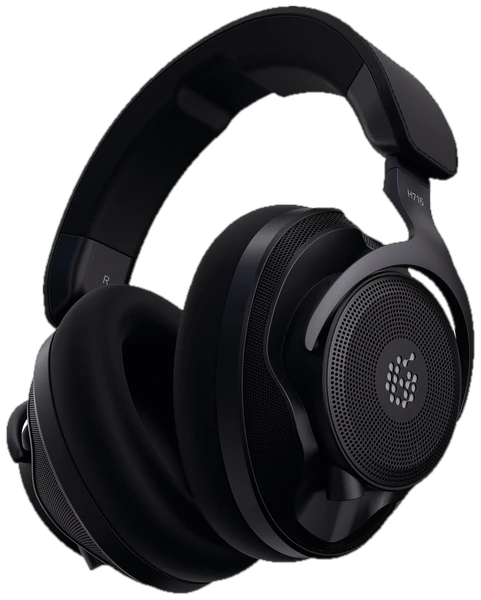
ADAM Audio H715 Reference open-back studio headphones

01The problem

Your room is lying to you about the bass

Below about 250 Hz, a room without acoustic treatment doesn’t play bass back as it is. Sound bounces between the walls, the floor and the ceiling and piles up into resonances: some notes boom, others nearly vanish, and which ones depends on the size of the room and where you sit. Enter your room and see what it does at your listening spot.

Units
ft
ft
ft
Try
+100−10−203040506080100150200250 Hz +13 dB · 47 Hz−16 dB · 181 HzLWHLWHLWLHWL

In a 12 × 10 × 8 ft room, sitting at 38% of its length, bass at 47 Hz (F#1) comes out 13 dB too loud and at 181 Hz (F#3) 16 dB too quiet. Mix by ear here and you will cut the first and push the second, and the track will sound thin and boomy everywhere else.

Put headphones on: this simulates your room, and speakers would add your real one on top. The crossfeed is our simple version of the idea, not the Sonnox plug-in.

Marks along the bottom are the room’s main resonances: L for length, W for width, H for height. Headphones take the room out of the path, which is the whole case for mixing on them. The catch is that they put the stereo image inside your head, and that is what the Sonnox software bundled with the H715 is there to fix. Switch to “H715 + crossfeed” to hear a simple version of it.

02The features

Every feature, explained

Design

Open-back cups

The back of each cup is open, so the sound isn’t trapped in a sealed box. Open-back headphones usually sound more natural and wider, and the bass doesn’t build up pressure.

Why it matters: over a long mixing session, an open design is easier on the ears and closer to how speakers sound.

Watch out: open-back leaks both ways. People around you hear your mix, you hear the room, and a microphone nearby will pick up the click track.

Drivers

Titanium-coated PEN drivers

PEN is a polymer film used for the diaphragm. ADAM coats it with titanium and drives it with powerful neodymium magnets: coatings like this make a light diaphragm stiffer, so it moves as one piece.

Why it matters: ADAM’s promise for the H715 is precision, and the driver is where that starts.

Impedance

150 ohms

Impedance is how hard a driver resists the signal. At 150 Ω the H715 sits in the middle: above most headphones made for phones, below the 250 to 470 Ω studio classics.

Why it matters: any audio interface or headphone amp drives it comfortably.

Watch out: phones and laptops may run out of volume. The chart in section 03 shows where its rivals sit.

Software

Sonnox Headphone Utility

The H715 comes with Sonnox’s Headphone Utility plug-in and deeper integration for it: crossfeed adjustments, ListenHub support and system-wide calibration options.

Why it matters: crossfeed lets each ear hear a little of the other channel, as it does with speakers, so panning and width translate better from headphones to a room.

Listening

A hi-fi mode, too

Besides its studio voicing, the H715 has an additional, dedicated hi-fi mode for listening to music.

Why it matters: one pair for work and for evenings, instead of studio headphones plus a hi-fi pair.

Build

Made to travel

A lightweight design with memory foam ear pads, swivelling ear cups and a spring steel headband. The pads, in fabric and faux leather, attach with magnets. Two cables come with it: a 1.3 m coiled cable that stretches to 3 m and a balanced 4.4 mm Pentaconn cable, all in a hardshell case.

Why it matters: mixing anywhere is the point, and the case and the coiled cable are made for the bag.
03The rivals

The H715 against its rivals

Open-back studio headphones at Thomann from $389 to $757, at today’s prices. Specs come from Thomann’s product descriptions.

ModelPriceImpedanceWeight
Audio-Technica ATH-R70xa $389470 Ω199 g
Sony MDR-MV1 $44024 Ω223 g
Sennheiser HD-490 PRO Plus $458130 Ω260 g
Audeze MM-100 $50118 Ωnot listed
beyerdynamic DT 1990 Pro MKII $60130 Ω442 g
Neumann NDH 30 $668120 Ω352 g
ADAM Audio H715 ReferenceThis project $724150 Ωnot listed
HEDD HEDDphone D1 $75732 Ω350 g

Prices update every night from Thomann’s feed. Links to Thomann are affiliate links.

Impedance, from easiest to hardest to drive

  • Audeze MM-10018 Ω
  • Sony MDR-MV124 Ω
  • beyerdynamic DT 1990 Pro MKII30 Ω
  • HEDD HEDDphone D132 Ω
  • Neumann NDH 30120 Ω
  • Sennheiser HD-490 PRO Plus130 Ω
  • ADAM Audio H715 Reference150 Ω
  • Audio-Technica ATH-R70xa470 Ω

Impedance is only half of how loud a pair gets: sensitivity is the other half, and Thomann doesn’t list it for most of these.

Where $724 sits among 138 studio headphones

$10$3,789

The H715 costs more than 119 of the 138 studio headphones Thomann has in stock: it is a step up, priced against the Neumann and beyerdynamic open-backs rather than everyday studio cans.

04The fit

Who it’s for, and who should skip it

Get it if

  • You mix or master in a room without acoustic treatment.
  • You work on the move and want a reference that travels, with a hardshell case and a coiled cable.
  • You want one pair for mixing and for listening to music, thanks to the hi-fi mode.
  • You already use a balanced 4.4 mm output on a DAC or a player.

Skip it if

  • You record vocals or acoustic instruments in the same room: open-back cups leak into the microphone.
  • You need isolation on a train or in a noisy space: closed-back headphones block more.
  • Your budget is closer to $200: ADAM’s own H200 is closed-back and costs $161.
  • You only listen from a phone: a 150 Ω pair can run quiet without an interface or an amp.

05Questions

Questions about the H715

Is the ADAM Audio H715 good for mixing?

It is designed for it: Thomann lists the H715 as open-back studio headphones for mixing and mastering, and the bundled Sonnox Headphone Utility adds crossfeed and calibration to help a mix translate to speakers. We haven’t measured a pair ourselves yet, so for the sound itself, read hands-on reviews as well.

Open-back or closed-back headphones for mixing?

Open-back for mixing and mastering when you are alone in a quiet room: they sound more natural and tire the ears less over long sessions. Closed-back for recording and noisy places, because they keep sound in and out.

Do I need a headphone amp for the H715?

Usually not. At 150 ohms, the H715 is a comfortable load for audio interfaces and headphone amps. Phones and some laptops may not get it loud enough. Thomann’s description doesn’t list its sensitivity, which is the other half of that answer.

What does the Sonnox Headphone Utility do?

It is a plug-in bundled with the H715 that changes how headphones present a mix. According to Thomann’s description, the H715 version brings crossfeed adjustments, ListenHub support and system-wide calibration options.

What is the hi-fi mode on the H715?

An additional, dedicated mode for listening to music, next to the studio voicing. It lets one pair cover both work and evenings.

What comes in the box?

Two cables (a 1.3 m coiled cable that extends to 3 m and a balanced 4.4 mm Pentaconn cable), ear pads in fabric and faux leather that attach magnetically, and a hardshell case. The Sonnox plug-in is bundled.

How much does the ADAM Audio H715 cost?

$724 (€649) at Thomann today. We record its price every night; it has been listed since October 23, 2026.

H715 or ADAM H200?

The H200 is ADAM’s closed-back model at $161: better for recording and noisy rooms, and far cheaper. The H715 is open-back for mixing and mastering, with the Sonnox software, the hi-fi mode and a balanced cable.

Is this page sponsored?

It is a special project made for a Thomann campaign. The room test and the data are ours, our rankings are not affected, and links to Thomann are affiliate links.

 Check price ↗

Magazine

Popular charts

Press / on any page to search.