
All three are conical brass instruments with valves, and the euphonium and baritone even play in the same range, a B flat an octave below the trumpet. The tuba sits an octave lower again. What separates them most is the bore, and that sets everything else.
| Baritone horn | Euphonium | Bb tuba | |
|---|---|---|---|
| Bore, typical | 13.9 mm | 14.5 to 16.8 mm | 18.5 mm and up |
| Valves | 3 | 4, often compensating | 4 or 5 |
| Sound | lighter, brighter | dark, round, singing | the bass of the band |
| At Thomann | 15 | 55 | 67 |
| From | $501 | $311 | $1,672 |
| Median | $1,060 | $5,079 | $10,269 |
A note on names: in Thomann's catalog, "Baritones" are German-style baritones with rotary valves, closer to a euphonium. The British and American baritone horn, with piston valves and a narrow bore, sits with the alto horns.
Baritone horn: the light one
Thomann BR-802L, $882

A B flat baritone horn with a 13.89 mm bore, three Monel valves, a 9.5-inch gold brass bell and a light case with a backpack strap. It ranks second of 16 alto and baritone horns. #2 of 16 alto-/baritone horns.
Baritone horns are standard in British brass bands and common in American school bands, where they often read treble clef. They are lighter and easier to carry than a euphonium.
Euphonium: the soloist
Yamaha YEP-321, $2,961

Four piston valves, a 14.5 to 15.5 mm bore and a 280 mm bell, with a case and mouthpiece. It ranks first of 13 non-compensating euphoniums. #1 of 13 standard euphoniums.
The fourth valve fills in the low notes; on a compensating euphonium, extra tubing corrects the tuning when valves are combined. 34 of the 55 euphoniums at Thomann are compensating, at a median of $9,488, but Thomann's own EP 902L is compensating for $1,338. The cheapest euphonium of all, Startone's PEP-20, is plastic and costs $311.
Tuba: the bass
Yamaha YBB-321, $7,292
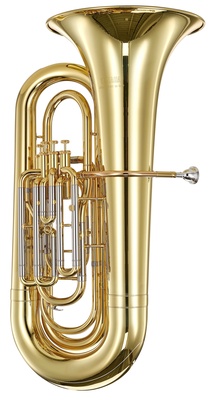
A full-size B flat tuba with four inline piston valves, an 18.5 to 19.5 mm bore and a 443 mm bell. It weighs 10 kg, almost three times a euphonium, and ranks first of 61 Bb tubas. #1 of 61 bb tubas.
Tubas also come in F, E flat and C. In the US, B flat and C tubas are the usual choice for bands and orchestras; F and E flat are smaller tubas for solo and chamber playing.
Which one?
- A child starting in a school band: a baritone horn, or a euphonium if the band uses them. Both are light enough to carry and play the same parts.
- An adult or a serious student: a euphonium. It has more solo repertoire and a bigger sound.
- The bass of the band: a tuba. Many players start on euphonium and move down.
The mouthpiece fits the bore: baritones and euphoniums usually take a small or large shank trombone-size mouthpiece, tubas their own. Check before swapping.
Where the numbers come from. Every euphonium, baritone and alto horn, German baritone and tuba Thomann had in stock on November 9, 2026, from its partner feed. Bores, valves and weights are from Thomann's descriptions. Places are from our brass rankings. Prices are Thomann's US prices.
Share this story

Denis Kataev runs AudioFu. Every night the site records the prices of more than 38,000 instruments and studio tools at Thomann, and he writes about what those numbers show: what got cheaper, what just arrived, and which discounts are real.
All stories by Denis Kataev →


