
Best Passive Stage Monitors Under $500 2026
Alright, so you need stage monitors and you're working with a budget, huh? Been there, done that. Getting decent wedge monitors doesn't have to bankrupt you, but you gotta know what you're looking for. We're focusing on passive speakers - you'll need an amp to power them - under $500 each, because let's be honest, that's a realistic ceiling for most working bands.
Last updated: April 11, 2026

the box pro Mon P15
- • Coaxial driver delivers surprisingly focused and clear stage monitoring coverage.
- • Robust enclosure construction suggests good durability for gigging musicians.
- • Built-in stand flange simplifies setup and positioning on stage.
- • High peak power handling ensures headroom for loud performances.
- • Passive design necessitates a powerful amplifier for optimal performance.
- • Relatively heavy; transport and setup can be challenging for solo acts.
- • 80° x 80° dispersion might be limiting for wider stage configurations.

the box pro Mon P12
- • Coaxial design delivers surprisingly wide, consistent coverage for stage monitoring.
- • Solid 350W RMS power handles most small to mid-sized gigs easily.
- • Integrated stand flange simplifies mounting and reduces setup time.
- • 80°x80° dispersion minimizes feedback issues in challenging acoustic environments.
- • Passive design requires external amplification, adding to overall cost and complexity.
- • 14kg weight makes transport a bit cumbersome for solo performers or frequent travel.
- • While capable, the coaxial design might lack the ultimate clarity of dedicated 2-way systems.

the box pro Mon P10
- • Coax design provides surprisingly even coverage for stage monitoring
- • Robust polypropylene woofer handles higher SPLs than expected for the price
- • Integrated pole mount offers flexible placement options on stage
- • Lightweight for a 10’ speaker, making transport and setup easier
- • Coax design can lack definition in the low end at higher volumes
- • 8-ohm impedance limits amplifier choices and power delivery
- • Plastic enclosure feels somewhat basic, lacks premium build feel

Behringer VP1220F
- • Titanium tweeter delivers crisp highs, surprisingly detailed.
- • 12 in woofer provides respectable low-end for a stage monitor.
- • Rugged enclosure handles gigging without immediate concern.
- • Connectivity options offer flexibility for various setups.
- • Limited internal protection circuitry; could be easily overloaded.
- • DSP is absent; lacks modern EQ and processing options.
- • While robust, the plastic handles feel somewhat flimsy.
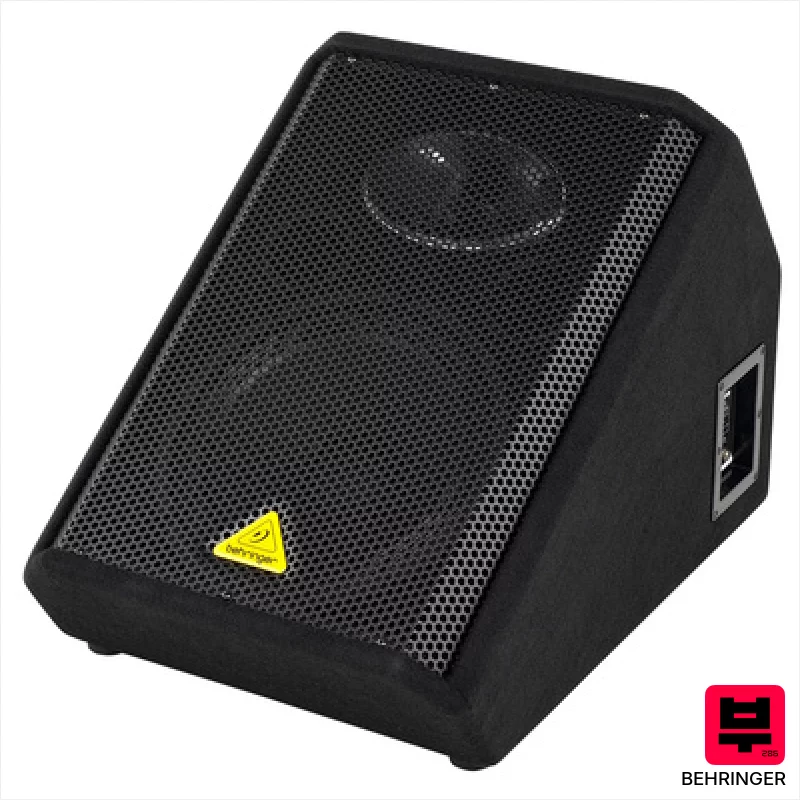
Behringer Eurolive VS1220F
- • Surprisingly robust 12 in woofer delivers respectable low-end
- • High-frequency response is clear, avoiding typical Behringer harshness
- • Lightweight for a monitor of this power and size
- • Excellent value proposition for budget-conscious performers
- • Plastic enclosure feels less durable than higher-end alternatives
- • Limited EQ controls restrict fine-tuning sound shaping
- • 80° x 40° dispersion can be narrow for wider stages
How to Choose the Best Passive Stage Monitors
Frequency Response
A wider, flatter response is ideal, but in this price range, expect some compromises. Look for something that doesn't overly emphasize the mids (muddying the mix) or get overly bright (harsh on vocals).
Power Handling
Critical. You need enough headroom to handle your band's dynamics without distorting horribly. 100W RMS or higher is a good starting point; anything less and you'll be pushing it hard.
Coverage Pattern
A 60° x 40° coverage pattern is pretty standard and generally works well for most stage setups. Wider patterns are good for larger stages, but can lead to more reflections.
Build Quality
Let's be real, at this price point, you're not getting aircraft-grade aluminum. But look for sturdy plywood construction and a decent grille to withstand the inevitable bumps and scrapes of gigging.
Low-End Extension
Don't expect earth-shattering low-end thump. Most monitors in this price range will roll off somewhere around 80-100Hz. That's okay, you've got your bass player for the real low frequencies, but you want something that doesn't sound thin and brittle.
Buying Guide
At this budget, you're making trade-offs. The biggest corner that gets cut is usually in the horn components - don't expect pristine high-end articulation. You'll also likely be dealing with a less-refined crossover design, which can sometimes lead to a slightly less-coherent soundstage. Prioritize power handling and a decent frequency response over flashy features; a monitor that can handle the volume and deliver a relatively clean sound is far more valuable than one that looks pretty but falls apart under pressure.
How This List Is Built
We don't play these instruments — we're a catalog, not a review desk, and we'd rather say so than pretend otherwise. This page ranks 5 passive stage monitors from the Thomann catalogue, which is the largest single source of specification data in this category.
Position is computed, not curated. Four signals, in order of weight: how completely the manufacturer documents the instrument (number of published specifications), where it sits in the price range, how specific the model designation is — which filters out generic accessories — and whether a product image exists. The same inputs always produce the same order, so nothing here is shuffled to look fresh.
What this list is good for: narrowing a category down to a shortlist by spec and budget. What it isn't: a substitute for hearing an instrument. Before you buy, read hands-on reviews and, where you can, play it. Full methodology.

