AudioFu Chart · October 2026
Best Button Accordions Under $5,000 2026
The top pick is Hohner Varia One Button B Black ($3,300). Hohner XS Accordion Button blue gives you the most for the money at $771. Ranked by the AudioFu Index from 6 models across 3 brands, prices checked every night.
Last updated: October 27, 2026
Top 6
Full detail for the 6 highest AudioFu Index scores. Every other model is listed below.
-
- Weight4.8 kg
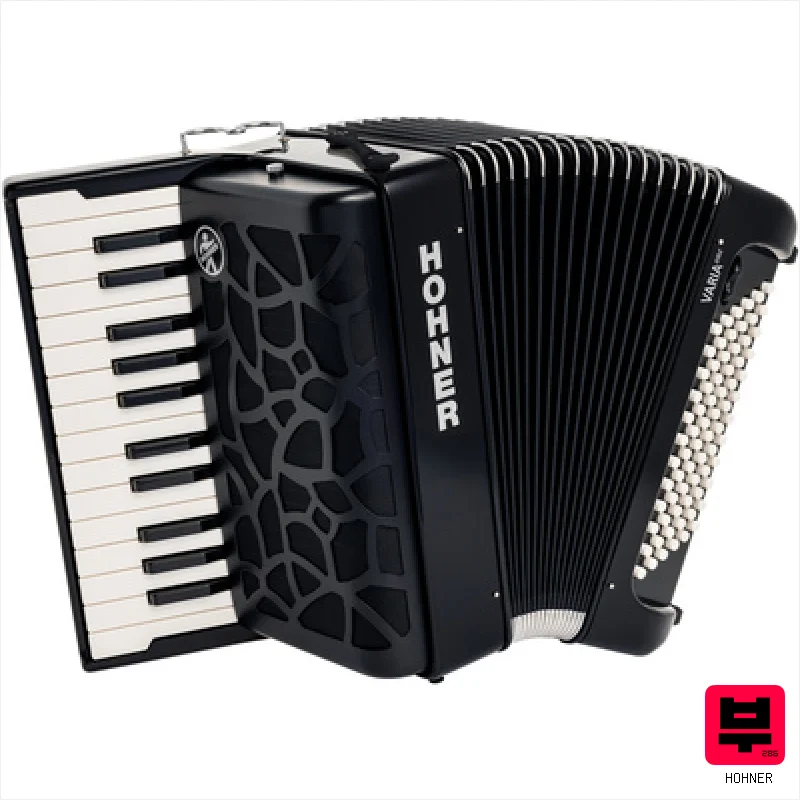
This accordion is built specifically for kids ages six to ten with a very light weight that feels gentle on growing shoulders. The metal-free bellows and compact size make it durable and easy to manage for music school students. While the bass mechanism is new and flexible, the limited number of reed ranks means the sound won't be as complex as an adult model.
Pros
- Lightweight design protects childrens shoulders and arms during play
- Compact build makes it easy for small hands to carry
- Flexible metal-free bellows holders prevent damage to the instrument
Cons
- Limited to a single reed rank on the treble side
- Melodic bass section lacks a dedicated reed rank
70AudioFu
Index↓ 11.5%since Aug 17 · lowest so far$3,729 · Aug 17$3,300 now$3,300€2,950 at Thomann · in stockCheck price ↗ -
This accordion packs a lot of sound into a manageable size. The new bellows sensor and twelve-eight-note polyphony make it feel very responsive. It suits players who want a full orchestra sound without needing a big case.
Pros
- Sixty-two velocity-sensitive treble buttons for dynamic playing
- Seventy-two bass buttons with velocity sensitivity
- Twelve-eight-note polyphony handles complex chords well
Cons
- Battery operation lacks a mains power outlet option
- Seven accordion sets feel like many registers for one case
64AudioFu
IndexStableno change since Aug 17Aug 17$2,102 now$2,102€1,879 at Thomann · in stockCheck price ↗ -
- Weight2.9 kg
The Hohner XS is a fantastic entry point for anyone wanting to explore the button accordion. Its lightweight design and simplified layout make it especially well-suited for children or adults new to the instrument, while still offering a genuine Hohner build quality and a pleasing, if limited, tone.
Pros
- Lightweight construction eases learning for younger players and adults.
- Ergonomic design promotes comfortable play, reducing fatigue.
- Click-and-play carrying system enhances portability and convenience.
Cons
- Limited register options restrict tonal versatility for experienced players.
- Single-chord treble simplifies music but limits complex arrangements.
57AudioFu
IndexStableno change since Aug 17Aug 17$771 now$771€689 at Thomann · in stockCheck price ↗ -
- Weight2.9 kg
The Hohner XS is a fantastic entry-level button accordion, especially for kids or adults just starting out. Its lightweight design and easy-to-use system make it approachable, while still providing a solid foundation for learning traditional button accordion techniques. Don't expect concert-level performance, but it’s a great, fun way to get started.
Pros
- Lightweight construction eases learning for younger or smaller players.
- Ergonomic C handle promotes comfortable and extended playing sessions.
- The Click'n'Play system simplifies setup and transport significantly.
Cons
- Single reed rank on treble limits tonal complexity and expression.
- 15 bass buttons are restrictive for advanced or complex arrangements.
57AudioFu
IndexStableno change since Aug 17Aug 17$771 now$771€689 at Thomann · in stockCheck price ↗ -
- Weight6.7 kg
This Startone B-handle accordion is a solid entry point into traditional button accordion playing, offering a good balance of features and affordability. It's a great choice for students or players looking for a reliable, portable instrument for folk music or traditional dance. The build quality is decent for the price point, and it’s surprisingly comfortable to hold and play.
Pros
- Solid B-handle construction offers reliable, traditional feel.
- Red bellows add visual flair and potentially improved air tightness.
- 72 basses provide a surprisingly comprehensive chord range.
Cons
- Standard reed plates may lack the nuanced voicing of premium brands.
- Black finish can be prone to showing fingerprints and wear.
54AudioFu
IndexStableno change since Aug 17Aug 17$781 now$781€698 at Thomann · in stockCheck price ↗ -
- Weight6.7 kg
This Startone is a solid entry into the world of button accordions, built with a traditional feel and a surprisingly full sound. It’s a great option for intermediate players looking for a reliable, well-made instrument without the premium price tag—especially those drawn to the classic C-handle style.
Pros
- Solid German-style construction ensures lasting durability and reliable performance.
- The C-handle offers a comfortable, traditional feel for experienced players.
- Dual reed ranks on treble provide a richer, more complex tone than single-rank models.
Cons
- The weight (6.7 kg) can be tiring for beginners or those with less upper body strength.
- Standard reed plates may lack the nuanced voicing of premium, hand-bellowed reeds.
54AudioFu
IndexStableno change since Aug 17Aug 17$781 now$781€698 at Thomann · in stockCheck price ↗
Button Accordions by the numbers
Measured across all 7 models we track, not a sample.
median of 6 models · 2.9 kg–6.7 kg
How to choose the best button accordions
Reed Quality & Voicing
Cheap reeds sound tinny and brittle. You want a warm, responsive tone with good sustain, not a harsh, ice-picky sound. Good voicing means the bass and treble registers blend reasonably well - a muddy low end or a shrill top end will kill your articulation.
Bellows Condition & Seals
Bellows are the heart of an accordion. Leaks drastically reduce volume and responsiveness. Expect to pay more for a recently serviced set of bellows, and factor in potential repair costs down the line.
Action & Key/Button Layout
A stiff or uneven action makes playing a chore. The layout needs to be comfortable and intuitive - a poorly designed layout will slow you down and limit your expression, especially when you're trying to nail a fast reel.
Construction & Durability
Accordions take a beating. Solid construction and quality materials (like seasoned wood for the body and well-fitted hardware) are vital for longevity. Expect some compromises at this price point; cheaper instruments often use thinner wood or less robust hardware.
Pickup System (if applicable)
If you plan on recording or amplifying, the pickup is critical. A poorly voiced pickup can make your accordion sound lifeless and flat. Integrated systems are generally better than clip-on options, but even then, expect to tweak the EQ to get a usable tone.
Buying guide
Alright, so you're in the market for a button accordion, but you're not looking to remortgage the house. Finding a good one under $5000 takes some digging, but it's absolutely doable. We're focusing on instruments that'll gig well, record cleanly, and not leave you feeling like you've been ripped off - because let's be honest, a lot of gear out there is all hype. This isn't about getting the 'best' in the world; it's about the best value.
At this budget, you're balancing quality and compromise. Don't expect a Stradivarius - you'll likely find a bit of 'patina' (read: wear and tear) on most instruments. Prioritize reed quality and bellows condition over flashy cosmetic features.
A well-maintained older instrument from a reputable maker (Hohner, Excelsior, Weltmeister) will almost always outperform a brand-new, budget-focused model. Get it checked out by a qualified accordion technician before you buy.
How the AudioFu Index works
Five measured signals and nothing else — no stars from strangers, no “tested by experts” we didn’t do. The weights are fixed and public. We don’t play these instruments; we measure the market around them.
This chart covers 7 button accordions from the Thomann catalogue. Before you buy, read hands-on reviews and, where you can, play it. Full methodology.
AudioFu earns a commission when you buy through our Thomann links. It never changes the order — the index does.
- Demand40%
How many of this exact model are for sale on Reverb right now — what musicians actually buy and resell.
- Lineup20%
How many finishes Thomann stocks — makers expand the models that sell.
- Price15%
Where the price has moved since we started tracking in August.
- Specs15%
How completely the maker documents it.
- Maker10%
How deep the brand’s range is in this category.
Questions
What's the difference between a 'L-system' and an 'M-system' accordion?
It's all about the button layout, primarily for the treble side. L-system is common in much of Europe, M-system is more prevalent in Scandinavia. Learning one system is a significant investment, so choose based on the music you want to play.
Are used accordions a gamble?
Absolutely. Accordions are complex machines. Always inspect the bellows for leaks and the action for stiffness. If possible, have a technician look it over before you commit. Photos online can be deceiving.
Can I realistically expect a great recording without a pickup?
It's tough. The natural acoustic tone of many accordions in this price range isn't always mic-worthy. A decent pickup and some EQ can make a huge difference, but it's still a compromise.
What about digital accordions?
Digital accordions have come a long way, offering versatility and portability. However, the feel and responsiveness often don't match a traditional instrument. They can be a good option for practice or travel, but if you're serious about tone and expression, stick with a mechanical accordion.
What's 'patina' really code for?
It's a polite way of saying 'it's used, and it shows.' Expect scratches, worn keys, and maybe some minor repairs. It's not necessarily a dealbreaker, but factor it into the price and your willingness to potentially do some maintenance.