Best D&R Analogue Mixing Desks 2026

Premium D&R analogue mixing desks - legendary tone and craftsmanship

Last updated: September 1, 2026

The best analogue mixing desks in 2026 are D&R Airmate USB Radio Production (top pick), D&R Airlite MKII for tighter budgets, and D&R Airence Expansion Unit MKII for pros — selected from 5 options, priced $1,632–$3,245, ranked by brand, price and popularity.
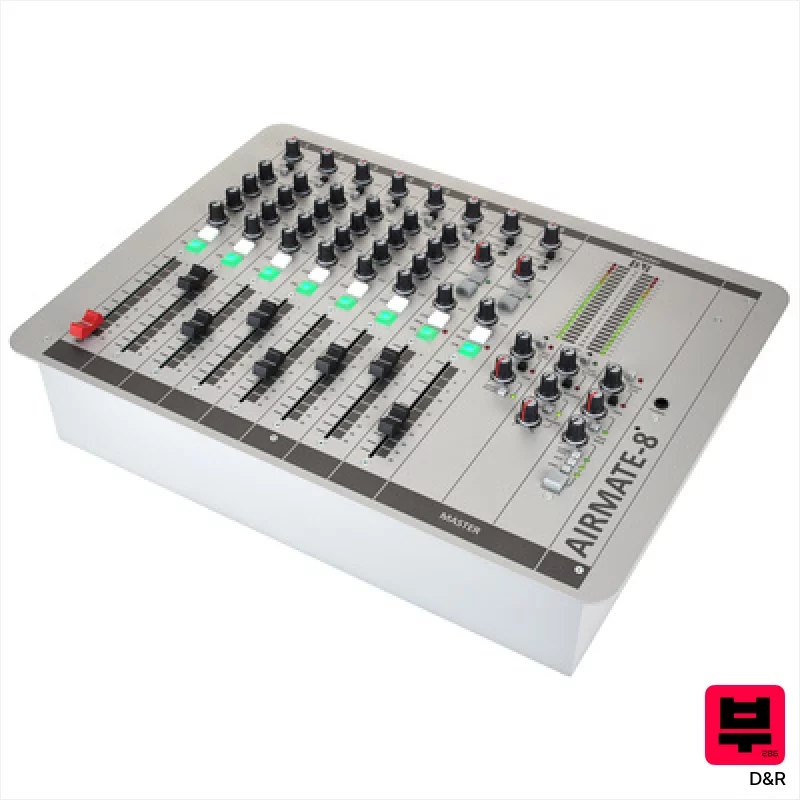
D&R Airmate USB Radio Production - Professional Music Instrument Photo
#1

D&R Airmate USB Radio Production

Size 19" Weight 11 kg
Large Format Professional Studio Mix Bus Processing
Key Feature:
The D&R Airmate is a well-built, compact console perfect for smaller radio stations, podcasters, or online broadcasters needing a functional and streamlined workflow. It’s got a clean, professional sound and the fader start is a real time-saver for live broadcasts. A great choice for those who prioritize efficiency over massive channel counts.
PROS
  • • Solid build quality, feels robust for a compact radio console
  • • Balanced mic preamps deliver clean, low-noise performance
  • • Fader start functionality streamlines live radio workflows
  • • Flexible aux sends offer versatile routing options for monitoring and effects
CONS
  • • Limited channel count might restrict complex productions
  • • 19 in rack format restricts placement options in smaller studios
  • • Telephone hybrid integration may require additional configuration
4.4/5 AudioFu Score
Specs:
4/10
Detail:
5/10
Value:
4/10
Art. 248569
$2,782
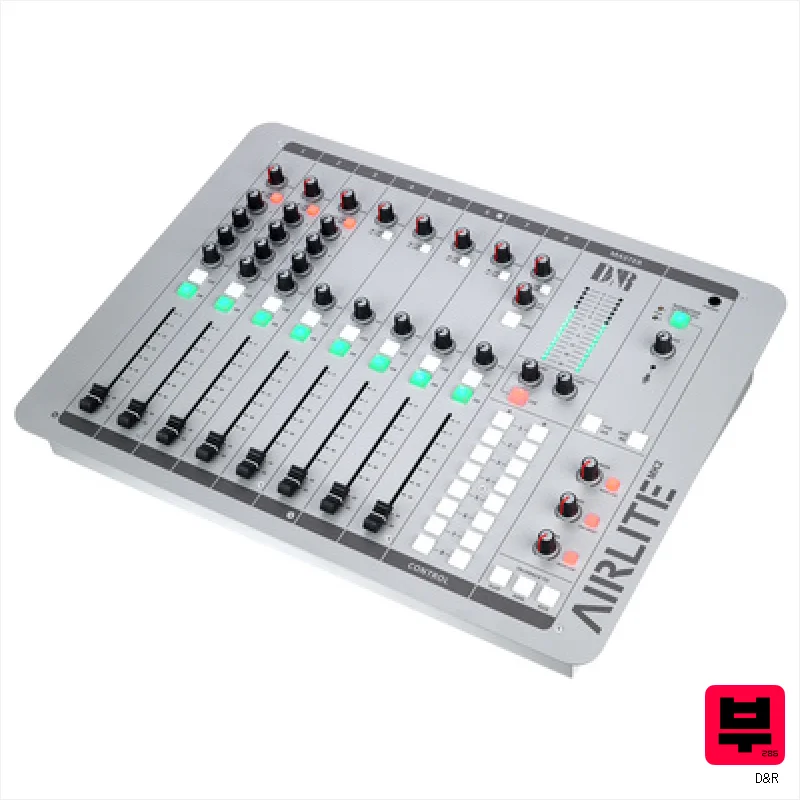
D&R Airlite MKII - Professional Music Instrument Photo
#2

D&R Airlite MKII

Professional Studio Mix Bus Processing Large Format
Key Feature:
This mixer is great for radio producers who need clean mic inputs and USB connectivity. It handles a lot of signals with its many channels and built-in EQ. Perfect for small studios that want a solid, practical console without the huge price tag.
PROS
  • • Built with three balanced mic inputs for clean audio capture
  • • Offers eight dual line inputs plus three triple mic channels
  • • Includes three band EQ on specific microphone channels
  • • Features four USB channels and one phone VoIP channel
CONS
  • • Lacks dedicated stereo aux send controls in the text
  • • Missing specific fader type details like linear or logarithmic
  • • No stated weight or physical size for space planning
4.2/5 AudioFu Score
Specs:
1/10
Detail:
5/10
Value:
4/10
Art. 358329
$2,712
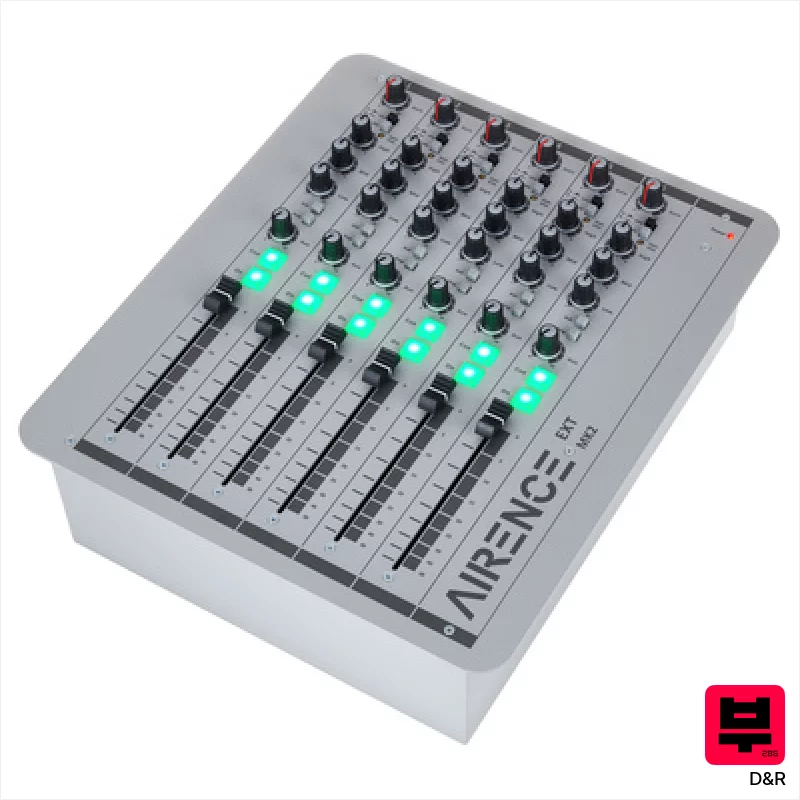
D&R Airence Expansion Unit MKII - Professional Music Instrument Photo
#3

D&R Airence Expansion Unit MKII

Analog Recording Mix Bus Processing Vintage Sound
Key Feature:
This Airence Expansion Unit MKII is a solid addition to an existing D&R Airence broadcast console, providing crucial input expansion and EQ control. It’s a premium-priced piece of kit, built to the same exacting standards as the main console, and ideal for broadcast facilities needing to extend their channel count and refine their audio processing.
PROS
  • • Robust D&R build quality ensures years of reliable service.
  • • 3-band EQ provides essential tonal shaping capabilities.
  • • 6 microphone/stereo inputs expand Airence console flexibility.
  • • 16V power supply compatibility simplifies integration for newer systems.
CONS
  • • Requires the Masterunit for full functionality; a separate purchase.
  • • Limited compatibility with older Airence power supplies and USB units.
  • • Designed specifically for D&R Airence consoles; not a standalone solution.
4.2/5 AudioFu Score
Specs:
1/10
Detail:
3/10
Value:
5/10
Art. 538735
$2,028
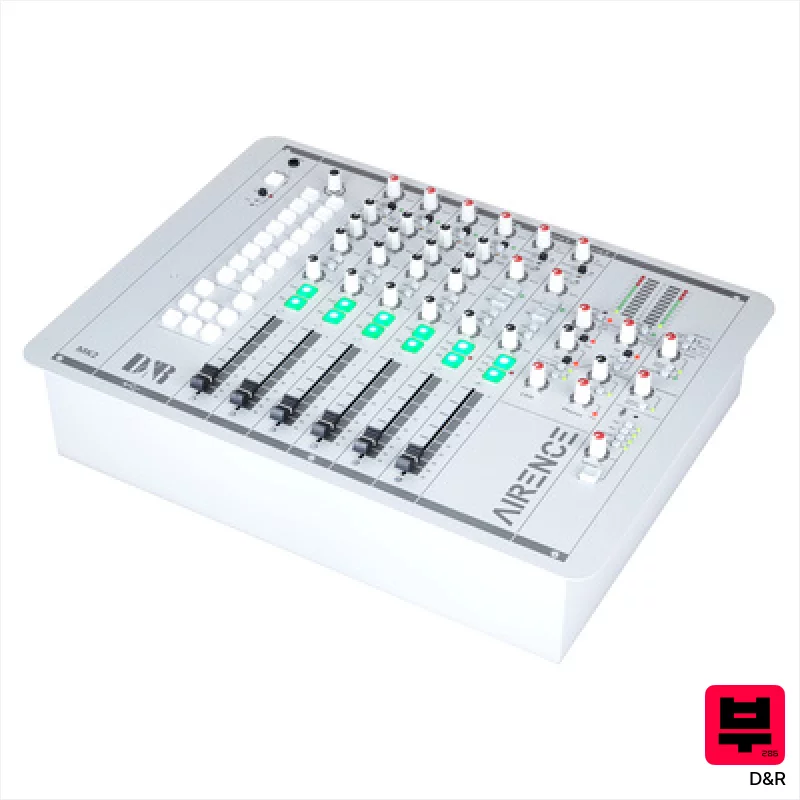
D&R Airence USB Main Unit MKII - Professional Music Instrument Photo
#4

D&R Airence USB Main Unit MKII

Analog Recording Mix Bus Processing Vintage Sound
Key Feature:
The Airence USB MKII is a seriously well-built broadcast console – it feels like a proper piece of studio gear. It's designed for podcasters, radio stations, or anyone needing professional-grade audio routing and control with integrated USB functionality. The split design is a bit unusual, but it allows for a modular, scalable setup.
PROS
  • • Solid build quality with robust 100mm faders for precise control.
  • • Integrated USB HID control module simplifies DAW integration and workflow.
  • • Telephone hybrid provides professional-grade broadcast connectivity and clarity.
  • • RingLED illumination offers excellent visibility in various studio lighting conditions.
CONS
  • • The split design necessitates an expansion unit for full functionality, adding to cost.
  • • MKII 16V incompatibility limits power supply and expansion options.
  • • Premium-priced, making it a significant investment for smaller studios.
4.2/5 AudioFu Score
Specs:
1/10
Detail:
6/10
Value:
3/10
Art. 538734
$3,246
D&R Webstation - Professional Music Instrument Photo
#5

D&R Webstation

Mix Bus Processing Professional Studio Analog Recording
Key Feature:
The D&R Webstation is a surprisingly capable little mixer, built like a tank and clearly designed for radio broadcasting and online streaming. It’s a solid choice for podcasters, internet radio stations, or anyone needing a simple, reliable on-air solution with integrated VOIP capabilities – just don't expect a ton of sonic flexibility.
PROS
  • • Robust metal chassis provides excellent stability and durability.
  • • Dedicated auto-silence feature simplifies on-air workflows significantly.
  • • VoiceOverIP integration streamlines remote broadcasting and interviews.
  • • USB control panel offers intuitive, illuminated button functionality.
CONS
  • • Limited channel count restricts flexibility for complex productions.
  • • EQ is basic; lacks the precision for detailed tonal sculpting.
  • • USB connectivity might be a bottleneck for high-resolution audio.
4.2/5 AudioFu Score
Specs:
1/10
Detail:
5/10
Value:
5/10
Art. 425788
$1,633

Analogue Mixing Desks by the numbers

Measured across all 35 models in this category, so «wide», «short» or «expensive» mean something you can check.

Price
median $695
from $184 to $24,572
Weight
median 4.78 kg
from 0.24 kg to 40.8 kg · 27 models
Size
median 19"
from 19" to 19" · 14 models

How This List Is Built

We don't play these instruments — we're a catalog, not a review desk, and we'd rather say so than pretend otherwise. This page covers 5 of 35 analogue mixing desks from the Thomann catalogue, which is the largest single source of specification data in this category: 5 in detail, the rest listed with their specifications.

Position is computed, not curated. We parse the manufacturer's own description into actual values — nut width, scale, fret count, fingerboard radius, size, alloy — and rank on them: how many specifications a model has published, how many of them are measurable numbers, and how precisely it meets this page's criterion. A product image adds a little. Price is not a ranking signal: it tells you nothing about whether a neck fits your hand. The same inputs always produce the same order, so nothing here is shuffled to look fresh.

What this list is good for: narrowing a category down to a shortlist by spec and budget. What it isn't: a substitute for hearing an instrument. Before you buy, read hands-on reviews and, where you can, play it. Full methodology.

How to Choose the Best Analogue Mixing Desks

Budget Planning

  • • Under $200: Entry-level
  • • $200-$500: Intermediate
  • • $500-$1000: Advanced
  • • $1000+: Professional

Quality Check

  • • Sound clarity & tone
  • • Build materials & finish
  • • Hardware durability
  • • Overall craftsmanship

Key Features

  • • Your musical style
  • • Skill level match
  • • Intended use case
  • • Brand reputation

Frequently Asked Questions

Key factors include build quality, sound characteristics, playability, brand reputation, warranty coverage, and value for money. Consider your musical style, skill level, and intended use to find the best match.
Budget depends on your needs and experience level. Beginners can find quality options for $200-500, intermediate players should consider $500-1500 range, while professionals often invest $1500+ for premium features.
Higher-priced analogue mixing desks typically offer better materials, craftsmanship, and performance. They're worth it if you're serious about music, perform regularly, or need professional-grade features.
Top brands combine quality, innovation, and reliability. We evaluate brands based on build quality, sound performance, durability, and customer satisfaction to recommend the best options for different budgets.
Both have advantages. Online offers better prices and selection, while stores allow hands-on testing. We recommend researching online first, then testing in stores if possible. Many online retailers offer excellent return policies.

We use cookies to improve your experience. Learn more